More Multi-Layer Inductor Options for Automotive Power-over-Coax

What you'll learn:
- Traditionally, two cables — one for power and one for data — are required to connect an automotive camera to an ECU. Power-over-coax consolidates these functions into just one coaxial cable.
- Because interfaces like ADAS cameras, LiDAR, and infotainment systems transmit across wide frequency spectra, single or cascaded inductors (often paired with ferrite beads) must hold high impedance across the entire operational range.
- TDK Corp. expanded its MLJ1608-G series (1.6 x 0.8 x 0.8 mm) of multi-layer inductors for automotive power-over-coax (PoC) circuits.
Automotive power-over-coax (PoC) enables direct-current (DC) power and high-speed alternating-current (AC) bidirectional data signals to be transmitted simultaneously over a single coaxial cable.
It’s used primarily in automotive cameras that form part of advanced driver-assistance systems (ADAS). Multiple cameras installed at the front, rear, sides, and other areas of a vehicle detect the surrounding environment, and the resulting information is processed by an electronic control unit (ECU) to support safe driving.
Traditionally, two cables — one for power and one for data — were required to connect an automotive camera to an ECU. PoC consolidates these functions into just one coaxial cable. This reduces the number of cables in a vehicle, offering benefits such as higher reliability, more compact wiring, reduced vehicle weight, and lower CO2 emissions.
Before the signals can be processed, PoC systems require a wideband filter consisting of multiple inductors to separate the data signal and the power. Inductors present very low resistance to direct current, letting the power supply flow smoothly from the source to the device (such as an automotive camera or sensor). Inductors exhibit high impedance at high frequencies, preventing high-speed data signals from leaking into the DC power rail.
What’s more, by maintaining high impedance over a broad bandwidth, often ranging from tens of megahertz up to gigahertz (depending on SerDes standards), they keep the coaxial cable's characteristic impedance stable and protect signal integrity. And they stop electrical noise and voltage fluctuations from the power supply from coupling into and corrupting the high-speed communications stream.
Because modern interfaces (like ADAS cameras, LiDAR, and infotainment) transmit across wide frequency spectra, single or cascaded inductors (often paired with ferrite beads) must hold high impedance across the entire operational range.
More Inductor Options for Power-over-Coax
TDK Corp. has expanded its MLJ1608-G series (1.6 × 0.8 × 0.8 mm) of multi-layer inductors for automotive power-over-coax circuits.
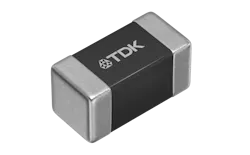
Using proprietary material and structural designs, the MLJ1608-G series is said to achieve high impedance across the frequency range from 300 MHz to 2 GHz, owing to its high inductance of 1.2 μH, compared with 0.56 μH for conventional products. In the 100- to 700-MHz range, it provides 1.7X to 2X higher impedance than conventional components, thereby delivering effective noise suppression. With its size of 1608, the component also helps shrink camera modules.
Other key features include:
- Compact 1608 size is achieved using multilayer processing technologies
- AEC‑Q200 compliant
- Operating temperature range of −55 to +125°C
Mass production of these new components began in October 2026. For the development of inductors targeting automotive PoC applications, TDK will continue to expand its lineup to meet evolving market needs through optimized designs utilizing multi-layer, wire-wound, and thin-film technologies. In doing so, TDK will contribute to improving the quality of PoC transmission signals