eVTOL’s Wings and Rotors Help Carry Two People on 100-Plus-Mile Missions
What you’ll learn:
- SkyFly’s Axe, a “hybrid” eVTOL, uses a combination of wings and rotors to achieve much higher energy efficiencies than basic multicopter-style craft.
- The Axe can be thought of as a conventional canard-style aircraft with four large electrically driven propellors located at the tips of its stubby wings.
- SkyFly refers to it as a vertically capable aircraft (VCA) because it can take off and land vertically or operate like a conventional airplane.
SkyFly’s Axe is a so-called “hybrid” eVTOL that uses a combination of wings and rotors (Fig. 1) to achieve much higher energy efficiencies than basic multicopter-style craft, which only produce lift by “beating the air into submission” with relatively small-diameter rotors.
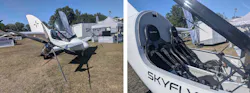
Besides being able to carry larger payloads across much longer distances, the Axe’s simple design could make it an affordable, practical alternative to helicopters for a variety of real-world missions. This video of my conversation with SkyFly’s Harryd Franks at the Sun n’ Fun 2026 airshow provides some insights into the aircraft’s unique design, its capabilities, and potential applications (watch video above).
The Axe is essentially a conventional canard-style aircraft with four large (1.9 meters) electrically driven propellors located at the tips of its stubby wings. The motors are mounted at a fixed 45-degree angle to provide both lift and thrust. SkyFly refers to it as a vertically capable aircraft (VCA) because it can take off and land vertically or operate like a conventional airplane (Fig. 2).
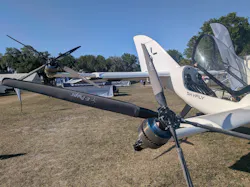
For vertical operations, the pilot pitches the Axe’s nose upward to a 45-degree angle, which points the thrust generated by its propellers directly downward. Vertical landings are accomplished by gradually transitioning from forward flight to a stable hover. During both transitions, the Axe’s flight-control software handles the trickier aspects of the operation. The motors’ peak output of 280 kW allows it to carry up to 440 lb. worth of crew or cargo.
While operating as a fixed-wing craft, the Axe relies mostly on its wings, which allows it to perform energy-saving short takeoff and landing (STOL) operations from small runways at around 55 mph and cruise at speeds of up to 100 mph. During cruise, its wings provide roughly 80% of the lift required to sustain horizontal flight, enabling it to fly for 100 miles on its 70-kWh battery.
With preparations underway to begin production in 2027, a base model Axe is expected to cost around $400,000. That’s only slightly more than Diamond’s DA-20, Flight Design’s CTLSi, and several other small two-place, fixed-wing aircraft.
>>Check out more content from the Sun 'n Fun airshow
About the Author
 Lee Goldberg
Lee Goldberg
Contributing Editor
Lee is the author of the popular PowerBites series.
Lee Goldberg is a self-identified “Recovering Engineer,” Maker/Hacker, Green-Tech Maven, Aviator, Gadfly, and Geek Dad. He spent the first 18 years of his career helping design microprocessors, embedded systems, renewable energy applications, and the occasional interplanetary spacecraft. After trading his ‘scope and soldering iron for a keyboard and a second career as a tech journalist, he’s spent the next two decades at several print and online engineering publications.
Lee’s current focus is power electronics, especially the technologies involved with energy efficiency, energy management, and renewable energy. This dovetails with his coverage of sustainable technologies and various environmental and social issues within the engineering community that he began in 1996. Lee also covers 3D printers, open-source hardware, and other Maker/Hacker technologies.
Lee holds a BSEE in Electrical Engineering from Thomas Edison College, and participated in a colloquium on technology, society, and the environment at Goddard College’s Institute for Social Ecology. His book, “Green Electronics/Green Bottom Line - A Commonsense Guide To Environmentally Responsible Engineering and Management,” was published by Newnes Press.
Lee, his wife Catherine, and his daughter Anwyn currently reside in the outskirts of Princeton N.J., where they masquerade as a typical suburban family.