The Rise of the Integrated Voltage Regulator
What you'll learn:
- Why are integrated voltage regulators preferred in the latest power designs for AI data centers?
- Details of Ferric's unique IVR technology.
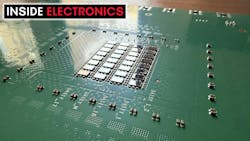




The next generation of high-performance GPUs and CPUs in data centers will be powered from below. To prevent power losses, engineers are relocating voltage regulator modules (VRMs) crowded around these devices to the opposite side of the circuit board, slinging ultra-high currents into the processor directly above. By routing power vertically through the board instead of across it laterally, they can avoid a lot of the PCB resistance, reducing power losses and the associated heat.
With the power demands of AI data centers on the rise, companies try to close the gap even further by placing the voltage regulators directly on the processor’s package or inside it. But binding everything so close together isn’t going to be possible with current DC-DC converters, said Noah Sturcken, co-founder and CEO of power-management startup Ferric.
Today’s AI accelerators are literally surrounded by DC-DC converters that use large power inductors to keep the current flowing and vast clusters of capacitors to keep the voltage from fluctuating as power races into the load.
Rather than packing these components into the hot, overcrowded region around the SoC, Ferric bundles most of these building blocks into a single chip, hence the term integrated voltage regulator (IVR). Ferric claims these chips can be up to 25X smaller and 30% more efficient than other common solutions. They can also deliver up to 100X higher bandwidth, allowing for faster transient responses, which are increasingly key to keeping up with the highs and lows of AI workloads.
In the latest Inside Electronics podcast (above), Sturcken explains what’s wrong with how GPUs and other big processors in data centers are powered today and how IVRs can help solve technical challenges.
Ferric is facing stiff competition. The top players in power electronics such as Infineon Technologies, MPS, and Texas Instruments are all racing to roll out advanced voltage regulators to meet the unique needs of kilowatt-class processors. At the same time, a number of startups are piling into the sector, some competing directly with Ferric and others indirectly. Empower Semiconductor released its first IVR for vertical power delivery over a year ago, and it raised $140 million in fresh funding last year to scale up production.
What differentiates Ferric is that it developed a unique technology to integrate thin-film magnetic power inductors within its devices, eliminating the need for bulky external components. As a result, it can create “chip-scale” DC-DC converter modules that integrate power transistors, inductors, and capacitors as well as most of the other core components of a traditional voltage regulator, including feedback control and telemetry.
Ferric’s Fe1766 integrates both power transistors and inductors, giving it the ability to supply up to 160 A from within a package measuring 35.5 mm2, translating to 4.5 A per mm2 of current density.
Designed for vertical power delivery, the 16-phase IVR can convert 1.8 V to 0.75 V at 89% efficiency while delivering the full 160 A. It delivers a regulation bandwidth of over 10 MHz. The architecture is also scalable: Up to 64 devices can be linked to create a massive multiphase power converter capable of supplying more than 10 kW.
According to Sturcken, these IVRs are small enough to be placed directly under the processor’s carrier board or embedded within it, carrying power across the final few millimeters of the power delivery network (PDN). They can also be integrated as power “chiplets” in a system-in-package (SiP). As a result, Ferric and other startups are positioning the IVR as a solution for AI silicon.
Sturcken said TSMC has started integrating IVRs into its CoWoS advanced packaging technology, which is used by NVIDIA in many of its most advanced processors.
SHOW NOTES
01:35 – Getting Power to Data Centers
06:10 – Shift to Vertical Power
15:15 – Integrated Voltage Regulators
23:42 – IVR Building Blocks
32:32 – Fast Transient Response Times
36:31 – IVR Power Inductors
45:23 – Adding a DC-DC Stage
49:16 – Integrating IVRs into the Package
55:07 – How Early Designers Think About Power
About the Author
 James Morra
James Morra
Senior Editor
James Morra is the senior editor for Electronic Design, covering the semiconductor industry and new technology trends, with a focus on power electronics and power management. He also reports on the business behind electrical engineering, including the electronics supply chain. He joined Electronic Design in 2015 and is based in Chicago, Illinois.
Noah Sturcken
CEO and Co-Founder, Ferric Semiconductor
Noah Sturcken is CEO and co-founder of Ferric Semiconductor. He's an experienced leader with a demonstrated history of working in the semiconductors industry. Noah is skilled in analog & digital circuit design, CMOS, field-programmable gate arrays (FPGAs), semiconductor processing, and ferromagnetic materials. He holds a Ph. D. in Electrical Engineering from Columbia University in the City of New York.
Comment About the Article
To join the conversation, and become an exclusive member of Electronic Design, create an account today!
 Leaders Logo
Leaders relevant to this article: