Low-Cost Sophisticated Particle Detector Tracks Muons
What you'll learn:
- The challenge of detecting muons in a complicated environment using low-cost parts.
- How an off-the-shelf sensor was used, along with high-performance analog circuitry.
- Other sensor, circuitry, and analog/digital-processing steps that were taken to assure valid results.

I’ll be honest: I have an affinity for advanced STEM projects that include a significant amount of sensor and analog I/O. I have nothing against the 555 and its countless circuits — among the most amazing and versatile ICs ever designed, thanks to the late Hans Camenzind — but most of its projects tend to have simple analog I/O, if any. On the other hand, I find projects that are heavy on programming and downloaded library modules (think Arduino) often minimize the realities and challenges of sensors and their interfaces.
That’s why I was fascinated by a recent project at the University of Delaware, where Spencer Axani, assistant professor in the Department of Physics and Astronomy, invented what he calls CosmicWatch Detector v3X. It’s a portable, low-cost particle detector that tracks muons, sub-atomic particles that originate from space (Fig. 1).
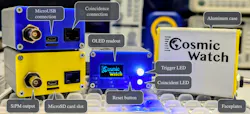
When cosmic rays collide with atoms that are high in the Earth’s protective atmosphere, they trigger a cascade of secondary particles. Among these new particles are muons, which can pass through the atmosphere and even penetrate into the ground.
Note that muons were once designated as mu-mesons, but they were subsequently “reclassified” by physicists and aren’t really mesons according to present understanding (it’s a long and complicated story). These sub-atomic particles achieved some fame when they were used in a clever 1960s experiment to further confirm Einstein’s postulate about time-dilation of fast-moving objects, which you can watch here.
Most muon detectors are large and expensive, limiting the kinds of physics experiments that could be done and the number of schools that could use them. As impressive as this project is on the technical side, equally impressive is the bill-of-materials (BOM) cost of only around $100.
Prof. Axani estimated that thousands of CosmicWatches have been built since the first version was released eight years ago (he has introduced upgrades and enhancements since then). In May, one unit was launched on a high-altitude balloon that rose to 100,000 feet, collecting data on its upward journey.
The Detector and the Analog Front End
The project begins, of course, with the sensor that’s “triggered” by passage of muons. When a charged particle such as an electron, proton, or muon passes through the 5- × 5- × 1-cm plastic scintillator slab, it excites the scintillant molecules, which then de-excite by emitting photons isotopically along the particle’s track.
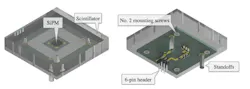
Scintillation photons are either internally reflected at the scintillator–air interface or, if they escape, redirected by a surrounding layer of reflective aluminum foil. A fraction of these photons reaches a plastic scintillator and silicon photomultiplier (SiPM) device (onsemi MicroFC 60035 C-Series) that’s optically coupled to the scintillator with optical gel and/or a silicone pad (Fig. 2). The SiPM converts each detected photon into an electrical pulse, the amplitude (or pulse height) of which is proportional to the light intensity.
The SiPM signal is amplified and sent to a comparator and an analog peak detector (Fig. 3). The comparator triggers data acquisition by providing a timestamp, while the peak detector holds a constant fraction of the pulse peak for accurate amplitude measurement by the Raspberry Pi Pico (RPi) MCU. The resulting ADC value is proportional to the number of incident photons. In addition, the SiPM signal is available through a BNC connector for external readout with nanosecond timing resolution.
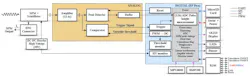
Once triggered, the RPi records the event count, timestamp, 12-bit pulse amplitude, SiPM pulse height, temperature, barometric pressure, linear acceleration, angular velocity, cumulative dead time, and whether or not the event was seen by a coincidence detector.
Of course, many other subtleties are involved in collecting meaningful, valid data. For example, to suppress the radiogenic background signals and focus only on cosmic-ray muons, the detector employs coincidence detection using multiple units.
In this two-detector configuration, each unit independently processes events as previously described. However, a coincidence event, defined as a trigger in both detectors within a predefined time window, is flagged when both comparators fire nearly simultaneously. This time-based correlation effectively rejects uncorrelated background events such as environmental gamma and beta radiation, which are unlikely to occur in both spatially separated detectors at the same time.
An Analog Peak Detector
Note their use of a classic all-analog peak detector, rather than the “obvious” but costly, resource- and power-hungry method of using a superfast ADC and high-speed comparison loop software to determine a peak. In its basic form, the analog peak detector is an extremely simple, low-component count circuit, requiring just an input op amp, low-loss capacitor, a diode (in this design, a Schottky diode), and an output buffer (Fig. 4). There’s often an electronic switch (FET) added to reset it for the next peak by dumping the charge on the capacitor via user or system command.
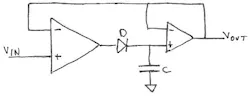
Its speed is limited primarily by the speed of the op amp, but it predates semiconductors and has been in use since the early days of vacuum tubes — it’s still widely used in many test and measurement systems. Variations of the peak detector, sometimes called an “envelope detector,” are used to demodulate amplitude-modulated signals, and the classic crystal radio uses a “leaky” version to extract modulated audio from the AM carrier.
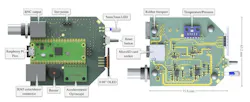
There’s a lot more I could tell you about this project and its high level of professionalism (Fig. 5), effectiveness, design, and low cost. Instead, you can read all of the details in their highly readable, published project paper “CosmicWatch: The Desktop Muon Detector (v3X)” published in The Journal of Instrumentation.
Unfortunately, it’s behind a paywall there, but an open-access pre-print version is posted at the Arxiv (a free distribution service and an open-access archive for nearly 2.4 million scholarly articles) here. Prof. Axani has also posted full construction details, BOM, software listings, and more at github here, and there’s an interesting profile of the project and team here.
Projects such as these maintain my faith in both the never-ending role of sensors and analog components. It’s also an impressive demonstration of the dedication and competence of those who deal with real-world signals and related design, rather than just coding and thinking the rest of the problem is “no big deal.”
About the Author
 Bill Schweber
Contributing Editor
Bill Schweber is an electronics engineer who has written three textbooks on electronic communications systems, as well as hundreds of technical articles, opinion columns, and product features. In past roles, he worked as a technical website manager for multiple topic-specific sites for EE Times, as well as both the Executive Editor and Analog Editor at EDN.
At Analog Devices Inc., Bill was in marketing communications (public relations). As a result, he has been on both sides of the technical PR function, presenting company products, stories, and messages to the media and also as the recipient of these.
Prior to the MarCom role at Analog, Bill was associate editor of their respected technical journal and worked in their product marketing and applications engineering groups. Before those roles, he was at Instron Corp., doing hands-on analog- and power-circuit design and systems integration for materials-testing machine controls.
Bill has an MSEE (Univ. of Mass) and BSEE (Columbia Univ.), is a Registered Professional Engineer, and holds an Advanced Class amateur radio license. He has also planned, written, and presented online courses on a variety of engineering topics, including MOSFET basics, ADC selection, and driving LEDs.
Comment About the Article
To join the conversation, and become an exclusive member of Electronic Design, create an account today!
 Leaders Logo
Leaders relevant to this article: