Hall Effect Literally Has a New Angle
What you'll learn:
- The basics of the well-known Hall effect and its “normal” sensitivity.
- How a multi-university team understood and demonstrated a Hall-effect sensitivity at right angles to the well-established one.
- How a device was built to assess this new sensitivity angle.

Readers of Electronic Design are undoubtedly familiar with the Hall-effect principle as well as devices based on it. For many years, this eponymous effect has been a key tool for studying material properties by scientists as well as sensing position and motion by engineers. In 1879, Edwin Hall showed that applying a magnetic field perpendicular to a material deflects moving charges, producing a measurable voltage (Fig. 1).
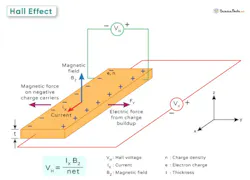
Scientists use it to determine whether the electric current is carried by negative or positive charges, how many of those charges are moving through the material, and how easily they flow. For engineers and system designers, countless low-cost, reliable, off-the-shelf Hall-effect devices are available for widely used sensing technologies found in applications spanning motors, automobiles, and even computer keyboards.
In-Plane Hall Effect
Now, a multi-institution team of researchers, led by Carnegie Mellon University’s Department of Physics and its Lab for Investigating Quantum Materials, Interfaces and Devices (LIQUID), has identified a new manifestation of the Hall effect. While the belief was that a real Hall-effect device only worked when the magnetic field was applied perpendicular to the plane of the film, they have shown that’s not the case and a response is possible when the field is in-plane.
In practical terms, that means a single, ultra-thin device can now detect magnetic fields along multiple axes. In principle, a single sensor can be used for multidimensional magnetic sensors, rather than needing two independent sensors to measure the magnetic field in two directions.
Their discovery allows for a magnetization-dependent Hall response along more than just one axis. The discovery can enable novel planar device architectures and sensor types, such as vector magnetometry, via measuring the out-of-plane and in-plane anomalous Hall-effect signals in the same device.
Note that the concept of an in-plane anomalous Hall effect (AHE) was theoretically proposed but never experimentally demonstrated until now. That’s because it’s very difficult to make a magnetic material with the right symmetry needed to do it. The researchers had to find or create a material with the right symmetry and then make it magnetic.
2D Quantum Materials
To build the unique nanometer-sized devices used in this research, they needed to fabricate two-dimensional quantum materials. They started with tantalum iridium telluride (TaIrTe4), which has the necessary crystalline symmetry to produce a multidimensional Hall effect. They thinned it down to the thickness of a few atomic layers and paired it with a magnetic layer, Cr2Ge2Te6 (CGT).
Due to the proximity of the layer to each other, magnetism leaks into the nonmagnetic layer, giving it magnetic properties while preserving its electronic characteristics. (Note that this demonstrates the power of building atomically precise heterostructures of emergent two-dimensional quantum materials to obtain on-demand electronic and magnetic properties.)
The many sophisticated tests they performed demonstrate the perpendicular plane and in-plane performance (Fig. 2). The reduced symmetry due to pairing with CGT allows additional spin-orbit coupling at the interface. These spin-orbit coupling terms are crucial for the in-plane anomalous Hall effect to emerge once CGT becomes ferromagnetic at low temperatures.
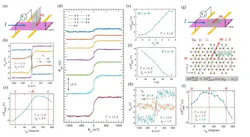
Their hands-on research was accompanied by deep-physics analysis, of course. The full story and in-depth details are in their paper “Magnetization Dependent In-plane Anomalous Hall Effect in a Low-dimensional System” published in Nature Materials, but it’s behind a paywall. Fortunately, the paper is also posted at Arvix. (Arvix is a free, open-access, university-sponsored research-sharing repository that hosts electronic preprints and postprints of scientific papers.)
I will warn you: Their paper is one of the most intense and esoteric deep-physics ones I have seen in a very long time, with many obscure designations that I had to look up to uncover their formal definition. There were also special symbols (mostly Greek) with which I was unfamiliar; many of the latter also had subscripts, superscripts, and some even had both. Reading it was slow going, that’s for sure. But even if the principles are semi-comprehensible at best, the result of the researcher team’s work and final pronouncement is still impressive and significant.
About the Author
 Bill Schweber
Contributing Editor
Bill Schweber is an electronics engineer who has written three textbooks on electronic communications systems, as well as hundreds of technical articles, opinion columns, and product features. In past roles, he worked as a technical website manager for multiple topic-specific sites for EE Times, as well as both the Executive Editor and Analog Editor at EDN.
At Analog Devices Inc., Bill was in marketing communications (public relations). As a result, he has been on both sides of the technical PR function, presenting company products, stories, and messages to the media and also as the recipient of these.
Prior to the MarCom role at Analog, Bill was associate editor of their respected technical journal and worked in their product marketing and applications engineering groups. Before those roles, he was at Instron Corp., doing hands-on analog- and power-circuit design and systems integration for materials-testing machine controls.
Bill has an MSEE (Univ. of Mass) and BSEE (Columbia Univ.), is a Registered Professional Engineer, and holds an Advanced Class amateur radio license. He has also planned, written, and presented online courses on a variety of engineering topics, including MOSFET basics, ADC selection, and driving LEDs.



Comment About the Article
To join the conversation, and become an exclusive member of Electronic Design, create an account today!
 Leaders Logo
Leaders relevant to this article: