Precision Op Amps Cover Current Sensing, Motor Control, and Sensor Processing
What you’ll learn:
- The main features of the new op amps, including high accuracy and low noise.
- The advantages of rail-to-rail input and output capabilities in precision op amps.
- Where high-performance op amps fit into industrial automation, automotive, and consumer electronics.
Several new series of precision op amps introduced by ROHM Semiconductor bring low input offset voltage, low noise, and fast slew rates to automotive, industrial, and consumer electronics.
While op amps are fundamental building blocks in analog circuit design, ROHM said the demand for high-accuracy devices has been rapidly increasing in factory automation and automotive systems, where fast and precise analog signal processing is required. For instance, precision op amps are widely used in industrial analog front ends (AFEs) to amplify sensor outputs for data acquisition, monitoring, and control. In these situations, reducing signal error and delay is critical.
According to ROHM, the new CMOS op amps are designed for high accuracy and low noise. The TLRx728 series comes with a maximum input offset voltage of 150 μV at 25°C and an input offset drift of 5 μV/°C, while the BD728x series features input offset voltage of 1.6 mV with drift of 4 μV/°C. The new series both have a noise voltage density of 12 nV/√Hz at 1 kHz, improving their ability to amplify small input signals and accurately reproduce larger ones. The slew rate of 10 V/μs supports fast output response.
As a result, the op amps are well-suited for a wide range of precision applications, including sensor signal processing, current-detection circuits, motor-driver control, and power-supply monitoring systems, where signal accuracy and response time directly affect control stability.
The Advantages of Rail-to-Rail Op Amps
With a supply voltage range of 2.5 to 5.5 V, ROHM said the op amps also incorporate rail-to-rail input and output stages. They maximize use of the available supply voltage range and support a wider dynamic range.
Op amps with rail-to-rail inputs allow the input signals to cover the full power-supply range of the power-supply rail from the maximum voltage in the power rail (VCC) to its minimum positive voltage (or negative voltage, VEE).
Op amps with rail-to-rail outputs are capable of driving the output voltage very close to the power-supply voltage without impacting performance or increasing noise susceptibility. That gives them the wide dynamic range required by current-sensing circuits for switch-mode power supplies (SMPS), signal-conditioning circuits for analog-to-digital converters (ADCs), and the like.
Rail-to-rail op amps generally guarantee that the output can remain within millivolts of the supply rail. This point is important for maximizing the dynamic range of op amps powered by low-voltage supply rails in industrial, automotive, and other systems.
Dynamic range, defined as the ratio between the largest and smallest output signals that it can produce, determines how well the op amp is able to amplify smaller inputs and reproduce larger ones. But as supply voltages shrink, maximizing the dynamic range is much more difficult.
Supply voltages are trending down for two main reasons: improving power efficiency and simplifying the overall system, often by reducing the number of required voltage rails. Using the full input common-mode and output voltage ranges is a big deal when dealing with a single power rail of +5 V or +3.3 V, or a bipolar power supply of ±5 V, because it directly impacts dynamic range. But many general-purpose op amps will struggle to do that.
Precision op amps are particularly critical in power supplies. They almost always require knowledge of the switching current, often sensed on the primary side, for the purposes of voltage regulation, current protection, and power monitoring. In switching power supplies, pulse-width modulation (PWM) usually requires a current-sense signal (VS) to provide short-circuit protection or to accurately control the output — or to enable both protection and control. The peak value of VS varies, but it’s typically about 1 V.
In many SMPS, the method most often used to sense current employs a sense resistor (RSENSE) and then measuring the voltage drop that occurs as current runs through it. These sense resistors are usually high-power, low-inductance parts that can add significant cost and power dissipation to the power-supply design. But using a high-precision op amp to amplify the current-sense signal opens the door for designers to use more compact, efficient, and inexpensive resistors, helping overcome these drawbacks.
Progress in Precision Op Amps
To support these and other applications, ROHM and other companies such as Analog Devices, STMicroelectronics, and Texas Instruments have been rolling out precision op amps with improved input offset voltage, faster speeds, and reduced noise.
Even with these improvements, op-amp design continues to be a game of tradeoffs since enhancing one parameter often impacts others. In most cases, engineers tend to focus on one parameter that’s more critical than the rest and accept compromises with the others.
ROHM said the TLRx728 and BD728x series are designed to be as general purpose as possible. They strike a balance between accuracy, speed, and noise for a wide range of applications instead of focusing on a single type of system.
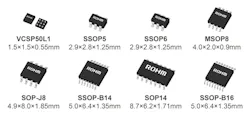
The op amps come in single-, dual-, and quad-channel configurations as well as a wide range of packages, giving engineers the flexibility to choose the best part based on the specific application and the available space on the PCB (see figure). Most, but not all, of the op amps are being released at the same time. Sample pricing starts at $2.00 per unit for the 1-channel components, $2.80 for the 2-channel, and $4.00 for the 4-channel.
About the Author
 James Morra
James Morra
Senior Editor
James Morra is the senior editor for Electronic Design, covering the semiconductor industry and new technology trends, with a focus on power electronics and power management. He also reports on the business behind electrical engineering, including the electronics supply chain. He joined Electronic Design in 2015 and is based in Chicago, Illinois.