Mini Receiver Module Demodulates All Major IR Remote-Control Codes
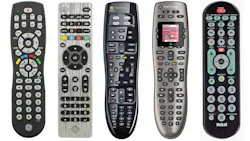
The modern infrared remote control is an ideal case study for dramatic shifts in end-product implementation brought on by disruptive technologies and user expectations, culminating in a low-cost, easy-to-use, ubiquitous device and function (see image above).
How so? The concept and implementation of the basic remote control just for TV isn’t new. It began in the 1950s with a hardwired link to initiate a stepper-like motor on the mechanical TV tuner to change channels (this was before our instantaneous, synthesized, non-mechanical tuning became standard). It then made a first disruptive shift to totally mechanically driven, ultrasonic, handheld remote controls, and subsequently shifted dramatically to today’s wireless infrared varieties.
Today, basic remote controls are a standard accessory that often come packaged with TVs, set-top boxes, fans, air conditioners, and just about any and every home appliance you can think of (see “Historical References” at the end for a two-part series on the history of the remote control — it’s a real trip back to the early days, with some fascinating photos; a separate set of “Technical References” is there as well).
However, one problem exists when it comes to the abundance of different remote-control units: For historical reasons, different end-product OEMs used different modulation schemes (frequencies and encoding) for the basic data emitted by the remote control.
Many speculate that the idea was to lock the user into using a given brand of remote control, or to allow a single remote to control all of the appliances in that vendor’s family. Not that it mattered. Within a few years, “universal remote controls” were developed, retailing for around $15, that could be programmed to transmit using any modulation scheme.
However, there’s still the need to receive, demodulate, and decode all of the different code schemes. It would be much easier for OEMs if a single electro-optical component (photosensor plus analog circuit) could be used across all products, thus reducing design time, verification, production issues, and inventory.
Enter Vishay’s IR Receiver Module
That’s the rationale for the Vishay Intertechnology TSOP15300 IR Receiver Module. This tiny component supports a wide range of modulation frequencies from 30 to 68 kHz. It’s designed to receive and demodulate all major remote-control codes on the market, enabling a single-component universal remote-control solution. It addresses the limitation of standard IR receivers that are tuned to one center frequency, thus reducing the need for multiple devices across different code sets.
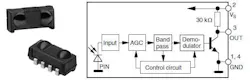
The receiver, measuring just 6.8 × 3.0 × 3.2 mm, integrates a PIN-diode photodetector, preamplifier circuit, and IR filter in a 4-pin package (Fig. 1).
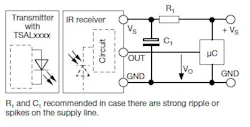
The demodulated output signal can be directly connected to a system microprocessor for decoding (Fig. 2).
The device is able to distinguish data signals from noise due to their differences in frequency, burst length, and envelope duty cycle. This provides immunity against ripple noise and interference from common sources of IR emissions such as CFL lamps (yes, there are still some in use!) and LCD televisions, and even nearby EMI/RFI emissions from onboard Wi-Fi antennas that can affect IR receiver performance. It supports demodulation of NEC, RC5/RC6, Thomson RCA 56 kHz, Sharp, Panasonic, and Mitsubishi codes (the Sony code isn’t supported).
The device operates from a wide supply voltage of 2.0 to 5.5 V with a typical supply current of 0.35 mA. When paired with a 50-mA IR emitter, it supports reliable transmission distances up to 18 meters. If you have signal-strength issues, Vishay also offers the VSOP383xx series of preamplifiers for IR remote-control receivers.
In addition to a 13-page datasheet with basic information as well as graphs related to signal levels and timing, key waveforms, optical characteristics, and more, Vishay offers a series of application notes that facilitate design-in and use. After all, applying even an apparently “simple” component has its idiosyncrasies.
Historical References
EEWorld Online, “The winding path to the infrared remote control: part 1”
EEWorld Online, “The winding path to the infrared remote control: part 2”
IEEE Spectrum, “The Day the U.S. TV Industry Died”
ME TV, “A history of the TV remote control as told through its advertising”
Technical References
DroneBot Workshop, “IR Remotes Revisited – 2023”
Jasco Products Company, “Universal Remote Code List”
Vishay Semiconductors, “Data Formats for IR Remote Control”
Circuit Basics, “How to Set Up an IR Remote and Receiver on an Arduino”
Autodesk Instructables, “Simple IR Remote Controls”
About the Author
 Bill Schweber
Bill Schweber
Contributing Editor
Bill Schweber is an electronics engineer who has written three textbooks on electronic communications systems, as well as hundreds of technical articles, opinion columns, and product features. In past roles, he worked as a technical website manager for multiple topic-specific sites for EE Times, as well as both the Executive Editor and Analog Editor at EDN.
At Analog Devices Inc., Bill was in marketing communications (public relations). As a result, he has been on both sides of the technical PR function, presenting company products, stories, and messages to the media and also as the recipient of these.
Prior to the MarCom role at Analog, Bill was associate editor of their respected technical journal and worked in their product marketing and applications engineering groups. Before those roles, he was at Instron Corp., doing hands-on analog- and power-circuit design and systems integration for materials-testing machine controls.
Bill has an MSEE (Univ. of Mass) and BSEE (Columbia Univ.), is a Registered Professional Engineer, and holds an Advanced Class amateur radio license. He has also planned, written, and presented online courses on a variety of engineering topics, including MOSFET basics, ADC selection, and driving LEDs.