22-nm Arm Cortex Processor Integrates NPU, Bluetooth LE Radio

What you’ll learn:
- How the nRF54L’s integrated NPU, memory architecture, and integrated low-power radio change the design space for edge AI in Bluetooth and multiprotocol products.
- The nRF54LM20B SoC pairs an Axon NPU with 2-MB NVM, 512-kB RAM, a 128-MHz Arm Cortex-M33 plus RISC-V coprocessor, high-speed USB, up to 66 GPIOs, and Nordic’s fourth-generation ultra-low-power 2.4-GHz radio.
Nordic Semiconductor’s nRF54L processor, introduced at CES 2026 (booth #52039), targets designers who have hit the ceiling of traditional Bluetooth LE SoCs that treat AI as an external add-on rather than a native capability.
While prior generations of devices have focused on incremental radio and power gains, the nRF54L folds a neural processing unit (NPU) and AI-centric tooling into a low-power wireless platform optimized for high-volume, resource-constrained endpoints. The result is a device positioned not only as a successor to the nRF52 family, but as a competitive alternative to general-purpose MCUs with bolt-on radios in AI-aware designs.
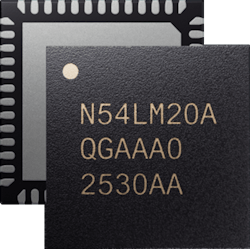
Silicon Architecture and NPU Integration
The nRF54L series is built on a 22-nm process that yields both lower active current and higher integration than Nordic's prior generation 55-nm nRF52 devices. This gives RF engineers more headroom on link budgets and better thermal margins without enlarging the system's battery.
The nRF54LM20B SoC pairs a proprietary “Axon” NPU with 2-MB NVM, 512-kB RAM, a 128-MHz Arm Cortex-M33 plus RISC-V coprocessor, high-speed USB, up to 66 GPIOs, and Nordic’s fourth-generation ultra-low-power 2.4-GHz radio supporting Bluetooth LE, Bluetooth Channel Sounding, Matter over Thread, and more.
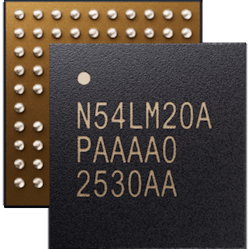
Nordic combines a main application core with additional processing resources so that time-sensitive tasks such as peripheral handling and signal pre-processing can be offloaded, reducing jitter and freeing cycles for inferencing. The integrated NPU enables common sensor machine-learning (ML) workloads to run on the device without an external accelerator or having cloud dependency.
Memory, Security, and Protocol Flexibility
To support AI models alongside full protocol stacks, the nRF54L architecture moves beyond the modest flash and RAM footprints that constrained older Bluetooth LE designs. It provides higher nonvolatile and a volatile memory capacity that better fits combined application, stack, and model images. Security features are hardened to meet advanced IoT certification levels, which is relevant once inference and model parameters become sensitive assets that must be protected from extraction and tampering.
On the RF side, the radio, supporting Bluetooth 5.4 and multiprotocol operation with proprietary 2.4-GHz modes up to multi-megabit rates, facilitates an overlay of custom low-latency links or sensor backhauls on top of standard USB or GPIO connectivity.
Differentiation vs. Legacy and Competitors
As compared with Nordic's earlier nRF52 devices, nRF52L roughly halves receive current and provides significant improvements in overall processing efficiency. This directly translates into either longer battery life or the option to shrink energy storage without sacrificing performance.
Competing SoCs that offer Bluetooth plus a microcontroller often require external NPUs, and they can have higher system cost or a more fragmented toolchain. Conversely, the nRF52L aligns the hardware with a dedicated edge AI ecosystem from the same vendor. For RF and embedded engineers, that means fewer compromises between RF performance, compute for ML, and system complexity and cost when targeting wearables, smart-home endpoints, or industrial sensing.
Tools and Ecosystem
Beyond silicon, Nordic backs the nRF54L series with development kits, SDK support, and a cloud-assisted workflow through its “Edge AI Lab” tool. These resources help teams move from data collection to model deployment on the embedded NPU with fewer custom scripts.
The company’s Edge AI Lab helps developers generate custom “Neuton” models for such applications as anomaly detection, activity and gesture recognition, biometric monitoring, and more. They deliver privacy-preserving, real-time intelligence on minimal battery sizes and constrained memory, without cloud dependency. Neuton models are ultra-tiny, CPU-run, edge AI models that are typically under 5 kB and up to 10X smaller, faster, and more efficient than other CPU-run models.
Companion hardware options, including Wi-Fi plug-in boards for the nRF54L development environment, enable hybrid designs where Bluetooth LE devices can efficiently bridge or backhaul to IP networks when required.
Nordic Edge AI Lab and custom Neuton models are available today for Nordic wireless nRF54 Series SoCs and cellular IoT SiP modules. The nRF54LM20B SoC with Axon NPU is now sampling to selected customers, with broad availability for development expected early Q2 2026. For samples, contact Nordic Semiconductor’s sales team. A datasheet was not available for review at the time of publication.
Andy's Nonlinearities blog arrives the first and third Monday Tuesday of every month. To make sure you don't miss the latest edition, new articles, or breaking news coverage, please subscribe to our Electronic Design Today newsletter. Please also subscribe to Andy’s Automotive Electronics bi-weekly newsletter.
Check Out More CES 2026 articles
 CES at Las Vegas Convention Center West Hall
About the Author
 Andy Turudic
Andy Turudic
Technology Editor, Electronic Design
Andy Turudic is a Technology Editor for Electronic Design Magazine, primarily covering Analog and Mixed-Signal circuits and devices and also is Editor of ED's bi-weekly Automotive Electronics newsletter.
He holds a Bachelor's in EE from the University of Windsor (Ontario Canada) and has been involved in electronics, semiconductors, and gearhead stuff, for a bit over a half century. Andy also enjoys teaching his engineerlings at Portland Community College as a part-time professor in their EET program.
"AndyT" brings his multidisciplinary engineering experience from companies that include National Semiconductor (now Texas Instruments), Altera (Intel), Agere, Zarlink, TriQuint,(now Qorvo), SW Bell (managing a research team at Bellcore, Bell Labs and Rockwell Science Center), Bell-Northern Research, and Northern Telecom.
After hours, when he's not working on the latest invention to add to his portfolio of 16 issued US patents, or on his DARPA Challenge drone entry, he's lending advice and experience to the electric vehicle conversion community from his mountain lair in the Pacific Northwet[sic].
AndyT's engineering blog, "Nonlinearities," publishes the 1st and 3rd Tuesday of each month. Andy's OpEd may appear at other times, with fair warning given by the Vu meter pic. His cartoon series, "Inventors", appears each week in Electronic Design Weekly.