2026 Prediction: Engineers Ramp Up Learning in the AI Era
What you'll learn:
- Why AI is pushing engineers toward deeper specialization and continuous learning.
- How degrees, certificates, and self-directed study can improve relevance and earning potential.
- Where engineers can start building AI literacy and advanced skills, including free options.

It’s like a big drop on a rollercoaster. You grit your teeth to the wind. Your eyes are watering. You squint. You feel the intense pressure of the air. It’s movement you can’t stop. That’s what technological advancement feels like to me these days. It’s been AI (artificial intelligence) in its many forms that’s been a catalyst to rapid progress in technology.
Every company everywhere is adopting AI. We need to advance along with it.
We focus our education from general to hyper-specific. We go from grade school to college. Bachelor’s degree to master’s, to PhD. I think for 2026, 2027, 2028 — maybe even for the next decade — we need to keep sharpening our skills and knowledge. I predict a massive return to school calling for every engineer out there.
We’re engineers. We’re in the business of creativity, progress, advancement, and innovation. It’s what we do. To paraphrase my favorite reporter: We bought the ticket, we take the ride.
What AI is Doing to Us Right Now
Workplaces are using AI to automate tasks that humans have worked on forever. AI performs code generation, data analysis, system design, and testing more precisely, quickly, and efficiently than humans. We all know this. In a 2023 GitHub study, developers using Copilot implemented a JavaScript HTTP server task 55.8% faster (1 hour 11 minutes vs. 2 hours 41 minutes), with a higher completion rate (78% vs. 70%) (Fig. 1).

We’ve already seen AI integrated in software development. Tools like IBM watsonx Code Assistant suggest snippets, generate code, and predict bugs. Programmers can then focus on AI output review and ensure workflow matches objectives. IBM internal tests show time savings of up to 90% on code explanation and 38% on code generation/testing. Code documentation time also decreased by 59%.
We Need to be More Than What AI Could Ever Become
For workers to excel at their jobs, they need to perform better than AI rather than remain a generalist. Good enough simply won’t pass the mark. Engineers should welcome hyper-specialization. McKinsey notes engineers must refine their skills to capture value, which involves a niche requiring human creativity, judgment, and insight (Fig. 2). Sure, machines may be able to handle the task, but we should also aim to do it better and differently.

AI is on the minds of engineers everywhere. In the 2025 Electronic Design Salary Survey, 36.11% of respondents are concerned about staying current with the latest technologies. The biggest of all is AI, of course. The same salary survey shows that 42.52% are worried about some aspect of incorporating AI into their design or workflow. These are significant jumps in percentage versus even one year prior.
With hyper-specialization, workers expand their skills even further so that AI can’t replicate them. An aerospace engineer doesn’t know how to just design a wing. They understand the slight interplay between aerodynamics, material science, and climate resilience, which comes from years of experience with study, experimentation, and problem-solving.
In addition, software engineers don’t solely focus on writing code. They also perfect algorithms, allowing them to create new architectures or optimize systems better than AI.
To stay ahead of the game and in the loop, engineers must continuously learn more and refine their intuition. In 2026, 2027, 2028, and I even say beyond that, being relevant is the only way engineers can remain indispensable.
School is Changing
Recently, the University of California experienced a decline in computer science class enrollment across all campuses. According to a report by the San Francisco Chronicle, it saw a 6% drop in 2025 after a 3% drop in 2024. Although the United States saw a 2% increase in college enrollment, students have chosen not to pursue traditional CS degrees. Even then, UC San Diego is taking a different approach as it added an AI major.
This may be a preview of what the future looks like with AI, too. China has embraced AI usage. Based on an MIT Review report, Chinese universities have welcomed AI literacy, regarding it as essential infrastructure. The majority of Chinese students and educators turn to AI tools several times a day. Universities are starting to formalize that shift. Zhejiang University made AI-focused study mandatory, while Tsinghua launched interdisciplinary colleges focusing entirely on artificial intelligence.
U.S.-based campuses are attempting to keep pace. In the past few years, universities rolled out degree tracks and departments centered around AI.
At MIT, the "AI and Decision-Making" major grew into one of the school's most popular programs. University of South Florida drew over 3,000 students into its college focused on AI and cybersecurity during the fall term. Meanwhile, the University at Buffalo introduced an "AI and Society" department last summer, revealing seven specialized undergraduate degrees that attracted over 200 applicants before classes started.
Enrollment patterns tell a different story. According to a survey from the nonprofit Computing Research Association, 62% of respondents saw undergraduate enrollment in traditional computing programs drop this fall. At the same time, students have gained more interest in AI-focused pathways.
Universities like the University of Southern California, Columbia University, Rice University, and New Mexico State University are introducing dedicated AI degrees in the coming academic year. Instead of signaling a retreat from technology fields, the data reveals that students are leaning toward AI-centered programs they believe offer better employment opportunities.
How More Education Affects Engineers
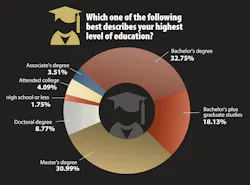
A bachelor’s degree serves as the starting point for engineers setting foot in the workforce for roles like mathematics, physics, and systematic problem-solving. More are pursuing their master’s degrees to become specialized in high-growth subfields, including robotics, data modeling, autonomous systems, quantum computation, electrical systems, and sustainable materials.
>>Check out these TechXchanges for similarly themed articles and videos
 271129759__ruslan_batiuk__dreamstime
A master’s degree teaches engineers how to learn iteratively, rapidly, and critically. Those skills are essential in this field where the half-life of technical knowledge is approximately five years.
PhDs are necessary for research and development or highly intensive roles in aerospace, energy systems, and pharmaceutical manufacturing. This involves new materials development and complex simulations.
Depending on the field and location, an entry-level bachelor’s degree in engineering typically has a salary ranging from $60,000-$80,000 per year. Beyond that, a master’s degree can raise earnings to $90,000-$110,000 for mid-level roles. Those brandishing a PhD in specialized areas like aerospace or research often surpass $120,000 with experience. I’ve seen beyond that.
What About Just Having Certificates?
People aren’t limited to degrees in terms of pursuing education. They also gain expertise and increase earning potential through technical certificates and professional licenses. Cloud certifications from AWS, GCP, or Azure, and AI-focused credentials like Google’s AI engineering certificate, serve as recognized markers of professional value. Industry surveys verify 10% to 30% salary increases. AWS Solutions Architect averages $155K (associate)/$200K+ (professional), GCP Cloud Architect $190K, with certificates adding $30K on average.
Professional engineers, for example, require the ability to master industry standards, ethics, and technical know-how. This leads to higher competition among engineers and higher salaries. Other than that, certifications in cybersecurity, project management, advanced software certificates, or advanced design tools are very valuable.
Employees and clients often view these credentials as a bonus since they demonstrate an engineer has special knowledge augmented by AI, but humans set standards. Certificates are what make a practitioner an expert, and this knowledge depth creates a long-standing professional value.
By pursuing higher education in terms of degrees and certifications, engineers will more likely stay up-to-date with emerging technologies. This also applies to understanding complex systems and new tools and techniques. They can leverage AI as a powerful collaborator while handling the innovation, decision-making, and problem-solving skills in that role. I think we all know that more degrees, more certificates, and the like do nothing but increase our usefulness and salary as a byproduct.
AI Still Needs You
Even in code generation, engineers must grasp logic, security, and architecture to catch AI’s flawed outputs. AI excels at patterns but can’t weigh tradeoffs or predict what may happen next. That’s only possible with humans, through judgment and real-world knowledge. Otherwise, it’s risky as AI could output a flawed, inefficient solution.
Of course, workers must do their jobs, like high-level design and architecture, without AI as well. Relying too heavily on automated systems can lead to unintended consequences, such as overlooking critical errors. In such cases, machines are well-known for producing errors or suggestions that appear correct statistically, but they don’t work well in practice.
According to a study, 62% of AI-generated code had design flaws or security vulnerabilities, especially when using the latest AI models (Fig. 3). If engineers don’t have, or acquire, the skills to tackle the tasks, they won’t be able to effectively verify or change AI outputs.

The best workaround is to further develop and refine expertise alongside AI literacy. By understanding the theoretical and practical aspects of their work, engineers can guide AI the right way, ensuring precise, meaningful outputs. Becoming an expert in the field while achieving competency in AI tools enables professionals to leverage the technology without depending on it.
Civil engineers, for example, could use AI to suggest a structural design based on simulations. For now, only humans can factor in materials limitations, environmental factors, or regulatory requirements. This ensures that while the AI provides options, humans determine what’s feasible and responsible.
You’re Already an Expert — Time to be a Better Expert
You may already be an expert in your field. But technology and methods always change, which means that expertise won’t stay the same. According to The World Economic Forum’s “Future of Jobs Report 2025,” employers expect 39% of workers’ core skills to change by 2030.
Staying relevant in this context requires engineers to go beyond what they already know. This doesn’t just involve mastering your skills and new tools, it’s also about being more innovative and applying better problem-solving skills. Often, you’ll see that top engineers push themselves to improve, even with experimentation and curiosity.
Where You Can Start This Education for Free
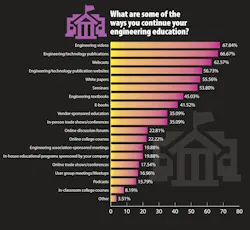
Opportunities to improve don’t always come with a price tag. These days, free resources are available to engineers to advance their skills. Free online college courses are becoming more accessible, offering training in subjects like machine learning and advanced engineering.
Platforms like edX, Khan Academy, and Harvard Online allow engineers to study at their own pace, offering theoretical understanding and practical exercises. Seminars, workshops, and certification programs provide valuable knowledge that can strengthen your expertise. Even attending a professional workshop introduces new techniques, insights, and networking opportunities to advance your career.
These may seem like small steps. But combined together, they create a strong foundation of knowledge to help you compete with AI-augmented workflows.
Traditional Schooling is the Way, if You Can Get It
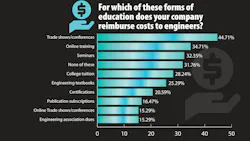
The easiest path for those who want to continue to stand out can do so through traditional schooling, especially if their company helps pay for it. Maybe you’re lucky. Organizations like Boeing, Google, and Siemens offer tuition assistance as part of technical career tracks. They recognize that continuous education strengthens their workforce. Employers tend to notice and reward those who keep learning. Google reimburses tuition, rewarding elite projects and leadership roles.
Time Passes, Things Change
Time for a quick story. At an expo I attended, I met the founders of a software company. They make sites, apps, whatever for clients. For a long time, they were just hardcore programmers.
After a while, one programmer rose to the top as their best. I’ll call that person the Wizard. AI entered this company’s door. The founders made all of the novice programmers use it. The Wizard refused. For some time, the Wizard outperformed the novices. But AI helped augment the novices into producing quite a bit of code.
The founders then asked the Wizard to adopt AI. The Wizard refused again, knowing they were the best. The founders fired the Wizard. Now the company is 100% novices augmented by AI.
At first that story angered me. Even though the Wizard still outperformed the typical novice, the collective novices outdid the Wizard. Typical corporate “what about the bottom line” response. However, a bit later I thought, what if the Wizard used AI. How much more powerful would the Wizard have become?
I don’t think the Wizard should work for that company anymore, but I do hope they’re exploring AI with their natural talent. I’m sure they’re doing great.
Failing to Evolve
Failing to evolve means obsolescence. This isn’t hypothetical. It’s already happening, like legacy programmers sidelined by cloud/DevOps in the 2010s. COBOL/mainframe programmers suddenly couldn’t pivot. Banks rewrote legacy code with AWS juniors at one-third the cost. Without growth, small tasks get automated.
Nowadays, companies pay more attention to those who evolve with technology and not to those stuck using past methods. Fail to grow, and you’ll be sidelined permanently.
Of course, old-school programmers are still in demand (Fig. 4). A very small group of companies seek workers who can handle roles like server mainframe programmers, systems engineers, Ruby coders, COBOL coders, and even Fortran coders. And they usually pay a high salary.

However, there’s an important catch. Those who possess the right skills for a specific job have a focused and deep expertise in that field. Their knowledge is esoteric and not something AI can easily replicate. Even if your field focuses on AI integration, robotics, embedded systems, cloud architecture, or another specialty, the deep focus and mastery give you a competitive edge that machines can’t touch.
AI is a Really Good Pencil
AI isn’t a thinker or innovator. Rather, it’s a powerful tool — a productivity booster for engineers, not a replacement. Similar to a pencil, it allows creativity and expression, like putting thoughts on paper. That also means AI won’t do the thinking for skilled workers and can help them push out ideas faster and correct any mistakes.
Engineers may even find it challenging to use AI without it doing all of the work and thinking for them. Of course, this means they’ll need to understand that it’s an extension of human expertise. And these skilled workers must be able to do their work, such as designing systems, coding, data analysis, etc., before using AI in any capacity.
With certain skills, AI works as a force multiplier. Software engineers can prompt AI to write boilerplate code, debug errors, or suggest optimizations. Despite that, engineers still need to figure out how to install the generated solution within a larger system.
Another example deals with mechanical engineers. They run AI-driven simulations for design parameter testing. However, their job still involves interpreting and adjusting the results and considering practical constraints. Human insight and AI efficiency working together enable engineers to produce more high-quality work and give them more time to focus on the creative side of their projects.
We need the right resources and practices to effectively work with AI, especially in the workforce. Online platforms offer courses, workshops, AI documentation, and tutorials tailored for engineers. Some of the best choices in 2026 include:
They cover a wide range of topics, from introductory AI applications in engineering to advanced machine-learning techniques. Webinars and technical seminars focus on industry-specific AI tools. Engineers using these resources will most likely be more proficient in AI without losing their expertise. Doing so allows them to remain in control of the process.
AI skills as we use them now will eventually become obsolete as better tools emerge. But keep learning — mastering each framework builds adaptability muscles, ensuring engineers evolve faster than the tools do.
Don’t Chase Trends… Rather, Chase Focused Knowledge
With each education level, the knowledge focus narrows. Traditional paths narrow from basics (bachelor’s) to PhD precision. But AI/cloud eras demand agility and targeted depth. NSF’s 2023 GSS shows master’s enrollment (329k) exceeding PhD (268k) in S&E fields (Fig. 5). But PhDs remain the rarest at ~3% of advanced degrees.

Today is different, though. AI, cloud, and cross-disciplinary technology make that model feel dated. Engineers now require targeted depth and scope, mixing generalist agility with ninja-like specialization. The old-school path still exists and works, but the real edge comes from customizing your own trajectory.
The Self-Taught Accelerator
Even self-taught engineers rise to become stars in their field. Like ninjas in training, they zero in on their natural strengths, interests, and skills, refining them with laser focus rather than scattering effort across every trend.
Historically, ninja apprentices started training as young as 7 or 8, selected and molded based on aptitudes. Agility for strength missions, strength for combat, or sharp strategy for espionage. Their path didn’t involve mastering every weapon or tactic equally. Instead, it focused on targeted perfection of what they did best. All of this was achieved through endless repetition, adaptation, and real-world testing.
Self-taught engineers mirror this ninja-like discipline. They experiment, embrace failures as feedback, and iteratively sharpen their edge, even if it’s AI integration, deep systems architecture, or creative problem-solving. Focused honing like this pushes them to challenge or surpass formally educated individuals. And this produces agile, adaptive professionals who stand out because they’ve improved what makes them unique.
For example, self-taught engineers have developed research-grade projects on their own, using cloud GPUs, open-source hardware, and collaborative platforms. Successful engineers in the 2020s contributed to open projects, built reputations through community credibility, and learned in public.
What I’m getting at is, you can teach yourself this approach. Use AI, but focus on what you excel at and pump that aspect up to superhuman with AI learning.
Rewatch the Movie “Hackers”
Anyone can be an engineer. Think about the 1995 cult classic Hackers movie. Elite teens had their clunky computers perform some crazy stuff like hijacking TV broadcasts, cracking bank networks, stealing corporate secrets, and unleashing garbage truck viruses. And yes, Hollywood gave it a more magical feel with physics-defying visuals. However, the whole idea was realistic.
Those kids gained their elite status from raw know-how as they learned how to bend code, networks, and systems through constant tinkering and problem-solving. Compared to today’s technology, theirs was slower than a smartwatch. Yet, the principle still applies. Engineering mastery comes from focused application, not privilege or mystery. Curious and gritty people can replicate it today, using free tools and countless resources, proving it’s a skill they can build.
Use that AI to garner “whoas” from those around you. Don’t let the distaste for AI slop repel you; remember that AI is a really good pencil. It’s a tool. AI will build upon your shoulders, then you turn around and build yourself up on its shoulders.
Onward.
P.S.
I thought I would share what I want to do.
I want to do back to school, but I have no way to pay for it.
So, it will have to be freebie options for me. In my journey down the free path, I will share my experiences with you all here. See you soon.
P.P.S.
I just wanted to use a P.P.S. No, I wanted to say I rewatched Hackers after seeing it in the theaters back in the day. I barely remembered a thing from it. It’s a joyous basking in old tech. I would argue it’s all stuff still viable today. Certain “hacking scenes” are surprisingly realistic. Something glossed over in most tech-centric movies today. Rewatch it for the first time today, this weekend. “Hack the Gibson.” You won’t regret it.
>>Check out these TechXchanges for similarly themed articles and videos
271129759__ruslan_batiuk__dreamstimeAbout the Author
 Cabe Atwell
Cabe Atwell
Technology Editor, Electronic Design
Cabe is a Technology Editor for Electronic Design.
Engineer, Machinist, Cartoonist, Maker, Writer. A graduate Electrical Engineer actively plying his expertise in the industry and at his company, Gunhead. When not designing/building, he creates a steady torrent of projects and content in the media world. Many of his projects and articles are online at element14 & SolidSmack, industry-focused work at EETimes & EDN, and offbeat articles at Make Magazine. Currently, you can find him hosting webinars and contributing to Electronic Design and Machine Design.
Cabe is an electrical engineer, design consultant and author with 25 years’ experience. His most recent book is “Essential 555 IC: Design, Configure, and Create Clever Circuits”
Cabe writes the Engineering Life & Engineering on Friday blog on Electronic Design.
See Cabe's cartoons & comic strips here.
Comment About the Article
To join the conversation, and become an exclusive member of Electronic Design, create an account today!
 Leaders Logo
Leaders relevant to this article: