The U.S. is Reshoring Chips — But It's Still Missing the Board Designers
What you’ll learn:
- Despite the CHIPS Act, American companies still can't build boards fast enough to meet demand.
- Why the bottleneck is not silicon but the board it sits on, in addition to a shrinking electrical engineering workforce.
- How AI-driven design tools offer a way to multiply the workforce's output without waiting a decade to train new engineers.
Advanced chips have been getting hit by tariffs for years, with policymakers framing them as efforts to rebuild America's semiconductor supply chain. But one piece of that supply chain hiding in plain sight rarely gets the same attention: the printed circuit board (PCB).
While the U.S. has invested tens of billions of dollars through the CHIPS Act to reshore chip manufacturing, the PCB remains a critical, unsolved link in the electronics supply chain. Reduced resources, a lack of policy incentives, and a shrinking pool of qualified talent have left this part of the industry largely to fend for itself.
Fabricating the chip is only one early step in the long process of manufacturing a full system. Every CPU, every GPU, and every other piece of AI hardware needs a PCB to connect it to power, memory, sensors, and other boards. The PCB layout is also the one component in any electronic system that’s never a commodity. Chips are mass-produced and sold off the shelf, but every board needs to be custom-designed for its specific application before even one can be fabricated.
That design step is the bottleneck, both in AI hardware and equally in robotics, defense, aerospace, EVs, and telecom.
The PCB Bottleneck, By the Numbers
The numbers tell the story. Since the 1990s, the U.S. share of global PCB production has dropped from approximately 30% to 4% today, according to data from the Printed Circuit Board Association of America. The number of domestic PCB fabricators has fallen from more than 2,000 to about 145 over the same period, and the U.S. now produces only about 1% of the world's PCBs directly. Thus, engineers in the U.S. rely largely on Asia for roughly 90% of their boards, with more than half coming from China.
Years of offshoring has left the U.S. with a structural dependency on foreign supply chains, creating an infrastructure gap in which American companies still can't build fast enough to meet demand.
New Investments Trickle Down to PCB Production
Policymakers have started to notice. A 2018 Department of Defense industrial base assessment, conducted under Executive Order 13806, called the domestic PCB industry "aging, shrinking, and failing to maintain the state of the art," and flagged that some advanced board types were "simply not producible in the U.S.”
Mike Cadenazzi, the current U.S. assistant secretary of war for industrial base policy, has since warned that chips, substrates, and PCBs represent "multiple avenues of attack for a potential malicious actor," with worst-case scenarios including missiles that malfunction in flight due to compromised boards.
In early 2023, the U.S. invoked Defense Production Act Title III to support domestic PCB production, and the Department of Defense has since put more than $118 million in DPA grants behind manufacturers. That includes $11.7 million awarded in 2024 specifically to expand PCB assembly capacity for hypersonic weapons.
A bipartisan bill, the Protecting Circuit Boards and Substrates Act (HR 3597), would add a 25% tax credit and a $3 billion assistance program modeled on the CHIPS Act. But it remains in committee.
The Bottleneck Behind the Bottleneck: PCB Design
Every one of these interventions targets the same three things: fabrication, substrates, or assembly. None of them touch the bottleneck upstream of all three: design.
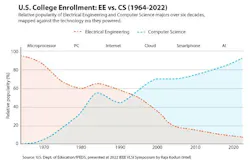
Every board that ships from a U.S. factory starts as a design file that takes weeks or months to produce by hand. However, the workforce that produces those files is shrinking faster than it can be replaced. Senior designers take 10 to 20 years to develop the intuition required by the job. Colleges aren't graduating PCB layout talent anywhere near replacement rate. For every three senior engineers retiring, only one to two new graduates enter electrical engineering, and not everyone ends up in PCB layout (see figure).
The AI boom driving unprecedented demand for PCBs is also the force most capable of addressing the talent and throughput constraints on the design side. Tax credits and DPA grants can build a fab. They can't shorten the design queue feeding it, and a reshored fab running at partial utilization because customers still need three months for a layout doesn't solve the strategic problem.
That's the bet behind a new wave of AI-assisted layout tools, including the one developed at Quilter: Take the slowest, most repetitive parts of the layout process off a designer's plate so a fixed-size team can carry meaningfully more volume. Teams using these tools cut layout time from multiple months to a matter of weeks. The goal isn't to replace engineers, but to give the ones we have left the leverage that policy alone can't legislate into existence on a useful timeline.
The U.S. has made real progress at the chip level, but chips don't function in isolation. Congress can fund new fabs in a few years, but we can’t legislate a new generation of senior PCB designers into existence on that same timeline. Without a resilient domestic design ecosystem to match the manufacturing investment, the broader push to rebuild America's electronics supply chain risks running into a bottleneck almost no one is talking about.
While we still need to rebuild the talent pipeline, automated PCB design is one of the only levers available at the speed necessary to tackle this problem. The electronics industry's best path forward is equipping the designers it does have with tools that multiply their output.
About the Author
 Sergiy Nesterenko
Sergiy Nesterenko
Founder and CEO, Quilter
Sergiy Nesterenko is the Founder and CEO of Quilter, the first physics-driven AI platform for fully autonomous printed-circuit-board (PCB) layout design. Founded in 2019, Quilter has pioneered a new approach to electronics design — one that compresses weeks of manual layout work into hours, generates multiple production-ready board designs, and verifies them against manufacturability and physics-aware constraints. Backed by Index, Benchmark, Coatue, and Tony Fadell, Quilter is creating the missing automation layer for hardware.
Sergiy came to the problem firsthand. During his five years at SpaceX as a Senior Radiation Effects Engineer — working on electronics for Falcon 9, Falcon Heavy, and Dragon — he experienced PCB design as one of the most persistent bottlenecks in hardware development. As AI capabilities advanced, Sergiy saw the opportunity to rethink PCB design from first principles: a physics-first approach that could eliminate human error, dramatically accelerate workflows, and unlock a fundamentally new pace of hardware innovation.
Sergiy holds a triple major in chemistry, physics, and mathematics from UC Berkeley.
Comment About the Article
To join the conversation, and become an exclusive member of Electronic Design, create an account today!
 Leaders Logo
Leaders relevant to this article: