“Breaking the Data Movement Bottleneck” Chiplet Summit Session
What you’ll learn:
- What types of fabrics can connect chiplets together?
- What is a software-defined fabric?
- How do you build multi-die coherent networks?
Kent Orthner, Principal Solutions Architect at Baya Systems, talks about multi-die coherent networks and how this software fabric approach works with chiplets (watch the video above). Essentially, chiplets require one or more network-on-chip (NoC) subsystems to tie together the functional blocks. These can be a mix of coherent and non-coherent NoCs. The Baya Systems design flow allows designers to design these systems (see figure).
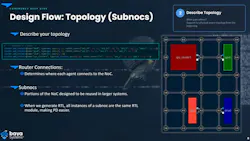
Baya Systems’ tools address on-die as well as cross-die and cross-chip communication. This includes support for multi-chiplet coherency, global address maps, and deadlock avoidance across dies and chips. The tools can be used for traffic simulation.
Read more about the 2026 Chiplet Summit
 Chiplet Summit at the Santa Clara Convenction Center
 Santa Clara Convention Center
About the Author
 Kent Orthner
Kent Orthner
Principal Solutions Architect, Baya Systems
Kent Orthner has over 25 years of experience designing all aspects of on-chip networks, FPGA technology, and high-speed silicon connectivity. Before joining Baya Systems, Kent served as Sr. VP of Engineering at Achronix Semiconductor, where he led the development of cutting-edge FPGA devices and IP solutions, including the FPGA-embedded high performance on-chip network. Before Achronix, Kent served as the Vice President of Engineering at Arteris, where he was responsible for all hardware and software development, and where he developed and released the world’s first highly scalable and configurable cache-coherent interconnect IP. Before that, Kent spent 11 years at Altera, leading multiple cross-functional engineering teams, including Altera's NoC design tool suite, IP infrastructure, and debug and design visibility tools. Kent holds a Master of Engineering in Electrical Engineering from Carleton University, Canada, and a Bachelor of Applied Science in Computer Engineering from the University of Ottawa, Canada.