Provably Correct Ethernet
What you'll learn:
- Why data corruption can occur when using an Ethernet network.
- What is Atomic Ethernet?
- Why is Ethernet not scaling for critical transaction systems?
Ethernet has proven to be a robust, long-term, networking solution, but it uses protocols that can lead to data corruption in large-scale systems. TCP with its handshaking protocol is supposed to provide reliable communication. However, what happens to transactions when the handshake fails? This aspect is addressed by the Open Compute Project’s Open Atomic Ethernet project and other similar architectures designed to provide reliable, low-latency, atomic transaction-oriented communications.
Daedaelus is one company that’s working on Atomic Ethernet. Deaedaelus’ Sahas Munamala provides some insight into how reliable communication would work (watch video above). The demonstration system (Fig. 1) shows what the protocol can do, but things get really interesting when we’re talking about hundreds to thousands to possibly millions of nodes within a system, as might occur in a chiplet-based system.
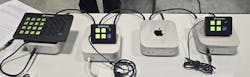
According to Daedaelus, “80% of observed network-partition failures had a catastrophic impact, including data loss.” Oftentimes, the failures were silent or had unclear warnings.
The fabric proposed by the company has each node connected to all nearby neighbors (Fig. 2). All links are atomic — they know immediately if a packet isn’t exchanged properly.
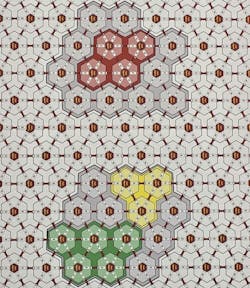
The graph-based topology and communication theory is a bit more extensive than can be covered here. Nonetheless, the approach has many features that are required in this type of environment. They include exactly-once semantics at line rate and self-healing, demand-aware networks that provide reliable, transaction-oriented communication by default. This video provides some insight into the problems and solutions.
>>Check out more of our 2026 Chiplet Summit coverage
 Chiplet Summit at the Santa Clara Convenction Center
About the Author
 William G. Wong
William G. Wong
Senior Content Director - Electronic Design and Microwaves & RF
I am Editor of Electronic Design focusing on embedded, software, and systems. As Senior Content Director, I also manage Microwaves & RF and I work with a great team of editors to provide engineers, programmers, developers and technical managers with interesting and useful articles and videos on a regular basis. Check out our free newsletters to see the latest content.
You can send press releases for new products for possible coverage on the website. I am also interested in receiving contributed articles for publishing on our website. Use our template and send to me along with a signed release form.
Check out my blog, AltEmbedded on Electronic Design, as well as his latest articles on this site that are listed below.
You can visit my social media via these links:
- AltEmbedded on Electronic Design
- Bill Wong on Facebook
- @AltEmbedded on Twitter
- Bill Wong on LinkedIn
I earned a Bachelor of Electrical Engineering at the Georgia Institute of Technology and a Masters in Computer Science from Rutgers University. I still do a bit of programming using everything from C and C++ to Rust and Ada/SPARK. I do a bit of PHP programming for Drupal websites. I have posted a few Drupal modules.
I still get a hand on software and electronic hardware. Some of this can be found on our Kit Close-Up video series. You can also see me on many of our TechXchange Talk videos. I am interested in a range of projects from robotics to artificial intelligence.