The Processor Pipeline Behind Real-Time AI
What you'll learn:
- How physical AI connects sensing, perception, planning, and control into a sensor-to-actuator system at the edge.
- How to ensure fast, predictable responses across the entire pipeline from sensor input to actuation.
- Why the biggest optimization wins often reside in time synchronization, preprocessing, sensor fusion, memory bandwidth, scheduling, and data movement.
- How a heterogeneous compute architecture combining a CPU, GPU, and NPU with unified memory can preserve determinism at the edge.
Physical AI is moving out of the research phase and into actual infrastructure. Perception models that once ran on robots in the lab are being deployed on factory floors, in warehouses and hospitals, and under the hood of vehicles.
As deployments scale at the edge, the central question shifts from "How capable is the model?" to "Can the system deliver the right action at the right time under real operating conditions over its entire lifecycle?" These systems must behave predictably in conditions in the hardest conditions to recreate in the lab: thermal steady state, background workloads, intermittent connectivity, degraded sensors, and long-tail scenarios where safety margins are tight.
A New Set of Requirements for Physical AI
Navigating the uncertainties of the real world demands tight timing constraints, determinism, and reliability, often in harsh environments with strict power envelopes, long product lifecycles, and a high bar for safety. These constraints push computation toward the edge as a system-level requirement: When the correct response must happen within a deadline and must keep happening when networks degrade, cloud offload can cause delays.
Physical AI can’t rely on a centralized brain. It must be designed as a distributed nervous system with intelligence embedded across sensors, edge processors, and actuators — close to where data is collected and decisions are executed. This shift fundamentally changes how workloads are partitioned, how compute is architected, and how hardware and software must be co-designed for deterministic, real-time operation.
What determinism means in practice is predictable timing behavior across the full system, with bounded end-to-end latency from sensing through compute to actuation. A critical nuance is that determinism is limited by tail latency and jitter, not average performance. A rare latency spike can be more dangerous than a slightly lower but consistent pipeline because deadline misses destabilize control loops, shrink safety margins, and complicate validation and certification.
A practical way to address this situation is to treat determinism as a measurable metric. At a minimum, teams should align with these system requirements:
- End-to-end timing constraints measured as distribution and as a hard maximum under defined conditions.
- Jitter for the control loop and real-time synchronization.
- Deadline-miss behavior, including whether misses occur and how the system reacts (fallback policy, reduced-rate operation, and safe state).
It Takes Time: The Complete Sense-to-Act Pipeline
The physical AI pipeline involves much more than running a neural network. Think about it in terms of end-to-end timing: from the instant that the sensor captures data — the sensor timestamp — to the actuator’s command. Even without assigning specific milliseconds, which vary by application, the overall sequence of stages remains consistent:
- Sensor ingest and time alignment: Capture, timestamping, and cross-modal synchronization (camera/radar/IMU/encoders).
- Preprocessing: ISP, filtering, normalization, and format conversion.
- Fusion/tracking/state: Observation association, world model updates, and track continuity.
- Inference and post-processing: DNN execution, output decoding, and confidence gating.
- Planning/decision: Trajectory generation, policy evaluation, and constraint checking.
- Control and actuation I/O: Control computation, command issuance, and health monitoring.
In production, the system’s worst-case behavior often doesn’t come from the model itself. Tail latency is frequently dominated by queueing between stages, synchronization delays, middleware overhead, memory copies, and bandwidth contention. These effects appear as intermittent spikes rather than constant slowdowns, which can be easy to miss in early prototypes. Two practices turn this into engineering discipline:
- Instrument end-to-end: Timestamp at each pipeline stage and track distributions.
- Treat data movement as a first-class design constraint: Transfers, serialization, and format conversions add latency, power and variability, all of which undermine determinism.
Why Heterogeneous Compute Architecture Matters for Physical AI
These realities are driving edge designs toward consolidated, heterogeneous compute that tightly integrates CPU, GPU, and NPU capabilities (Fig. 1). This is the distributed nervous system in practice: workloads partitioned across specialized compute elements keeping intelligence close to where data is generated. This directly addresses the data movement and contention challenges.
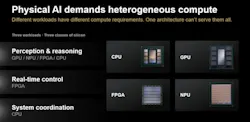
A practical workload partitioning often looks like this:
- CPU: Real-time orchestration, middleware, I/O handling, safety monitors, control threads, and non-uniform logic requiring low-latency scheduling.
- GPU: Highly parallel perception workloads (dense vision and mapping).
- NPU: Power-efficient execution of repeatable deep-neural-network (DNN) inference graphs for perception, prediction, and related workloads
- Memory: Unified memory shared by the CPU and GPU delivering a high response rate.
- FPGA: Adaptive compute at platform level to scale networking and sensor connectivity as needed to meet more complex system demands.
Consolidation reduces copies and transfers between stages, eliminates multichip coordination overhead, and improves responsiveness per watt. But it doesn’t automatically produce determinism. Contention becomes the central problem when multiple workloads share compute and memory, especially in mixed-criticality systems. Determinism is a systems property shaped by architecture, scheduling, and dataflow design, not by accelerator peak performance alone.
The Physical AI Pipeline, in Practice
The complete sense-to-act pipeline can be deployed in different domains using a heterogeneous processor such as AMD's Ryzen AI Embedded P100 series. While each application has unique constraints, all require deterministic execution and predictable latency. Therefore, the underlying architecture can work for them all.
An autonomous mobile robot (AMR) must fuse camera, LiDAR, IMU, and GPS data and close motion-control loops in real-time under tight battery and thermal constraints (Fig. 2). It incorporates the P100 that integrates x86 CPU cores for scalable performance and deterministic control and a GPU for real-time visualization and graphics in the same chip as a neural processing unit (NPU) for low-latency, low-power AI inference.
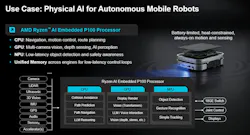
In robotics, the CPU handles navigation and real-time orchestration, while the GPU processes multi-camera vision and depth sensing. The NPU runs object detection and safety awareness within a bounded, power-efficient execution window. Unified memory across all three engines eliminates the cross-chip transfers that introduce jitter, keeping the full sensor-to-action loop predictable.
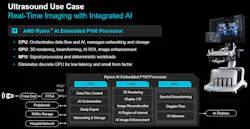
In real-time medical imaging, deterministic signal processing within strict power and form-factor limits is also required (Fig. 3). The CPU orchestrates data flow; the GPU handles the rendering of the ultrasound or other image; and the NPU executes spectral beamforming analysis and AI inference as repeatable, bounded workloads. Consolidating all three onto a single SoC eliminates the need for a discrete GPU, reducing inter-stage latency.
A factory edge PC must run mixed-criticality workloads concurrently, including real-time motion control, vision inspection, and multi-display HMI, on one ruggedized platform (Fig. 4).
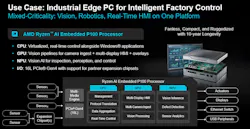
The CPU isolates deterministic control threads from standard OS workloads, while the GPU offloads the resource-heavy tasks of image and video pipelines along with the HMI. Finally, the NPU runs defect detection and sensor analytics within a bounded execution budget. A 16-lane PCIe Gen4 interface allows connectivity to scale without taxing core timing margins.
Keeping Physical AI Running Over the Long Term
Each of these systems must sustain their performance over a product lifecycle measured in years through model updates, evolving tool chains, and changing operational conditions. This is where the next set of engineering decisions begin.
Physical AI systems aren’t “ship once” products. Industrial robots, factory control PCs, and medical devices all have lifecycles measured in years or decades, with ongoing updates for models, runtimes, security posture, and feature expansion. That makes openness a practical engineering concern that includes portability across evolving tool chains, integration with existing OT/IT environments, and the ability to validate changes without restarting programs from scratch.
As AI models evolve with hardware still in service, treating timing constraints and jitter as regression targets — measured in the lab and monitored in the field — ensures that gains in one area don’t silently erode determinism elsewhere.
Training remains central to physical AI, but production value is created at inference time: at the robot, inside the machine, near the patient, on the vehicle. The most important engineering work is the construction of a sensor-to-actuator pipeline that can measure, bound, and sustain real-time behavior under power, thermal, connectivity, and lifecycle constraints.
Organizations that internalize “determinism by design” will be the ones that deploy autonomy broadly and keep it safe, reliable, and maintainable over time.
About the Author
Kiran Vishal Thanjavur Bhaaskar
Senior Manager, Robotics Lead, AMD
Kiran Vishal Thanjavur Bhaaskar is Senior Manager, Robotics Lead at AMD. He leads a team of experts in industrial, vision, healthcare and sciences fields, covering the technical roadmap, product planning, marketing, partner ecosystem, global customer pipeline and revenue
Comment About the Article
To join the conversation, and become an exclusive member of Electronic Design, create an account today!
 Leaders Logo
Leaders relevant to this article: