How Does Physical AI Change Embedded System Design?
What you’ll learn:
- Why physical AI creates different infrastructure requirements than traditional cloud AI.
- How power interruption, telemetry workloads, and flash wear affect long-term system behavior.
- Why predictable recovery and trustworthy operational data matter when humans rely on physical AI devices.
- Practical considerations for designing resilient physical AI systems.
Artificial intelligence is increasingly moving beyond cloud environments and into systems that interact directly with the physical world. Autonomous vehicles, industrial robots, medical devices, intelligent infrastructure, and edge AI systems are no longer simply processing information. They’re making decisions and taking actions in real-world environments.
As these systems move from controlled development environments into everyday operation, their behavior increasingly affects the people who depend on them. A vehicle occupant expects an assisted-driving system to recover safely after interruption. A maintenance engineer relies on accurate operational records to diagnose faults. A clinician depends on a medical device behaving consistently and retaining trustworthy data. In each case, the reliability of the underlying data path becomes part of the overall system outcome.
Much of today's AI discussion focuses on models, accelerators, and system capabilities. While these remain important, engineers deploying AI-enabled systems are increasingly encountering the challenge of ensuring that those systems continue to behave predictably throughout years of real-world operation.
Models determine what a system can infer, but the physical AI data layer determines whether it can continue behaving correctly and predictably in the real world across a long operational lifetime (see figure). As a result, storage, telemetry, update state, recovery behavior, and auditability are becoming part of system behavior itself.
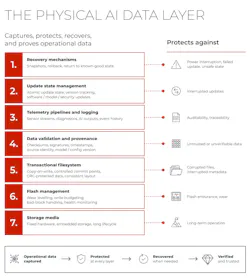
In physical AI systems, these functions help determine whether a device can recover safely, maintain operational continuity, and provide evidence of what occurred when something goes wrong.
Physical AI Introduces New Operating Constraints
Physical AI systems operate under conditions that differ significantly from traditional cloud infrastructure. Many are deployed on fixed hardware platforms expected to remain in service for 10, 20, or even 30 years. They must continue operating despite power interruptions, intermittent connectivity, environmental stress, evolving software requirements, and increasing volumes of operational data.
Unlike cloud environments, these systems can’t simply add resources when workloads grow. Instead, they must continue functioning within strict hardware constraints while supporting new software capabilities, AI workloads, security updates, and operational requirements throughout their lifetime.
This places increasing importance on the physical AI data layer; i.e., the infrastructure responsible for capturing, storing, recovering, and validating operational data. For embedded engineers, this infrastructure extends beyond storage media alone. It includes file systems, flash management, telemetry pipelines, operational logging, update state management, recovery mechanisms, timestamp handling, and the integrity controls that help preserve system state throughout the life of the device.
Power Interruption and Recovery
Power interruption remains one of the most challenging scenarios in embedded-system design. When power is lost during active write operations, systems may encounter incomplete updates, interrupted metadata operations, corrupted files, or lost telemetry records. In physical AI systems, these failures can affect more than data availability. They may influence system behavior after restart and complicate diagnostics when failures occur.
For example, if an industrial robot loses power during operation, maintenance teams may need reliable operational logs to determine whether the interruption was caused by a system fault, environmental condition, or unexpected workload. In connected vehicles, interrupted updates or incomplete recovery procedures can create similar challenges for service teams restoring normal operation. Recovery mechanisms, therefore, need to return the platform to a known and verifiable state.
For engineers, recovery behavior should be treated as a core design requirement rather than an afterthought. Considerations include atomic-write handling, journaling mechanisms, predictable and reliable recovery processes, and validation under repeated interruption scenarios.
Continuous Telemetry Changes Storage Behavior
Physical AI systems continuously generate operational data. Sensor streams, diagnostics, telemetry logs, software state information, and AI-generated outputs often create sustained write-heavy workloads that differ significantly from traditional embedded applications.
Over time, these workloads can influence flash endurance, write amplification, garbage-collection latency, and overall storage performance. Engineers need to consider not only how storage behaves during development, but how it will perform after years of continuous operation under real-world workloads.
Engineers should evaluate flash endurance requirements using realistic workload assumptions and consider wear leveling, write budgeting, flash health monitoring, and workload isolation strategies to manage long-term performance. Storage systems that appear sufficient during development may behave very differently after years of continuous operation in the field.
Auditability and Traceability
As systems become increasingly autonomous, organizations need greater visibility into how those systems behave under real-world conditions. Questions such as what the system observed, what decisions it made, what software version was running, and what operational state existed at the time of an event are becoming increasingly important.
This requires trusted operational data. In many deployments, information about system behavior is needed for engineering analysis, as well as by operators, service personnel, and compliance teams investigating an incident or unexpected event. In safety-critical and regulated environments, reliable telemetry and audit records support validation, root-cause analysis, and the ability to reconstruct what occurred during system operation.
For high-risk AI systems, frameworks such as the EU AI Act place increased emphasis on risk management, data governance, logging, traceability, and auditability, making trustworthy operational data an increasingly important part of system design.
Reliable logging, telemetry retention, timestamp integrity, and predictable recovery behavior all contribute to the ability to understand and validate system operation over time.
Designing for Resilience in Physical AI Systems
For embedded engineers, physical AI introduces a new set of design priorities. Systems must be designed to recover predictably after interruption, manage sustained telemetry workloads, preserve operational evidence, maintain data integrity, and support validation throughout long operational lifecycles.
From a design perspective, engineers should evaluate how the system behaves throughout its lifecycle, including after years of flash wear, repeated update cycles, and unexpected interruption events. Practical considerations include atomic-write handling, copy-on-write mechanisms, recovery to a known state, flash health monitoring, workload isolation between telemetry and application data, and validation under repeated power-failure scenarios.
Conclusion
Physical AI changes the definition of resilience. As AI moves into machines, many deployment challenges originate not in the model itself, but in the infrastructure responsible for storing, recovering, and validating operational data. Engineers designing physical AI systems must therefore think beyond model performance and consider how systems behave under real-world operating conditions over long operational lifetimes.
As physical AI systems move from pilot projects into long-term deployment, reliability increasingly depends on the quality of the physical AI data layer. Engineers must consider how AI models perform, as well as how operational data is captured, preserved, recovered, and validated throughout the life of the device.
Designing for predictable recovery, traceability, and long-term data integrity is becoming a fundamental requirement for building dependable physical AI systems. Ultimately, the success of physical AI will depend not only on what systems can do, but on whether their behavior can be recovered, validated, and trusted throughout years of operation.
About the Author
 Marko Finnig
Marko Finnig
VP, Head of Embedded Business Unit, Tuxera
Marko Finnig joined Tuxera in early 2023, bringing to the company a decade of experience in building and scaling world-class product and service businesses. He has an extensive background in the embedded software industry, and has held key product and service leadership positions at Vaisala, Qt Group, and F-Secure. Marko holds a B.Sc. in Engineering from Oulu University of Applied Sciences.
Comment About the Article
To join the conversation, and become an exclusive member of Electronic Design, create an account today!
 Leaders Logo
Leaders relevant to this article: