MRDIMMs: Memory for AI Data Centers
What you’ll learn:
- What are MRDIMMs?
- What’s the difference between RDIMMs and MRDIMMs?
- How are MRDIMMs helping the AI data center?
High memory bandwidth is key to meeting the demands of artificial-intelligence (AI) data centers. Within the package, high bandwidth memory (HBM) like HBM4 and SPHBM4 addresses those needs, but external DRAM is a different story. DDR5 DRAMs in the form of RDIMMs have been used in servers. However, the move to multiplexed rank dual inline memory modules (MRDIMMs) is providing improved performance and memory bandwidth.
Renesas is delivering support chips for MRDIMMs that significantly increase the memory bandwidth available to CPUs, GPUs, and NPUs (Fig. 1). I talked with Allen Youssefi, Director of Product Management, Memory Interface & Extended Enterprise Products, Analog & Mixed Signals - MID Product Division at Renesas, about the importance of MRDIMMs and Renesas’ latest chipset (watch the video above).
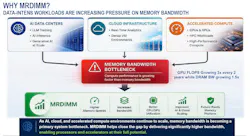
MRDIMM DDR5 Advantages
Each component in an MRDIMM addresses different aspects of the memory module (Fig. 2). The multiplexed data buffer (MDB) reduces the load on the host regardless of the number of DRAM chips in a channel. As a result, the system can operate at a higher frequency, although the main advantage is the parallel operation of multiple DRAM ranks that provides double the throughput compared to RDIMMs.
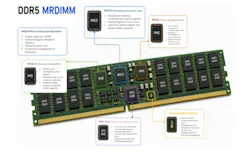
Capacity is another advantage of moving to MRDIMMs, due to the buffering that reduces host loading. This allows for modules with more than 256 GB of memory.
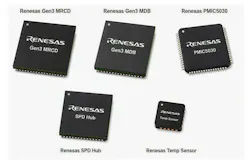
The serial presence detect hub (SPD), temperature sensor, and power-management IC (PMIC) are part of the mix, though they’re essentially the same as those used for RDIMMs.
This table highlights MRDIMM retimer advantages:
This table highlights data buffer advantages:
The other chips in the package are the data buffers. This table lists some of the performance issues for DDR5 RDIMM data buffers:
>>Check out more of our Future of Memory and Storage 2026 coverage
About the Author
 William G. Wong
William G. Wong
Senior Content Director - Electronic Design and Microwaves & RF
I am Editor of Electronic Design focusing on embedded, software, and systems. As Senior Content Director, I also manage Microwaves & RF and I work with a great team of editors to provide engineers, programmers, developers and technical managers with interesting and useful articles and videos on a regular basis. Check out our free newsletters to see the latest content.
You can send press releases for new products for possible coverage on the website. I am also interested in receiving contributed articles for publishing on our website. Use our template and send to me along with a signed release form.
Check out my blog, AltEmbedded on Electronic Design, as well as his latest articles on this site that are listed below.
You can visit my social media via these links:
- AltEmbedded on Electronic Design
- Bill Wong on Facebook
- @AltEmbedded on Twitter
- Bill Wong on LinkedIn
I earned a Bachelor of Electrical Engineering at the Georgia Institute of Technology and a Masters in Computer Science from Rutgers University. I still do a bit of programming using everything from C and C++ to Rust and Ada/SPARK. I do a bit of PHP programming for Drupal websites. I have posted a few Drupal modules.
I still get a hand on software and electronic hardware. Some of this can be found on our Kit Close-Up video series. You can also see me on many of our TechXchange Talk videos. I am interested in a range of projects from robotics to artificial intelligence.
 Allen Youssefi
Allen Youssefi
Director of Product Management, Memory Interface & Extended Enterprise Products, Analog & Mixed Signals - MID Product Division, Renesas
Allen Youssefi is Director of Product Management for Renesas' Memory Interface Division within the Analog & Mixed Signal Group.
Allen has been with Renesas for about eight years and has worked in the memory industry for over 20 years. Allen has a B.S. in Electrical Engineering and M.S. in Engineering Management from San Jose State University.