RISC-V Core Exceeds RVA23 Requirements

What you'll learn:
- What is the RVA23 RISC-V specification?
- How does SiFive’s P570 improve upon the specification?
The RISC-V RVA23 is a 64-bit specification that requires vector and hypervisor support with cache coherency. These were optional with RVA22. RVA23 is the base for Linux distributions like Ubuntu 25.10. Vector extensions can be exploited to support artificial-intelligence (AI) models.
SiFive’s P570 builds on the RVA23 specification, adding features like WorldGuard security support that provides features similar to Arm’s TrustZone. It can be utilized in a multicore cluster with multiple clusters as needed (Fig. 1). Each core is built on a 3-wide, 13-stage, fully out-of-order execution superscalar pipeline architecture. The 128-bit vector pipeline includes dot product extensions.
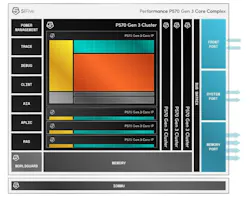
The cores support FP16 and BF16 floating-point formats that are often employed in artificial-intelligence/machine-learning (AI/ML) models.
Compared to its predecessor, the P550, the P570 provides a 13% improvement in dynamic power along with a 51% reduction in leakage current. It delivers twice the vector performance as well.
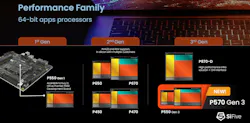
The P570, implementing SiFive’s third-generation architecture, is part of SiFive’s family of RISC-V cores (Fig. 2), including the high-end P870 that’s often paired with the X390 neural processing unit (NPU). The P870 targets the high end while the P570 hits the midrange, where a smaller footprint is useful.
The P570 includes a number of enhancements, primarily to augment vector operations (see table below). These work with the 128-bit vector pipeline. Others, like smepmp, improve security, which involves vector cryptography support, secure branch prediction, and support for protected memory.
Having vector and hypervisor features, along with additional security and vector optimizations, will prove useful in embedded applications that require some AI/ML in addition to regular computational support. The P550 is still available if an application doesn’t need some of the more advanced features found in the P570.
About the Author
 William G. Wong
William G. Wong
Senior Content Director - Electronic Design and Microwaves & RF
I am Editor of Electronic Design focusing on embedded, software, and systems. As Senior Content Director, I also manage Microwaves & RF and I work with a great team of editors to provide engineers, programmers, developers and technical managers with interesting and useful articles and videos on a regular basis. Check out our free newsletters to see the latest content.
You can send press releases for new products for possible coverage on the website. I am also interested in receiving contributed articles for publishing on our website. Use our template and send to me along with a signed release form.
Check out my blog, AltEmbedded on Electronic Design, as well as his latest articles on this site that are listed below.
You can visit my social media via these links:
- AltEmbedded on Electronic Design
- Bill Wong on Facebook
- @AltEmbedded on Twitter
- Bill Wong on LinkedIn
I earned a Bachelor of Electrical Engineering at the Georgia Institute of Technology and a Masters in Computer Science from Rutgers University. I still do a bit of programming using everything from C and C++ to Rust and Ada/SPARK. I do a bit of PHP programming for Drupal websites. I have posted a few Drupal modules.
I still get a hand on software and electronic hardware. Some of this can be found on our Kit Close-Up video series. You can also see me on many of our TechXchange Talk videos. I am interested in a range of projects from robotics to artificial intelligence.