How to Control Brushless Motors (Part 1) (Download)
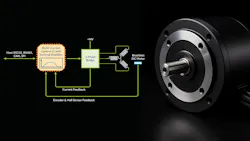
Brushless DC motors, also called brushless motors or BLDC motors, are popular for high-reliability and high-performance motion control. They don’t use mechanical brushes that can generate particulates and wear out; instead, they’re commutated electronically. The advantages of BLDC motors are high torque output, high spin rate, and brushless operation. However, their main drawback is cost relative to DC brushed or stepper motors
BLDC motors can be divided into two major motor groups: rotary BLDC motors and linear BLDC motors. There are further sub-divisions, specifically in the realm of rotary motors, which can be differentiated by inner or outer rotor construction as well as axial-flux or radial-flux designs. Inner-rotor BLDC motors break down into the interior permanent magnet (IPM) type or the surface-magnet type. Finally, iron core construction methods distinguish between slotted BLDC motors and slot-less BLDC motors.