Engineer Feedback on Careers and AI
What you’ll learn:
- How is AI impacting engineers and their designs?
- How much has AI made inroads into the engineering profession?

Our 2025 Salary and Career Survey results are in, with the surveyed engineers and designers having a background focus spanning from electrical to mechanical to automation. You can check out our Electronic Design Salary Comparison Tool if you’re so inclined.
Like everyone else, for years, we’ve been tracking the migration of machine learning (ML) and artificial intelligence (AI) on engineers and their careers. It’s affected everything from the development process to AI education.
Large language models (LLMs) and chatbots continue to improve the coding credentials. Still, AI slop from vibe coding can cause major problems, adding to the technical debt that needs to fixed in the future. This is especially true for safety and security applications.
So, here’s some analysis of AI-related results from our 2025 Salary and Career Survey.
- How AI is Impacting Engineers
- AI’s Impact on Designs
- Effects of AI on Engineering Careers
- Thoughts on AI and Engineering Careers
How AI is Impacting Engineers
Search and research remain the primary use of AI and chatbots, as indicated by 43% of engineer and programmer respondents (Fig. 1). This use keeps the engineer in the loop. AI search results tend to be better and more interactive compared to basic search engine results.
Of course, part of the challenge is determining if the response is valid, as chatbots are known to bend the truth and even make up results. Asking for references to source material and then checking them should be part of anyone’s best practices these days.
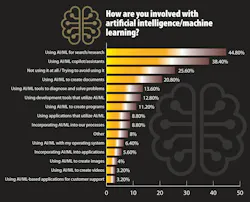
A step down from the research responses is the use of AI assistants at about 39%. We didn’t delve into the details, but this would include everything from code completion to code generation, which is becoming more common. Likewise, the quality of the generated code is improving.
Test and documentation currently represent a smaller percentage. However, I suspect that this will grow significantly in the future as documentation is something chatbots can do well. It’s also a task that few enjoy. Moreover, it’s invaluable for both people and AI assistants.
Of course, we asked what engineers and programmers thought about these AI/ML tools (Fig. 2). The results tend to align with what the general public thinks these days — it’s up from 38% last year. How AI regulation might be done is a discussion for another time. It’s very important for the kinds of embedded applications developed by our readers, though, because safety and security are often top requirements.
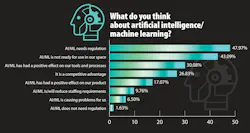
After looking at the results, we should probably have asked whether AI/ML tools had a negative effect rather than just asking the affirmative. The 65% who didn’t select a positive effect will be a mix of little or no effect (which is what I would expect), an unknown effect, or a negative effect. A small fraction indicated that AI was causing a problem. But we don’t have results that indicate the type of problem, which could range from chatbots giving the wrong answer to causing a loss of some sort.
The percentage of people who didn’t think AI was ready for their space dropped overall. However, it actually went up for Electronic Design responders (32% for all, as shown in the chart, versus 43% for Electronic Design readers).
AI’s Impact on Designs
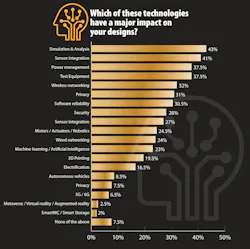
There was very little change regarding the impact of technologies since last year (Fig. 3). AI/ML remain one of the major items in the list. Yet there’s more concern about conventional engineering issues, from sensor integration to simulation and analysis. This may change as AI/ML improves and becomes more integrated into tools and middleware being used in embedded designs. However, the process may be more gradual than many pushing these technologies may like.
The amount of change with respect to specialties (Fig. 4) was low as well, with some notable exceptions. Overall, analog rose across the board for all of our publications, but there was a significant jump from Electronic Design and Microwave & RF readers. While the overall numbers rose to 30%, it was more like 50% for electrical and electronic designers.
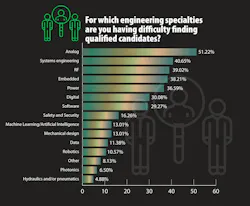
Similar but smaller differences were notable in power, embedded design, and RF. These differences aren’t surprising given the focus of those readers. Engineers and developers for publications like Control Design are utilizing systems that already address many of the challenges for handling power and analog sensors.
Effects of AI on Engineering Careers
Over 60% of respondents aren’t looking to change careers and over 90% would recommend engineering as a profession. For those considering a move, the results compared to last year are about the same (Fig. 5).
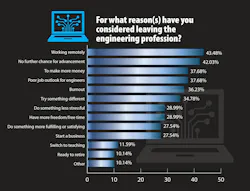
Burnout is still high on the list, but “trying something different,” “making more money,” and “doing something more fulfilling” are more popular responses. At this point, AI/ML issues tend to be less important.
When we looked specifically at AI/ML and the job, some changes were notable (Fig. 6). Those not using AI/ML dropped by almost 10%, to the point where we can probably say that AI/ML is being used everywhere but can’t indicate to what degree. We will need another survey for that.
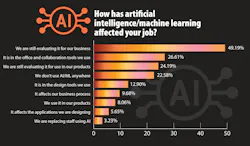
The answer, “We are replacing staff using AI,” was new this year. We’re happy to note that the numbers are very low at this point, at least from an engineering perspective.
Thoughts on AI and Engineering Careers
AI may be having some major negative repercussions for some jobs. However, for engineering and embedded programming jobs it appears to have less of a negative impact, at least with respect to salary and careers. I suspect that other issues such as wars, tariffs, and political issues will have a more direct impact than AI in the near term.
In the long term, the ways in which AI will help and how engineers, developers, and programmers adapt to the support or distraction that AI can deliver is still unclear. This is especially true given the financial nature of AI at this point, with a considerable number of people using subsidized AI support at least when it comes to LLMs via chatbots. It’s dangerous to assume that this support will continue or low-cost options will be able to replace this support.
The cost of AI, as well as its effectiveness, will impinge on engineering and embedded designers’ careers more over time. but that’s for next year’s survey. In the meantime, leave a comment and let us know what you think.
More 2025 Salary and Career Survey Articles
 university_dreamstime_l_328252413
AI’s Impact on Careers from Previous Years
 ed_survey_dreamstime_tondone_326165096_promo
 Rubiks Cat Dreamstime L 268115686
Electronic Design Poll
This is our ongoing poll about the use of vibe coding.
About the Author
 William G. Wong
William G. Wong
Senior Content Director - Electronic Design and Microwaves & RF
I am Editor of Electronic Design focusing on embedded, software, and systems. As Senior Content Director, I also manage Microwaves & RF and I work with a great team of editors to provide engineers, programmers, developers and technical managers with interesting and useful articles and videos on a regular basis. Check out our free newsletters to see the latest content.
You can send press releases for new products for possible coverage on the website. I am also interested in receiving contributed articles for publishing on our website. Use our template and send to me along with a signed release form.
Check out my blog, AltEmbedded on Electronic Design, as well as his latest articles on this site that are listed below.
You can visit my social media via these links:
- AltEmbedded on Electronic Design
- Bill Wong on Facebook
- @AltEmbedded on Twitter
- Bill Wong on LinkedIn
I earned a Bachelor of Electrical Engineering at the Georgia Institute of Technology and a Masters in Computer Science from Rutgers University. I still do a bit of programming using everything from C and C++ to Rust and Ada/SPARK. I do a bit of PHP programming for Drupal websites. I have posted a few Drupal modules.
I still get a hand on software and electronic hardware. Some of this can be found on our Kit Close-Up video series. You can also see me on many of our TechXchange Talk videos. I am interested in a range of projects from robotics to artificial intelligence.
Comment About the Article
To join the conversation, and become an exclusive member of Electronic Design, create an account today!
 Leaders Logo
Leaders relevant to this article: