Low-Power Vision Processing for Physical AI
What you’ll learn:
- What’s new with physical AI?
- How Hailo supports physical AI.
Physical artificial intelligence (AI) typically equates to robotics or some variation thereof. One of the key components of such a system is vision processing using large language models (LLMs) and vision language models (VLMs) running on a local system.
I talked with Yaniv Sulkes, Hailo VP of Physical AI at Hailo, about physical AI issues, including the need to handle models on the edge rather than the cloud and doing so without eating a lot of power. The video (see above) focuses on physical AI in general with a short mention of Hailo’s hardware (Fig. 1).
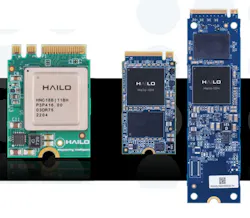
Data streams from optical, LiDAR, and radar sources can be processed by LLMs and VLMs like the Hailo-8 and Hailo-10 accelerators. The Hailo-10H has 40 TOPS of INT4 performance suitable for handling multiple streams and models. Hailo also provides a standalone system-on-chip (SoC), the Hailo-15. The DSP core handles image signal processing (ISP) and, through the use of AI models, it can work in low-light environments.
As with most AI accelerators, Hailo provides a compiler and HailoRT runtime as part of its software development kit (SDK). The company’s Model Zoo (Fig. 2) is a collection of AI models that developers can enhance in addition to using their own custom models.
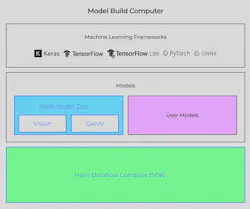
Hailo hardware and software support many of the commonly used AI frameworks and interchange standards, including TensorFlow, PyTorch, Keras, and ONNX.
About the Author
 William G. Wong
William G. Wong
Senior Content Director - Electronic Design and Microwaves & RF
I am Editor of Electronic Design focusing on embedded, software, and systems. As Senior Content Director, I also manage Microwaves & RF and I work with a great team of editors to provide engineers, programmers, developers and technical managers with interesting and useful articles and videos on a regular basis. Check out our free newsletters to see the latest content.
You can send press releases for new products for possible coverage on the website. I am also interested in receiving contributed articles for publishing on our website. Use our template and send to me along with a signed release form.
Check out my blog, AltEmbedded on Electronic Design, as well as his latest articles on this site that are listed below.
You can visit my social media via these links:
- AltEmbedded on Electronic Design
- Bill Wong on Facebook
- @AltEmbedded on Twitter
- Bill Wong on LinkedIn
I earned a Bachelor of Electrical Engineering at the Georgia Institute of Technology and a Masters in Computer Science from Rutgers University. I still do a bit of programming using everything from C and C++ to Rust and Ada/SPARK. I do a bit of PHP programming for Drupal websites. I have posted a few Drupal modules.
I still get a hand on software and electronic hardware. Some of this can be found on our Kit Close-Up video series. You can also see me on many of our TechXchange Talk videos. I am interested in a range of projects from robotics to artificial intelligence.