Edge AIoT Platforms Powered by Intel Bartlett Lake
What you'll learn:
- How ASRock’s Industrial Robust Edge AIoT platforms target edge AI and real-time automation.
- What’s offered by the flagship iEPF-9500S-EW7 and value-tier iEPF-9040VS-EW2/iEP-9040VE platforms.
- Where ruggedized Bartlett Lake-based systems fit in manufacturing, robotics, and industrial control applications.
The AI landscape over the last decade has shifted from the cloud to the edge. Industries are no longer exploring AI’s capabilities — they’re actively scaling and deploying it to suit their needs.
As large language models (LLMs) and generative AI become smaller and more efficient, they start reshaping the semiconductor, AI, and device ecosystems, according to a report from Arm. It’s also no secret that by processing data loads locally, there’s no need for cloud connectivity, making edge computing faster and more efficient.
AI processing continues to shift from the cloud to the edge, letting manufacturers move those workloads closer to where that data is generated. Consequently, LLMs and other models can make decisions in real-time without the need for physical internet connections.
That, of course, requires ruggedized hardware capable of handling the harsh environments found on factory floors. Vibration, heat, dust, and other variables can wreak havoc on hardware, and as a result, ruggedized hardware is just as important as AI processing power.
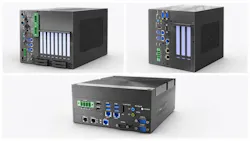
ASRock understands the importance of both edge computing and ruggedizing hardware with its new Industrial Robust Edge AIoT platforms (see figure below), which are driven by Intel’s Core Series 2 Processors with P-cores (Bartlett Lake-S/12P), suiting them for AI processing, real-time industrial control, and scalable deployment. While the new trio takes advantage of the same processor family, they differ in their performance levels, so let’s break them down.
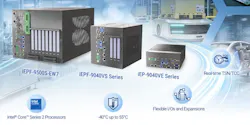
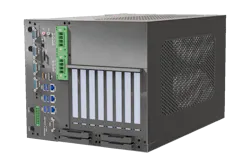
ASRock’s iEPF-9500S-EW7 is the company’s flagship model and comes outfitted with Intel’s Core Processors (Series 2) with R680E chipset. The platform also integrates Intel’s UHD Graphics, up to 192 GB of DDR5 RAM, a plethora of PCIe slots for expansion, and a host of communication and USB ports.
Product: ASRock iEPF-9500S-EW7
Company: ASRock Industrial
Form Factor: Expandable industrial Edge AIoT platform / embedded computer system; aluminum heatsink + metal chassis; desk-mount design; 288 × 450.3 × 250 mm; 13 kg.
CPU: Intel Core Processors, Series 2; LGA1700 socket; Intel R680E chipset.
GPU: Integrated Intel UHD Graphics; also supports high-power discrete GPU expansion, including one 600-W graphics card or dual 600-W graphics cards depending on configuration.
Memory: Dual-channel DDR5 5,600 MHz; 4x 288-pin DDR5 U-DIMM slots; up to 192 GB total, 48 GB per DIMM; ECC supported with R680E plus selected CPUs.
Storage: 2x M.2 Key M NVMe SSD slots, PCIe Gen4 x4; 4x SATA3 6 Gb/s with RAID 0/1/5/10 support; accommodates up to 4x 2.5-in. HDD/SSD trays.
Communication: 3x Intel i226-IT 2.5-GbE LAN ports, with LAN1 supporting vPro; M.2 Key E slot for Wi-Fi/Bluetooth module; 2x M.2 Key B slots for 4G/5G modules; 2x Nano SIM slots; optional 10BASE-T1S function card.
Expansion: 1x PCIe Gen5 x16 or dual PCIe Gen5 x8, 1x PCIe Gen4 x4, 4x PCIe Gen4 x1; 1x M.2 Key E, 2x M.2 Key B, 2x M.2 Key M; optional 10BASE-T1S, 8DIO, 4COM, and OOB function cards.
Connections: 6x USB 3.2 Gen2x1, 1x DisplayPort 1.4a, 1x HDMI 2.0b, 1x VGA, 6x USB 3.2 Gen2x1, 3x RJ45 2.5 GbE, 1x mic-in, 1x line-out, 2x RS-232, 2x RS-232/422/485, 8 DI / 8 DO, 4x SATA3, 9- to 36-V DC power input, and 8 reserved SMA antenna connector holes.
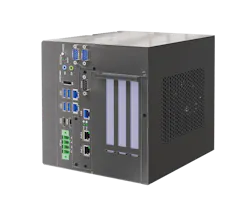
ASRock’s iEPF-9040VS-EW2 integrates Intel’s Core Processors (Series 2) with the R680E chipset, and like the flagship model, features Intel’s UHD Graphics, but a lesser amount of RAM at up to 96 GB of DDR5. ASRock calls this model and the next lower-tier model “value-tier,” as they balance performance with cost efficiency. Storage and expansion are handled by a single M.2 Key M Gen4x4 for NVMe SSD and a pair of SATA3 connectors with RAID 0/1 support. The platform also comes equipped with a host of industrial I/O, including four USB 3.2 Gen2x1 ports, dual internal USB 3.2 Gen2x1, dual Intel Gigabit LAN, dual COM interfaces (RS-232/422/485), and four DI/DO.
Product: ASRock iEPF-9040VS-EW2
Company: ASRock Industrial
Form Factor: Expandable industrial Edge AIoT platform / embedded computer system; aluminum heatsink + metal chassis; desk-mount design; 187 × 231.1 × 200 mm; 7.5 kg.
CPU: Intel Core Processors, Series 2; LGA1700 socket; Intel R680E chipset.
GPU: Integrated Intel UHD Graphics; DisplayPort 1.4a / DP++ and HDMI 2.0b output up to 4096 × 2160 at 60 Hz; supports up to a 75-W expansion card or active graphics card.
Memory: Dual-channel DDR5 5,600 MHz; 2x 262-pin DDR5 SO-DIMM slots; up to 96 GB total, 48 GB per DIMM; ECC supported with R680E plus selected CPUs.
Storage: 1x M.2 Key M slot for NVMe SSD, PCIe Gen4 x4, supporting 2242/2260/2280/22110/25110 modules; 2x SATA3 6 Gb/s with RAID 0/1 support; 1x CFast Type II socket shared with SATA3.
Communication: 2x 1-GbE LAN ports via Intel i219LM with vPro support and Intel i210IT; optional PoE, 10BASE-T1S, and OOB function cards.
Expansion: 2x PCIe Gen4 x8 slots; supports expansion/active graphics cards up to 192 × 148 × 60 mm with optional system fans, or 221 × 148 × 60 mm without optional system fans; optional kits include PoE function card, 10BASE-T1S function card, OOB function card, and system fans.
Connections: 1x DisplayPort, 2x HDMI 2.0b, 2x RJ45 1-GbE LAN, 4x USB 3.2 Gen2x1, 2x optional internal USB 3.2 Gen2x1, 1x line-in, 1x line-out, 2x RS-232/422/485, 4 DI / 4 DO, 2x SATA3, CFast Type II, and 9- to 36-V DC power input.
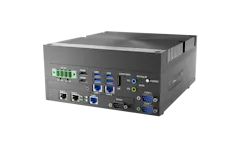
ASRock’s iEP-9040VE is the company’s other value-tier platform that sacrifices some performance for an increase in affordability. The model comes with Intel’s Core Processors (Series 2) with the R680E chipset, UHD graphics, and up to 96 GB of DDR5 RAM. Like the iEPF-9040VS-EW2, the iEP-9040VE also includes a single M.2 Key M slot for additional expansion, along with a pair of SATA3 (6 Gb/s) ports that offer support for RAID 0/1.
Product: iEP-9040VE
Company: ASRock Industrial
Form Factor: Compact industrial Edge AIoT platform / embedded computer system; aluminum heatsink + metal chassis; desk-mount design; 200 × 230 × 93 mm; 6 kg.
CPU: Intel Core Processors, Series 2; LGA1700 socket; Intel R680E chipset.
GPU: Integrated Intel UHD Graphics; DisplayPort 1.4a / DP++ and HDMI 2.0b outputs, each supporting up to 4,096 × 2,160 at 60 Hz.
Memory: Dual-channel DDR5 5,600 MHz; 2x 262-pin DDR5 SO-DIMM slots; up to 96 GB total, 48 GB per DIMM; ECC supported with R680E plus selected CPUs.
Storage: 1x M.2 Key M slot for NVMe SSD, PCIe Gen4 x4, supporting 2242/2260/2280/22110/25110 modules; 2x SATA3 6 Gb/s with RAID 0/1 support; 1x CFast Type II socket shared with SATA3.
Communication: 2x Intel 1-GbE LAN ports: 1x Intel i219LM with vPro support and 1x Intel i210IT; optional PoE, 10BASE-T1S, and OOB function-card support.
Expansion: 1x M.2 Key M for NVMe storage; optional PoE function card, 10BASE-T1S function card, and OOB function card.
Connections: 1x DisplayPort, 2x HDMI 2.0b, 2x RJ45 1-GbE LAN, 4x USB 3.2 Gen2x1, 2x optional internal USB 3.2 Gen2x1, 1x line-in, 1x line-out, 2x RS-232/422/485, 4 DI / 4 DO, 2x SATA3, CFast Type II, 9- to 36-V DC power input, TPM 2.0, and ignition power input with 13-mode condition.
Final Thought
As edge AI continues to advance into manufacturing, industrial automation, and robotics, the need for ruggedized hardware will continue to grow. ASRock’s latest Industrial Robust Edge AIoT platforms have moved to the forefront of the technology with scalable options that can handle everything from GPU-intensive AI inference and machine vision to cost-effective industrial control applications.
By combining Intel’s Bartlett Lake processors with ruggedized designs and industrial I/O, the company has developed its new platforms to meet the increased demand for reliable, real-time edge computing across myriad industries.
About the Author
 Cabe Atwell
Cabe Atwell
Technology Editor, Electronic Design
Cabe is a Technology Editor for Electronic Design.
Engineer, Machinist, Cartoonist, Maker, Writer. A graduate Electrical Engineer actively plying his expertise in the industry and at his company, Gunhead. When not designing/building, he creates a steady torrent of projects and content in the media world. Many of his projects and articles are online at element14 & SolidSmack, industry-focused work at EETimes & EDN, and offbeat articles at Make Magazine. Currently, you can find him hosting webinars and contributing to Electronic Design and Machine Design.
Cabe is an electrical engineer, design consultant and author with 25 years’ experience. His most recent book is “Essential 555 IC: Design, Configure, and Create Clever Circuits”
Cabe writes the Engineering Life & Engineering on Friday blog on Electronic Design.
See Cabe's cartoons & comic strips here.