AI Threat Intelligence on the Edge
What you’ll learn
- What can AI do to prevent network intrusion
- How neuromorphic computing addresses threat detection
Addressing hacks such as zero-day attacks, fileless malware and AI-assisted adversaries is becoming more important as artificial intelligence and machine learning (AI/ML) is brought to bear from the attack side. Using AI/ML to mitigate these kinds of attacks is one way to address these threats.
Nick Barsi-Rhyne, Machine Learning Engineer @ Quantum Ventura, highlights their CyberNeuroRT (Fig. 1) running on Brainchip’s neuromorphic computing platform that uses Spiking Neural Networks (SNN) to handle network threats (watch the video above).
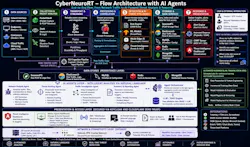
CyberNeuroRT does live network traffic monitoring performing protocol analysis like conventional intrusion detection systems (IDS) but doing more than just pattern matching by employing AI-powered threat detection.
The system employs a mix of detection engines. It uses supervised machine learning as well as statistical anomaly detection and rule-based detection. Temporal correlation models are used too.
Because it not only use signature recognition, it can do things like looking at behavioral deviations, traffic relationships and timing, network context and how the traffic relates to protocol characteristics. Historical observations benefit from AI analysis.
Running this type of analysis on the edge requires AI acceleration. In this case, Brainchip’s Akida cores and system-on-chip (SoC) solutions come into play (watch the video below). You can also listen to our Inside Electronics podcast on Neuromorphic Computing Delivers Low-Power AI.
About the Author
 William G. Wong
William G. Wong
Senior Content Director - Electronic Design and Microwaves & RF
I am Editor of Electronic Design focusing on embedded, software, and systems. As Senior Content Director, I also manage Microwaves & RF and I work with a great team of editors to provide engineers, programmers, developers and technical managers with interesting and useful articles and videos on a regular basis. Check out our free newsletters to see the latest content.
You can send press releases for new products for possible coverage on the website. I am also interested in receiving contributed articles for publishing on our website. Use our template and send to me along with a signed release form.
Check out my blog, AltEmbedded on Electronic Design, as well as his latest articles on this site that are listed below.
You can visit my social media via these links:
- AltEmbedded on Electronic Design
- Bill Wong on Facebook
- @AltEmbedded on Twitter
- Bill Wong on LinkedIn
I earned a Bachelor of Electrical Engineering at the Georgia Institute of Technology and a Masters in Computer Science from Rutgers University. I still do a bit of programming using everything from C and C++ to Rust and Ada/SPARK. I do a bit of PHP programming for Drupal websites. I have posted a few Drupal modules.
I still get a hand on software and electronic hardware. Some of this can be found on our Kit Close-Up video series. You can also see me on many of our TechXchange Talk videos. I am interested in a range of projects from robotics to artificial intelligence.
 Nick Barsi-Rhyne
Nick Barsi-Rhyne
Machine Learning Engineer @ Quantum Ventura
Nick Barsi-Rhyne is a Machine Learning Engineer at Quantum Ventura. He earned a Master of Science Data Science from University of San Francisco and Bachelor of Science in Computer Science from University of California, Santa Cruz.