A Trio of SoCs Deliver GenAI Support
What you’ll learn:
- What’s new in the value Genio 360/P?
- What’s new in the mainstream Genio 420?
- What's new in the premium Genio Pro 5100?
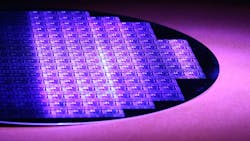
MediaTek’s latest announcement delivers across-the-board improvements for the company’s Genio system-on-chip (SoC) family (Fig. 1). All three incorporate MediaTek’s 8th-generation neural processing unit (NPU) that can support large generative AI (GenAI) models. However, the level of performance scales with the rest of the system, providing a good balance between performance, power, and cost. Long-term supply availability on the order of 10 years allows these to be employed in long-term solutions.
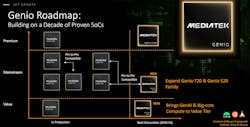
More Value with Genio 360/P
The Genio 360 contains one Cortex-A76 and five Cortex-A55 cores; the 360/P adds an extra of each core (Fig. 2). The pin-compatible chips allow for easy upgrades. The NPU delivers from 6 to 8 TOPS, supporting large language models (LLMs) up to two billion parameters.
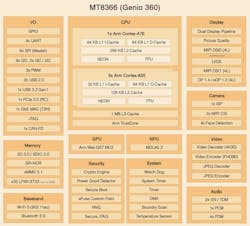
The chips target mobile and embedded devices and can drive dual FHD60 displays or a single 4K60 display. The input side handles a 16-Mpixel image at 30 frames/s. It can also handle six FHD30 streams simultaneously utilizing virtual channels.
Time-sensitive networking (TSN) support is included; the Gigabit Ethernet interface makes the chips useful in industrial as well as robotic applications. CAN-FD is a useful alternative to Ethernet. Support for consumer and industrial temperature ranges helps, too.
Genio 420 Delivers Solid Performance
Genio 420 is built on TSMC’s 6-nm process and kicks up the performance a notch with two Cortex-A78s and six Cortex-A55s (Fig. 3). The NPU delivers up to 7.2 TOPS. The SoC has a 6,400-Mb/s, x32 LPDDR5 interface supporting up to 16 GB of memory.
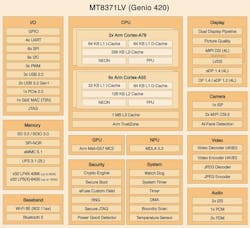
On the display side, the Genio 420 can handle a single ultra-wide UW5K60 display or a pair of 2.5K60 displays. The camera interface is similar to the Genio 360. The chips are also compatible with its older siblings, the Genio 520 and 720.
The Genio 420 also has TSN support, making it a good candidate for industrial and commercial applications, not just consumer apps. It does lack the CAN-FD support found in the Genio 360.
Genio Pro 5100 Targets Premium Platforms
MediaTek takes advantage of TSMC’s 3-nm technology for the high-end Genio Pro 5100 (Fig. 4). It has eight of Arm’s big cores, including one Cortex-A925, three Cortex-X4s, and four Cortex-A720s with a combined performance of 250K DMIPS. The NPU delivers over 50 TOPS of performance.
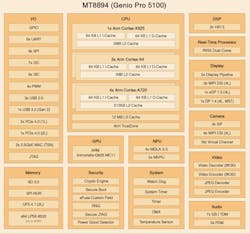
The Genio Pro’s graphics is a major step up. It incorporates a 3.1K-GFLOPS, Arm Immortalis-G925 GPU, which offers support for up to three 4K displays with 8K video encode and decode. On the input side, the chip can handle two 4K30 streams and eight FHD30 streams with up to 16 of the latter using virtual channels.
On the communication side, it has two 2.5 G Ethernet ports with TSN and USB 3.2 Gen 2 support. It has x1 and x2 PCIe Gen 4 interfaces.
All Genio family additions include a security subsystem with secure boot as well as a custom eFuse field. For debugging, it supports secure JTAG. Of course, there’s a hardware random number generator (RNG) and crypto engine.
MediaTek’s software support has also been extended. It works with the Robot Operating System (ROS) framework, which is handy for industrial and robotic applications. Linux support includes Yocto, Debian, and Ubuntu.
Check out more of our 2026 Embedded World coverage
 Embedded World entrance
About the Author
 William G. Wong
William G. Wong
Senior Content Director - Electronic Design and Microwaves & RF
I am Editor of Electronic Design focusing on embedded, software, and systems. As Senior Content Director, I also manage Microwaves & RF and I work with a great team of editors to provide engineers, programmers, developers and technical managers with interesting and useful articles and videos on a regular basis. Check out our free newsletters to see the latest content.
You can send press releases for new products for possible coverage on the website. I am also interested in receiving contributed articles for publishing on our website. Use our template and send to me along with a signed release form.
Check out my blog, AltEmbedded on Electronic Design, as well as his latest articles on this site that are listed below.
You can visit my social media via these links:
- AltEmbedded on Electronic Design
- Bill Wong on Facebook
- @AltEmbedded on Twitter
- Bill Wong on LinkedIn
I earned a Bachelor of Electrical Engineering at the Georgia Institute of Technology and a Masters in Computer Science from Rutgers University. I still do a bit of programming using everything from C and C++ to Rust and Ada/SPARK. I do a bit of PHP programming for Drupal websites. I have posted a few Drupal modules.
I still get a hand on software and electronic hardware. Some of this can be found on our Kit Close-Up video series. You can also see me on many of our TechXchange Talk videos. I am interested in a range of projects from robotics to artificial intelligence.
Comment About the Article
To join the conversation, and become an exclusive member of Electronic Design, create an account today!
 Leaders Logo
Leaders relevant to this article: