Can the U.S. Learn from Energy Solutions Accelerating African Industrialization?
What you'll learn:
- Africa is in the process of adopting sustainable technologies to produce significant portions of the massive amounts of thermal energy needed to power its growing industrial base.
- A recent article from the Rocky Mountain Institute describes how the use of electrification, clean energy, and alternate fuels are frequently less expensive and significantly more sustainable than the fossil-based process favored by most western industries.
- The report provides several practical examples of how these technologies are being used today or becoming readied for commercial deployment.
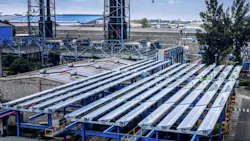
Africa is in the process of adopting sustainable technologies to produce significant portions of the massive amounts of thermal energy needed to power its growing industrial base. A recent article from the Rocky Mountain Institute (RMI) describes some of the findings of a recent in-depth report about how the use of electrification, clean energy, and alternate fuels actually carry much lower long-term costs while being significantly more sustainable than the fossil-based process favored by most western industries.
Could American entrepreneurs profit by borrowing a chapter from Africa’s playbook as our nation works to rebuild its own industrial base?
According to the Institute’s article, titled “The Opportunity for Renewable Thermal Technologies in Africa,” the continent’s manufacturers base is experiencing a surge in demand for industrial heat, which is used to perform tasks like simmering tomatoes into paste, setting dyes in fabric, calcinating limestone into cement, and forging iron and carbon into steel. If the projected rise in living standards and growing market for domestically produced commodities continues as expected, the continent’s demand could grow by up to 700% by 2050 (Fig. 1).
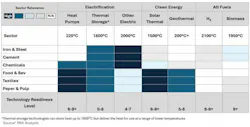
Leaders in industry and government are quickly realizing that, in addition to environmental considerations, relying on fossil fuels to deliver this energy will be expensive and put them at the mercy of geopolitical price pressures beyond their control. That’s why there’s growing interest in RMI’s earlier work, which has demonstrated that clean industrial heat (thermal energy from renewable or zero-emission sources) is becoming increasingly cost-competitive and can be tailored to local energy conditions.
In the introduction, the report’s authors explain:
“It can be delivered via electrified systems such as heat pumps and thermal batteries or come directly from solar and geothermal. Exhibit 2 matches these categories of clean industrial heat technologies with the heat grades required by various sectors. These technologies largely reduce operating costs and exhibit better efficiency (95%-500%+) compared to fossil boilers and furnaces (75%-85%). They can also be co-located with cheap renewable energy production, avoid the price volatility of imported energy, and enable faster permitting and siting in cases where traditional combustion fuels would pose pollution concerns.”
Areas for Innovation
In addition to breaking down thermal energy demands by industry, intensity level, and geo-economic sectors, the report identifies “Areas for Innovation,” i.e., renewable thermal technologies that can be utilized alone or in combination with one another to meet rising heat demands (Fig. 2).
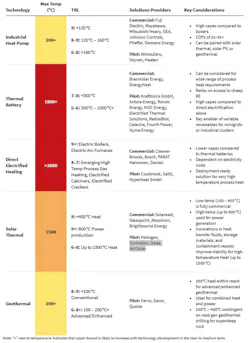
The analysis explores multiple processes commonly used within a single factory that often require heat at different pressures and temperatures. The authors focus on technologies they believe to be the best fits for Africa today: heat pumps, thermal batteries, direct electrification, and solar thermal. They also note that alternative combustion fuels such as hydrogen and biomass could also play a role in the African energy infrastructure, if they can overcome the technical and logistical issues that make them harder to deploy.
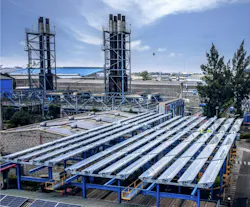
The report provides several practical examples of how these technologies are being used today or getting readied for commercial deployment. Among them is a 230-W concentrating solar thermal installation that’s being used to pre-heat the working fluid to near-boiling at a peaker power plant in Nairobi, Kenya (Fig. 3).
This look at how African economies are meeting the challenges of industrialization with clean-cost-effective solutions would be an interesting read for anyone involved in power technologies. However, it may be especially valuable for tech entrepreneurs involved in sustainable ventures.
Many of the technologies described in the report represent significant opportunities for commercial applications that could be used to improve the efficiency of North American manufacturing and energy production facilities, while helping wean our economy off its dependence on fossil fuels.
About the Author
 Lee Goldberg
Contributing Editor
Lee is the author of the popular PowerBites series.
Lee Goldberg is a self-identified “Recovering Engineer,” Maker/Hacker, Green-Tech Maven, Aviator, Gadfly, and Geek Dad. He spent the first 18 years of his career helping design microprocessors, embedded systems, renewable energy applications, and the occasional interplanetary spacecraft. After trading his ‘scope and soldering iron for a keyboard and a second career as a tech journalist, he’s spent the next two decades at several print and online engineering publications.
Lee’s current focus is power electronics, especially the technologies involved with energy efficiency, energy management, and renewable energy. This dovetails with his coverage of sustainable technologies and various environmental and social issues within the engineering community that he began in 1996. Lee also covers 3D printers, open-source hardware, and other Maker/Hacker technologies.
Lee holds a BSEE in Electrical Engineering from Thomas Edison College, and participated in a colloquium on technology, society, and the environment at Goddard College’s Institute for Social Ecology. His book, “Green Electronics/Green Bottom Line - A Commonsense Guide To Environmentally Responsible Engineering and Management,” was published by Newnes Press.
Lee, his wife Catherine, and his daughter Anwyn currently reside in the outskirts of Princeton N.J., where they masquerade as a typical suburban family.
Comment About the Article
To join the conversation, and become an exclusive member of Electronic Design, create an account today!
 Leaders Logo
Leaders relevant to this article: