11 Myths About VITA 100
What you’ll learn:
- What is VITA 100?
- What is OpenVPX?
- How does this relate to the Modular Open Systems Approach (MOSA)?
VITA 100 is an exciting, next-generation architecture built on OpenVPX that continues advancing the performance of embedded computing solutions. It will potentially provide speeds up to 400 GbE across the backplane. Because the technology is much higher speed, it will utilize a new connector, requiring a new architecture. It should be noted that VITA 100 is still in the Draft stage at this point.
It’s early days for VITA 100 and many myths are spinning around the architecture:
1. VITA 100 will replace OpenVPX.
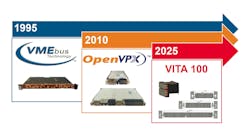
Not true. VITA 100 will likely be used in conjunction with OpenVPX portions of a backplane/system in many applications — a huge installed base of the OpenVPX solutions is out there. OpenVPX has more than enough capability for most applications and will likely be around in another 30 years. To this day, Pixus still does a new project about every year for customers utilizing the VME architecture…and the specification is over 50 years old!
2. The performance difference between OpenVPX and VITA 100 will be minimal.
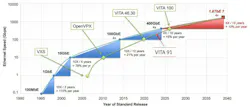
This isn’t a hybrid or short-term technology. VITA 100 offers speeds up to 8X the bandwidth of OpenVPX, which is significant. Figure 1 shows a performance chart.
3. The architecture won’t be ready for at least 3 to 5 years.
They’re hoping to complete the specification this year, but that may be aggressive. Regardless, prototype systems will likely start to emerge in 2027.
4. The new VITA 100 standard is backwards compatible to OpenVPX.
With a new connector interface, there won’t be backwards compatibility. But, as mentioned, it seems hybrid systems with an OpenVPX segment and a VITA 100 will arise.
5. VITA 100 is a completely new design standard.
While VITA 100 has a new connector that facilitates the leap in potential bandwidth, it leverages a great deal of VITA specs. The pinouts are different, but many of the lessons and root concepts of VITA 65, mechanicals and cooling approaches of VITA 48, and the RF/optical of VITA 66/67 will be leveraged.
6. The slot profiles for VITA 100 are the same as the ones in VITA 65.
While VITA 100 will leverage much of VITA 65 and SOSA-aligned slot profiles, they will take the lessons learned from the existing pinouts while maximizing the high pin density of the new connectors.
7. Designs as fast as VITA 100 can’t be cooled.
Though we will likely not see enclosures with just natural convection for the conduction-cooled modules, many applications will still be able to utilize the airflow over conductive-fins. Not every module in a system has power-hungry processors. For hotter systems, it’s likely that Air Flow Through (AFT - VITA 48.5 and others), Liquid Flow Through (LFT – VITA 48.4), and liquid through a chassis’ sidewalls will become more common.
8. VITA 100 will only use the same 3U and 6U form factors as OpenVPX.
VITA 100 will use the 3U and 6U form factors, but many of the new heavy-duty processors for AI and quantum computing will need to be larger than 3U. Going to 6U is an option and it will be necessary in some systems. However, 6U is just too much space for many applications, so a new 4U-size module will be introduced as a third option. Some modular enclosures already exist to support this size.
9. VITA 100 will harm the SOSA efforts.
Actually, many members of the SOSA Consortium are strongly interested in VITA 100 and are working with joint VITA members to suggest definitions of slot profiles for the specification. The SOSA Consortium members continue to also influence OpenVPX, VNX+, SpaceVPX, and other VITA standards.
10. Prototyping for VITA 100 without customization and long lead times will be impossible.
Power and ground backplanes can always be utilized to allow boards to be powered up and tested. Their lead time is short. There are also discussions of rear (RTM) connectors that open up the possibilities for pulling out I/O and potentially allowing cabled slot-to-slot connections if cabling solutions are developed by an industry vendor.
11. There aren’t any stepping-stones to the VITA 100 technology.
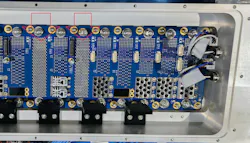
As we have mentioned, many VITA standards such as VITA 65/66/67 and VITA 48 have been leveraged for VITA 100. One we haven’t discussed is VITA 91. That architecture, which is compatible with OpenVPX, is used today for theoretical bandwidth of 200 GbE. The connector scheme of VITA 91 uses a similar double density connector approach as VITA 100. In both bandwidth and density, it’s truly a stepping stone to the next-generation technology (Fig. 2).
>>Check out this TechXchange for similarly related content
 image
About the Author
 Justin Moll
Vice President of Sales & Marketing, Pixus Technologies
Justin Moll is the Vice President of Sales & Marketing for Pixus Technologies and has been with the company since 2012. He’s active in trade associations such as VITA and PICMG and served as the Vice President of Marketing for PICMG. Justin has been a keynote speaker and featured commentator at multiple embedded computing industry events.
Related



Comment About the Article
To join the conversation, and become an exclusive member of Electronic Design, create an account today!
 Leaders Logo
Leaders relevant to this article: