Raspberry Pi on the Big Stage
What you'll learn:
- How Raspberry Pi systems can drive distributed video displays and digital signage at large events.
- How Raspberry Pis enable interactive sculptures, giant instruments, and music-reactive LED installations.
- Why networked, low-cost Raspberry Pi hardware works well as media players and controllers in larger productions.
People pour into major events like concerts and festivals not really considering what’s behind the stage. We marvel in the spectacle, but we should about the technology behind it, too. Synchronized lighting, giant displays, and other visual effects can easily transform an event.
All of the computers that make that magic happen are hidden, of course. Once powered by expensive and custom systems, Raspberry Pi devices have even found their way into large-scale events. They take care of interactions and the effects, on the cheap, without sacrificing the wonder.
Although we know Raspberry Pi for smaller and hobbyist projects, it’s very useful for larger applications. From gigantic LED sculptures and interactive exhibits to displays at public events, these computers work to produce surprising experiences for visitors.
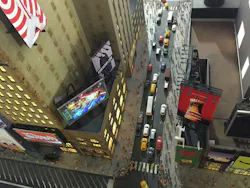
Raspberry Pi hardware isn’t used just to power something massive to give us that large-scale experience. It can also put something smaller in a larger setting.
At Gulliver’s Gate, 23 Raspberry Pi Zeroes powered digital billboards that are part of a 1:87-scale version of Times Square. Each Pi Zero connected to 7- and 10-in. displays set up inside one of the model buildings. These screens played advertisements, making the mini-Times Square look like it featured the same movement and animated character as its full-sized counterpart.
Raspbian OS and Adafruit’s Raspberry Pi Video Looper software ran on the Pi Zeroes to display the ads. Meanwhile, all of the Pis are plugged into a 24-port Ethernet switch underneath the platform. The project creator simplified the configuration for all 23 computers by writing scripts that automatically assigned static IP addresses and changed each Pi’s host name. Custom mounting hardware and cable mounting were essential for the project so that all of the hardware could fit inside the buildings.
14-Foot Head
14-foot head is just that, a head-shaped display.
The Pi can even control giant interactive displays, like the As We Are, a 14-foot head at the Greater Convention Center in Columbus, Ohio. Custom Sansi LED modules with 850,000 individual LEDs cover the tall sculpture, displaying extremely detailed images. It was envisioned by artist Matthew Mohr and made real by fabricator Mac Pierce.
People visiting go inside the sculpture. A wall with 32 Raspberry Pis and camera modules will capture their faces. Custom facial-recognition software 3D-scans their face before it flattens the final image. It then maps that image across the LEDs outside the head. Visitors can view the person’s face across the display. Each Pi remains hidden in the sculpture as they work together to handle the cameras, image processing, and display system.
12-Foot Guitar
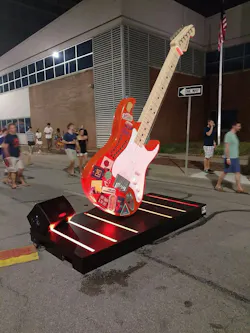
Huge instruments have also used the Raspberry Pi. In Kansas City, at a two-day music, food, and beer festival, design firm Dimensional Innovations built a 12-foot-tall electric guitar that was placed at the entrance. Attendees of the festival could play the 500-lb. instrument. Conductive wires were the strings. If someone touched them, a Bare Conductive Touch Board detected it. That information was sent to a Raspberry Pi, which chose and played an audio sample corresponding to that interaction.
Visitors pressed arcade buttons that connected to the Pi’s GPIO pins. These enabled them to play around with different chords and try sound modes. Audio was sent via HDMI through an adapter before being sent to a powered stage monitor. The Pi didn’t really do much of the flashy stuff on its own. Rather, it acted like a computer that made an interactive prop behave like an instrument.
Mariposa - L'Apres Midi d'une Faun at Burning Man 2023
Mariposa, like a creature out of a giant monster movie. It spread its wings at Buning Man 2023.
Raspberry Pi hardware was also used at a Burning Man festival in 2023. Christopher Schardt brought over Mariposa, a large butterfly sculpture with 39,000 LEDs capable of displaying patterns and images whenever music played. The installation was placed 15 feet above the ground. It included a swinging bench beneath the structure so that visitors could lie down and watch it illuminate. Raspberry Pi-based controllers handled the lighting sequences.
An iPad control system sent instructions to the Raspberry Pi, which then turned them into patterns that were shown on the LEDs. When visitors looked up, they saw a glowing butterfly that floated at the festival while the Pis remained hidden.
Video Festival
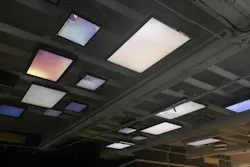
Even a video festival featuring large displays took advantage of Raspberry Pis. In 2023, Melbourne’s Overshare Video Festival had 40 repurposed screens hanging from the ceiling. All of them used a Raspberry Pi 3 Model A+ functioning as the media player. Across the installation, the festival as a whole had over 50 screens. Raspberry Pi systems were responsible for driving projectors and digital signage. They also powered an external large-format LED wall.
The video content stole the show rather than the computers themselves. Every connected Pi made it possible to play the on-screen material without a PC beside each display. This is a practical setup, especially where hardware is spread out throughout a venue. Projects like these show us that the Pi needn’t control the whole show. Instead, they work best together as cheap media players as part of a larger production.
Pis in a Wall
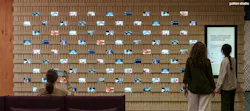
Google’s Toronto Event Space features the Yellow Brick Wall. This digital artwork installation has 85 mini displays integrated within the wall, consisting of handmade bricks. Visitors can use the integrated touchscreen to pick out content, like Canada’s art, culture, and geography.
Behind each display? 85 Raspberry Pis and OLED screens placed within a ventilated 3D-printed housing. Pis rely on Patten Studio firmware written in C++ to communicate with SOSO’s graphics software that controls what’s shown on the wall. This turns into a large interactive artwork with tiny computers operating as a distributed display system.
Changing Music into Light
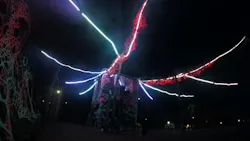
Raspberry Pi has also turned music into light at a music festival. Called Medooze, this project had real-time music analysis generate visual effects. Software processed the DJ mixer audio, analyzed its characteristics, and turned that data into visual patterns.
A Raspberry Pi received that information from a network. The Pi then controlled 12 LED strips covering 60 meters above the dance floor. The lighting changed in response to the music. Although hidden within the infrastructure, this setup meant that the Pi was one part of a larger system.
Final Thought
Every version of the Raspberry Pi has potential to create some amazing effects. These show the potential of taking over Time Square to off-the-grid at Burning Man still making a spectacle. I’ve used several Raspberry Pi models to create some impressive Halloween effects, take a look at this roundup. The first two are powered by a Pi. What other cheap system makes it easy to control a screen and a set of air pistons at the same time?
>>Check out this TechXchange for similar content

About the Author
 Cabe Atwell
Cabe Atwell
Technology Editor, Electronic Design
Cabe is a Technology Editor for Electronic Design.
Engineer, Machinist, Cartoonist, Maker, Writer. A graduate Electrical Engineer actively plying his expertise in the industry and at his company, Gunhead. When not designing/building, he creates a steady torrent of projects and content in the media world. Many of his projects and articles are online at element14 & SolidSmack, industry-focused work at EETimes & EDN, and offbeat articles at Make Magazine. Currently, you can find him hosting webinars and contributing to Electronic Design and Machine Design.
Cabe is an electrical engineer, design consultant and author with 25 years’ experience. His most recent book is “Essential 555 IC: Design, Configure, and Create Clever Circuits”
Cabe writes the Engineering Life & Engineering on Friday blog on Electronic Design.
See Cabe's cartoons & comic strips here.