Raspberry Pi Now Comes in a Reliable Industrial Edge Controller
What you'll learn:
- Why Pi-based prototypes can fall apart in industrial environments, and how the BB-400 fixes every weak point.
- How onboard UPS, dual-power inputs, deterministic I/O, and industrial-grade networking change reliability at the edge.
- Where Brainboxes switches and embedded networking fit into robotics, automation cells, and space-constrained systems.
Edge controllers have evolved over the last few years to become one of the most important components in modern factory automation. They sit between traditional industrial controllers (PLCs, PACs, CNC systems, motion controllers) and higher-level cloud/IT infrastructure, acting as real-time processing hubs that enable manufacturers to automate faster without relying on centralized servers.
Going that route puts real-time decision-making at the machine level rather than in the cloud, and it doesn’t require an internet or Wi-Fi connection to communicate with other devices and machinery.
Brainboxes saw that transformation firsthand and designed the BB-400 Industrial Edge Controller (Fig. 1). It’s a Raspberry Pi core, wrapped in hard engineering, industrial I/O, and backup power that doesn’t panic when someone pulls the plug. The controller made its debut at IBM’s TechXchange 2025, where Brainboxes’ Managing Director, Lou Walsh, was on hand to detail what the BB-400 had to offer.
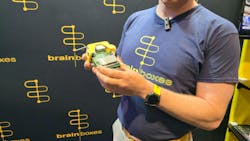
The device is designed around a Raspberry Pi Compute Module, with an industrial heatsink solution built specifically for that module. Airflow patterns and thermal stack-ups were tested in different deployment environments. For instance, when you mount electronics next to conveyors, motor drives, and cabinets with no ventilation, aluminum plates heat up quickly.
Another problem Brainboxes solved was power. On a plant floor, power can be disrupted for a variety of reasons. Someone unplugs the wrong line, maintenance isolates a cabinet, or the system browns out just long enough to corrupt storage.
“So we've taken the PI, and we've industrialized it. There are a number of ways we've done that,” said Walsh. “One is to accommodate for heat because industrial environments can get very hot. The other way we have overcome issues in the industrial environment is by adding a UPS power supply. So if somebody pulls the power on the device, it will keep running by itself, and if the power comes back, it will just carry on as if nothing's happened.”
Industrial I/O without the Adapter Board Sideshow
One of the bigger challenges of Pi-based industrial installations is linking into the real world. Brainboxes didn’t just bolt a Pi into a box; it rebuilt the connective tissue. The BB-400 includes isolated digital I/O, RS-232/422/485 serial support, integrated Wi-Fi and Bluetooth, dual Ethernet ports, USB expansion, and a real-time clock.
>>Check out more of our Sensors Converge coverage, and the TechXchange for similarly themed articles and videos
 promo_id_63615675__nils_ackermann__dreamstime
That hardware mix matters, as the RS-485 still drives CNC controllers, environmental meters, servo amplifiers, and older PLC networks. The dual Ethernet ports allow the device to drive segment networks, act as an inline boundary between legacy hardware and the wider plant network, or even isolate unsecure devices. Walsh called it “a bit of a Swiss Army knife,” as the platform can function as a gateway, firewall, visualization node, automation controller, or bridge between cloud analytics and plant-level equipment.
Unlike typical Pi designs relying on userspace libraries to wiggle GPIO pins, Brainboxes integrated an onboard Arduino specifically for deterministic I/O control. Therefore, timing doesn’t get lost when a Linux thread wakes up late, and edge logic behaves like industrial edge logic.
An Edge Box Built for How Plants are Run
The BB-400 does what’s required by most engineers. It talks to equipment, interprets what machines are doing, pushes data upstream, and can act directly when something needs to happen.
Brainboxes spelled out the core intention: It’s a device that sits on a factory floor, “talks to industrial equipment, and does something with the data.” That “something” might be buffering metrics locally, visualizing factory conditions at shift-change stations, pulling data off legacy drives and pushing it into SCADA dashboards, or running analytics locally.
Because the software base remains Pi-compatible, developers inherit the vast toolchain, including Node-RED flows, Python automation stacks, MQTT brokers, data dashboards, fleet management agents, security modules, and more. You don’t rewrite infrastructure to adopt the BB-400; you drop your existing stack onto hardware that won’t melt the first time someone turns on a welding rig nearby.
Switches Designed for Harsh Environments
While the BB-400 is the hero product, Brainboxes also builds the networking layer around it, including industrial-grade switches (Fig. 2) that show up in places most consumer networking gear never survives.
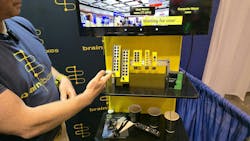
The five-port unmanaged switch isn’t just a clever platform; it’s actively used on competitive robots, including FIRST Robotics systems. That means shock, bouncing battery rails, cables being ripped in and out, and still-running connectivity. In parallel, the company’s broader switch portfolio includes Gigabit variants, PoE, fiber options, low- and high-port builds, and embedded versions for various chassis.
The embeddable switch variant is worth highlighting. If you’re designing an unmanned underwater vehicle or small aerial platform, you don’t have the luxury of full-size DIN infrastructure. Brainboxes engineered a switch for small, power-constrained systems, including UAVs, subsea vehicles, and inspection crawlers.
From Prototype-Class Pi to Production-Class Edge System
If engineers ever deployed a proof-of-concept Pi-based controller and wished someone had built a version actually designed for plant environments, this is that version. The BB-400 removes improvisation. No USB serial dongles taped to a panel wall, no unprotected power adapters dangling inside an electrical cabinet, no improvised heatsinks. Instead, they get redundant power, an onboard UPS, industrial-grade I/O, a deterministic control substrate, and thermal protection.
The result is a product positioned squarely between traditional industrial IPC systems and modern open-source development environments. It’s fast to develop on, easy to modify, and rugged enough to hand off to a maintenance supervisor without fear of a disaster.
Many companies have tried edge control by forcing Pi hardware into industrial roles. Brainboxes engineered the reverse — industrial hardware that happens to use Pi at the core. And in an industry where “just prototype it” has a way of becoming permanent infrastructure, that inversion is long overdue.
>>Check out more of our Sensors Converge coverage, and the TechXchange for similarly themed articles and videos
promo_id_63615675__nils_ackermann__dreamstimeAbout the Author
 Cabe Atwell
Cabe Atwell
Technology Editor, Electronic Design
Cabe is a Technology Editor for Electronic Design.
Engineer, Machinist, Cartoonist, Maker, Writer. A graduate Electrical Engineer actively plying his expertise in the industry and at his company, Gunhead. When not designing/building, he creates a steady torrent of projects and content in the media world. Many of his projects and articles are online at element14 & SolidSmack, industry-focused work at EETimes & EDN, and offbeat articles at Make Magazine. Currently, you can find him hosting webinars and contributing to Electronic Design and Machine Design.
Cabe is an electrical engineer, design consultant and author with 25 years’ experience. His most recent book is “Essential 555 IC: Design, Configure, and Create Clever Circuits”
Cabe writes the Engineering Life & Engineering on Friday blog on Electronic Design.
See Cabe's cartoons & comic strips here.
 William G. Wong
William G. Wong
Senior Content Director - Electronic Design and Microwaves & RF
I am Editor of Electronic Design focusing on embedded, software, and systems. As Senior Content Director, I also manage Microwaves & RF and I work with a great team of editors to provide engineers, programmers, developers and technical managers with interesting and useful articles and videos on a regular basis. Check out our free newsletters to see the latest content.
You can send press releases for new products for possible coverage on the website. I am also interested in receiving contributed articles for publishing on our website. Use our template and send to me along with a signed release form.
Check out my blog, AltEmbedded on Electronic Design, as well as his latest articles on this site that are listed below.
You can visit my social media via these links:
- AltEmbedded on Electronic Design
- Bill Wong on Facebook
- @AltEmbedded on Twitter
- Bill Wong on LinkedIn
I earned a Bachelor of Electrical Engineering at the Georgia Institute of Technology and a Masters in Computer Science from Rutgers University. I still do a bit of programming using everything from C and C++ to Rust and Ada/SPARK. I do a bit of PHP programming for Drupal websites. I have posted a few Drupal modules.
I still get a hand on software and electronic hardware. Some of this can be found on our Kit Close-Up video series. You can also see me on many of our TechXchange Talk videos. I am interested in a range of projects from robotics to artificial intelligence.