This New Lithium Cell Tech May Put SpaceX Out of Business
What you’ll learn:
- Amprius announced a 500-Wh/kg battery cell technology that enables low mass energy storage for 24/7 operation of solar-powered aircraft in the stratosphere, freeing up mass for increased payload functionality and scope.
- Persistent communications aircraft platforms (HAPS) operating in the stratosphere at slow airspeeds can facilitate low-latency communications links that have exclusively been in the domain of expensive, expendable, astronomer-frustrating, methane-powered, rocket-launched, LEO satellite technology from companies such as SpaceX and Amazon LEO (Project Kuiper).
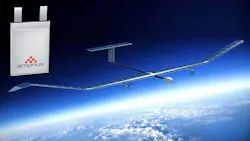
Amprius Technologies Inc. (NYSE: AMPX) introduced its second-generation SiCore battery platform. The silicon-anode lithium-ion cell is rated at 500 Wh/kg for uncrewed electric aviation systems (UAS) and other applications where battery mass directly limits mission endurance.
According to the company, the SiCore 500 cell achieves that specific-energy figure at a continuous 1C discharge rate and, crucially, can be built using conventional lithium-ion manufacturing equipment. Commercial availability is expected in the fourth quarter of 2026.
Reaching 500 Wh/kg is a notable performance milestone, particularly for high-altitude platform stations (HAPS), fixed-wing drones, and other aircraft designed to remain aloft for days or months. But the more important claim may be manufacturability: Amprius previously demonstrated cells at or above that energy density, though those products relied on specialized processes and did not reach commercial-scale production.
The newer SiCore platform is intended to change that equation. Instead of requiring purpose-built manufacturing lines or unusual cell constructions, the company said its second-generation product is compatible with established lithium-ion processes, equipment, and form factors. That approach potentially lets Amprius use its existing contract-manufacturing partners to ramp volume production while avoiding the capital burden of building new dedicated factories.
Silicon Supplement
Amprius’ method replaces or substantially supplements the graphite normally used in a lithium-ion battery’s anode with silicon. Silicon can store far more lithium per unit mass than graphite during charging. Its theoretical gravimetric capacity is roughly 3,600 mA/g versus 372 mA/g for graphite. That doesn’t translate directly into a nearly tenfold improvement at the cell level because cathode materials, electrolyte, current collectors, packaging, and inactive components all contribute mass to a cell.
Notwithstanding the pesky real-world realities of battery-cell construction, a higher-capacity anode can reduce the amount of anode material needed for a given energy target. It also allows more of the cell’s total mass and volume to support energy storage.
The engineering challenge is that silicon expands substantially as it alloys with lithium during charging — somewhere around 300%. Repeated expansion and contraction can fracture the anode, disrupt electrical paths, and will continually rebuild the solid-electrolyte interphase, consuming lithium and degrading capacity.
Therefore, silicon-anode battery developers must manage particle and electrode design, coatings, binders, electrolyte chemistry, and manufacturing processes to preserve cycle life and safety while extracting the inherent energy-density benefit.
For long-endurance aircraft, the tradeoff is straightforward: Every kilogram removed from the energy-storage system can be reassigned most critically to payload, but also to propulsion margin or for providing additional energy. At altitude, where solar-powered loitering aircraft must store enough electricity during daylight to fly through the night, gains in specific energy can have an outsized effect on endurance and in the amount and type of communications payload that’s able to be carried.
New Cell Likely Bound for HAPS and Fixed-Wing Uncrewed Aircraft
Amprius designed the 500-Wh/kg cell around sustained, lower-rate, discharge conditions rather than for high-power bursts. That makes it a closer fit for HAPS and fixed-wing uncrewed aircraft than for applications that prioritize the rapid acceleration or high peak current as was needed for the recent DARPA Lift Challenge.
The company already supplies batteries for AALTO’s Zephyr HAPS program, a solar-electric aircraft platform developed by Airbus SE (Euronext Paris: AIR) subsidiary AALTO. Zephyr reported a flight endurance record exceeding 67 days a bit over a year ago, only limited by battery-charge cycle life.
Such sustainable, clean, and self-sufficient, solar-powered, high-altitude aircraft platforms are being positioned for missions including persistent communications coverage. It’s a significant market that SpaceX (NASDAQ: SPCX) is trying to address with expendable, incinerate-it-all-in-the-corporate-atmospheric-toilet, LEO Starlink satellites and tens of thousands of methane-guzzling and CO2-spewing Starship rocket launches per year, as well as for Earth observation. Amazon.com Inc. (NASDAQ: AMZN) has similar ambitions and strategies for LEO satellites as SpaceX, though at a much smaller scale.
Initial SiCore 500 production is planned for Amprius’s Fremont, Ca., facility. The cells will be offered in customer-specific packages as well as the standard small-UAS pouch-cell form factor defined by SAE JA1016 (see figure).

Higher-volume production is expected to move through the company’s global contract-manufacturing network by year-end 2026.
To comprehend the very significant impact of this 500-Wh/kg battery cell technology announcement, understanding its key application and market size is crucial. So, here's the highly impactful core application for the Amprius 500 cells that reduces humanity's communications carbon footprint and that could threaten SpaceX's LEO satellite Starlink business:
The solar-powered aircraft flying high in the atmosphere. (BBC News)
It could subsequently lead to a certain former trillionaire's bank loans getting called in if his stock market equities collateral becomes completely worthless.
Andy's Nonlinearities blog arrives the first and third Monday Tuesday of every month. To make sure you don't miss the latest edition, new articles, or breaking news coverage, please subscribe to our Electronic Design Today newsletter. Please also subscribe to Andy’s Automotive Electronics bi-weekly newsletter.
>>Download the PDF of this article
 promo
promoAbout the Author
 Andy Turudic
Andy Turudic
Technology Editor, Electronic Design
Andy Turudic is a Technology Editor for Electronic Design Magazine, primarily covering Analog and Mixed-Signal circuits and devices and also is Editor of ED's bi-weekly Automotive Electronics newsletter.
He holds a Bachelor's in EE from the University of Windsor (Ontario Canada) and has been involved in electronics, semiconductors, and gearhead stuff, for a bit over a half century. Andy also enjoys teaching his engineerlings at Portland Community College as a part-time professor in their EET program.
"AndyT" brings his multidisciplinary engineering experience from companies that include National Semiconductor (now Texas Instruments), Altera (Intel), Agere, Zarlink, TriQuint,(now Qorvo), SW Bell (managing a research team at Bellcore, Bell Labs and Rockwell Science Center), Bell-Northern Research, and Northern Telecom.
After hours, when he's not working on the latest invention to add to his portfolio of 16 issued US patents, or on his DARPA Challenge drone entry, he's lending advice and experience to the electric vehicle conversion community from his mountain lair in the Pacific Northwet[sic].
AndyT's engineering blog, "Nonlinearities," publishes the 1st and 3rd Tuesday of each month. Andy's OpEd may appear at other times, with fair warning given by the Vu meter pic. His cartoon series, "Inventors", appears each week in Electronic Design Weekly.
Comment About the Article
To join the conversation, and become an exclusive member of Electronic Design, create an account today!
 Leaders Logo
Leaders relevant to this article: