Electric Aircraft Just Outperformed Fossil Fuels and Nobody Noticed
What you’ll learn:
- DARPA’s Lift Challenge attracted innovation from all corners of the planet, orchestrating an effort to increase efficiency in air transport logistics.
- Analyzing the attributes of the three winning corporations and their sUAS designs.

"I, for one, ...am looking forward to seeing >450 Wh/kg fall out of the current [battery cell chemistry] efforts that are planned to go to production. This energy-density threshold (400 Wh/kg is close enough for me) cracks aviation open." -Andy Turudic, Electronic Design, May 19, 2025
When I wrote that, I was aware of, and listed, some of the imminent battery technologies in the next few years, with sampling and pilot lines that started late last year.
During the early days of my design studies for the DARPA Lift Challenge, I called a few of the companies involved in some of the higher-energy-density battery-cell technologies, such as silicon anode. This was to at least pace the energy source mass that other competitors, like the Lock-Martins and others in aerospace, which actually had procurement budgets, would access and use. I discovered that I could reserve battery cells meeting the 400- to 450-Wh/kg threshold for aviation use, and that they could be delivered just in time to build a contender for the Lift Challenge competition.
The price of those pilot-line cells, however, blew my budget. In retrospect, it would have tripled my spend and, on an editor's salary, I made the painful decision to stick with cells that I could afford and had zero lead time.
DARPA's Lift Challenge did indeed have contestants that used these new, high energy density, battery technologies, with battery-powered sUAS (small unmanned aircraft systems — air vehicles weighing less than 55 pounds) earning first, second, and fifth place. Helicopters using Jakadofsky's advanced "Evolution" turbine engine took third and fourth place.
All machines failed mechanically/structurally during their attempts to cross over a 4:1 payload weight to unladen aircraft weight ratio ("Lambda"), with fifth place seeming to run out of energy. My design, with conventional cell chemistry, had a Lambda >6 on paper, The good thing now is I don't need to worry over the taxes I'd need to pay on a $2.5M windfall.
Everyone in media has focused on Lambda, on crashes, and on the wacky approaches to solving The Challenge in terms of lift and propulsion. So, I'll stick my neck out and be the first on the planet to state that DARPA has inadvertently stumbled into something substantially more significant than Lambda increases: We have now hit the inflection point in aviation powering because of battery-cell chemistry. Pure, electric propulsion has officially kicked liquid fuel's a$$ in a grueling mission profile of heavy lift and VTOL ops.
"With the electric propulsion inflection point for aviation revealed exclusively here at Electronic Design, and given DARPA has half of that 1st, 2nd, and 3rd, prize money left over, I say it's time for a DARPA Electric Lift Challenge in 2027, with no fuels allowed as onboard energy sources and double the course legs to 2200ft. Make it Lambda >5 to collect the full prize money to push the helis' tech harder and do Dayton in September to ease up a bit on the toll on both machines and humans**" —Andy Turudic, Technology Editor, Electronic Design
No, Lee, not even the kinds of advanced hybrid aircraft you wrote about recently would qualify to enter this next one. No half-measures, no market "stop-gaps," no Rex. Mass is everything in aviation and the Lift Challenge took its minimization to an extreme.
A Recap of The Darpa Lift Challenge
DARPA held its Lift Challenge on August 3-9, 2026, in Dayton, Ohio, where sUAS competed for $6.5M in total prizes. Of that amount, $2.5M would be awarded to the craft demonstrating the highest payload weight to unladen aircraft weight ratio ("Lambda") while navigating a grueling five-nautical-mile closed course that included four VTOL (vertical take-off and landing) segments to the 250-foot AGL operations nominal altitude. Second- and third-place Lambdas also received cash awards, as well as one of the trophies (Fig. 1).

More details on The Challenge's course in our pre-event coverage, here on Electronic Design, includes a revision of that nominal 250-ft. altitude to 150 feet after we published our article and were contacted by DARPA with the rule revision that halved the needed VTOL energy (someone likely whined that they couldn't do it).
" If we can be four times more efficient, maybe it can be four times less to transport something, to move cargo, to move people." —Phillip "Donna" Smith, Program Manager, DARPA Lift Challenge
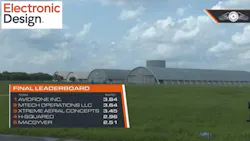
The target Lambda for a full prize payout was >4.0, with the money halved if the target wasn’t achieved. So, here are the final standings in the 2026 DARPA Lift Challenge (see? I'm already Y2K-proofing lift challenge dates), with none of the prize winners achieving 4.0 (Fig. 2).
Imported Designs
One of the goals of the DARPA Lift Challenge was to promote and advance American technology:
"But it's not just a prize competition — it's a catalyst for long-term growth and innovation across the American drone industry." —DARPA
For this aspect, DARPA gets graded a D- by this adjunct professor. Why? The top four Lambdas were attained by running the full challenge course, as well as The Most Promising Technology (MPT) prize winner, were from teams whose principals (in terms of the airframe technology) appear not to be domiciled in the USA, and I doubt they'll be setting up drone factories in the USA:
- Avidrone is a team from a Canadian company in the Waterloo, Ontario area that appears to have been fed cash in the past by the Canadian Government “to scale up, hire more people, and export Canadian innovation around the globe.” Their motor and ESC allegedly constitute a bespoke Chinese design specific to the challenge. Avidrone Inc. is a Delaware corporation that was formed after the December 2025 Lift Challenge announcement and has a physical address shared by several other corporations in Columbia, Maryland.
- MTech claims to be affiliated with MIT, but its principals, who hold drone speed records, and who collected the ceremonial check for second prize, are based in Cape Town, South Africa. The bespoke motor and battery designs for MTech’s drone were allegedly done by the South African team. The company is based in Massachusetts.
- Xtreme Aerial Concepts claims to be based in San Jose, but its 22-hp jet fuel turbine is the product of Peter Jakadofsky’s company in Austria, as is the design and fabrication of the critical 5:1 gearbox trains that take the turbine down from its 100,000 RPM speed to the helicopter’s 11-ft.-diameter main rotor’s speed of 800 RPM. The heli’s rotors, swash-plate mechanisms, etc., were all built in Jakadofsky’s machine shop, which is equipped with 5-axis CNC machining capability.
- (MPT prize winner) DefendTex of "Moab, Utah" is allegedly a front for principals from Australia. They were shrewd in showing off high Lambda, but it's meaningless without running the full DARPA Lift Challenge course. Yes, they had a lift ratio of over 9:1, but it was a clean and jerk, not the required DARPA marathon where the Lambda means anything.
Design details on the sUAS designs and components for each team remain somewhat elusive, but we can examine, speculate, research, and calculate what may be in the designs.
First Prize Winner: Avidrone Inc.
Their Katana design is an electric helicopter that uses a single motor and a belt drive for the main rotor and a loooong belt for the tail rotor (Fig. 3). Belt slippage was their demise in crossing over the 4.0 Lambda hurdle. I think they messed up on the structural design of the tail boom, too, though their use of a single monocoque carbon-fiber (CF) tube as the airframe is brilliant.
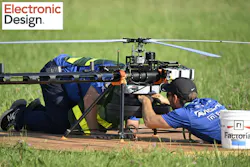
Despite still having swash-plate tail rotor lift-control mechanisms and a driveshaft out to the tail rotor like its fueled cousins, electric aircraft don’t have to carry 1.5 gallons of a jet fuel and oil mixture, about 10 lb., to run the course. It's not merely 10 lb. of fuel — tanks, valves, hoses, and additional structural weight are needed to support the extra weight.
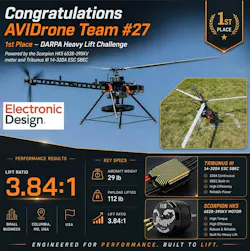
Avidrone uses Factorial Energy's "FEST" solid-state battery cells (see Murray's coverage here), and it was Factorial's first shipment for drone use this past May. The FEST cells have an energy density on the order of 390 Wh/kg. [Notice how close this was to my 400 Wh/kg viable for aviation line in the sand — THIS shipment from Factorial (and the verifying pail and shirt in Figure 3) is the fact that says we have hit the inflection point for pure electric energy sources in aviation. Factorial is on record with a short-term roadmap to 450 Wh/kg].
The motor and ESC appear to be a Chinese bespoke design (Fig. 4) from Scorpion Power System Co. Ltd.
The source of the helicopter mast mechanisms and rotor is unknown.
Second Prize Winner: MTech Operations, LLC
MTech's design (Fig. 5) takes it to 3D by slightly coning the hexacopter's CF arms downward and then creating a hexagonal hoop of CF rods that converts the payload forces into tension in the rods. From there, it's all battery and motors on inspection. Based on its endurance, it's safe to say that MTech is using advanced cells, most likely silicon anode or a solid-state prototype, in the 400-Wh/kg energy density range.
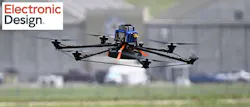
The principals are a South African father and son team, Mike and Luke Bell, who hold world speed records for drones with their Peregreen V4. So, they’re no strangers to the bespoke battery pack the machine is purported to have. A team from MIT is somehow affiliated, with speculation of their involvement in autonomous flight operation integration into the platform.
Hargrave Technologies bragged that six of their Hargrave microDRIVE ESCs were used, (look at how tiny they are in Figure 5), rated at 60 A continuous and 100 A burst per unit on a 14S LiPO battery string. This math is about right, based on my own design's calcs, where 13 to 15 kW is needed to keep the bird in the air (Fig. 6).
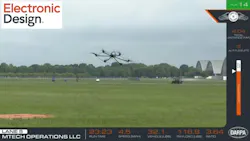
With 20-minute runs, around 4.5 to 5 kWh of energy storage is needed, which is around 12 kg of battery at 400 Wh/kg. 26 lb. of battery leaves 6.1 lb. for an energy reserve as well as for everything else... solid speculation and another point for Team Inflection Point.
MTech and Avidrone have dug the grave for ICE-based aviation propulsion thanks to now-emerging battery chemistries they were able to source in time for The Challenge, and to their brilliant, minimalist structural design.
Third Place and Last Dinosaur Standing: Xtreme Aerial Concepts
Peter Jakadofsky was largely responsible for the creation of the genius 22-hp turbine used in Xtreme's DARPA Lift challenge entry (Fig. 7), as well as providing propulsion power in fourth place H-Squared's helicopter (Fig. 8).
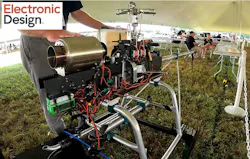
Xtreme's heli placed the powerplant "backwards" relative to the freestream of flight, with the exhaust braking forward flight to align the output shaft with the primary 5:1 ratio as well as the secondary 5:1 gearbox that yielded an 800-RPM rotor speed at 100,000 RPM on the turbine. All of it was fabricated by Peter's shop in Austria, with system integration and test performed by a team in San Jose, Calif.
The turbine burned about 20 lb. of jet fuel and oil mix per hour, with a fuel load of 10 lb. being used for the challenge course. Unladen chopper weight was right near the FAA maximum of less than 55 lbs. There's a great interview with Peter on Homestead Engineering's YouTube channel.
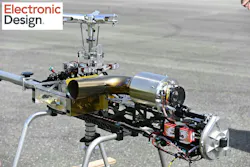
Hauer's Helicopter ("H-Squared," get it?), on the other hand, placed a very high efficiency gearbox of Hauer's design in front of the machine (Fig. 8). This enabled the jet turbine to have its inlet forward and to cleverly have its exhaust exiting in a direction to counter the torque of the main rotor. The design seemed more aerodynamic than the Xtreme machine, but allegedly had an engine failure that precluded a higher Lambda run to challenge for third place, finishing fourth overall.
Liquid Fuel Engines are Done — Stick a Fork in the Bankruptcy/Profit Curve
But it doesn't matter. Despite the brilliant design by Jakadofsky of producing a turbine yielding 22 HP and weighing only 8 pounds, his valiant effort to keep burnin' the dino-juice can be considered the very peak of what internal combustion tech can do.
Battery-cell chemistries, on the other hand, are seeing a fast ramp up of energy density. The 400-Wh/kg chemistries will soon enter full production and manufacturers like CATL are now seeing 1,200 Wh/kg in the lab for lithium-air chemistries at Argonne/IIT and it’s not balking at committing to such numbers in a few years.
In the time it takes to design develop, test, and certify an aircraft, it seems like a sure bet that a battery with 1,000 Wh/kg will be in production as the perfect intercept of a new electric aircraft design starting with a fresh piece of paper right now.
Those who don't play like hockey great Wayne Gretzky, going to where the puck will be versus where it is, will be assured of total annihilation in all aviation markets.
We'll still need oil as a feedstock, but burning oil products for mobility will be stories of horror told to our grandchildren of what we used to do for mobility without batting an eye.
"It is not the battery that makes electric flight exciting; it is the freedom from combustion. In an electric airplane, we don't carry fuel to burn — we harvest energy to move. Burning fossil fuels in flight belongs to the past century's mindset of brute force; the future of aviation is purely about elegance and efficiency." —Bertrand Piccard (Pioneering aviator & initiator of Solar Impulse, 2016)
Now you see the inflection point for aviation. Go do something about it!
-andyT
About the Author
 Andy Turudic
Andy Turudic
Technology Editor, Electronic Design
Andy Turudic is a Technology Editor for Electronic Design Magazine, primarily covering Analog and Mixed-Signal circuits and devices and also is Editor of ED's bi-weekly Automotive Electronics newsletter.
He holds a Bachelor's in EE from the University of Windsor (Ontario Canada) and has been involved in electronics, semiconductors, and gearhead stuff, for a bit over a half century. Andy also enjoys teaching his engineerlings at Portland Community College as a part-time professor in their EET program.
"AndyT" brings his multidisciplinary engineering experience from companies that include National Semiconductor (now Texas Instruments), Altera (Intel), Agere, Zarlink, TriQuint,(now Qorvo), SW Bell (managing a research team at Bellcore, Bell Labs and Rockwell Science Center), Bell-Northern Research, and Northern Telecom.
After hours, when he's not working on the latest invention to add to his portfolio of 16 issued US patents, or on his DARPA Challenge drone entry, he's lending advice and experience to the electric vehicle conversion community from his mountain lair in the Pacific Northwet[sic].
AndyT's engineering blog, "Nonlinearities," publishes the 1st and 3rd Tuesday of each month. Andy's OpEd may appear at other times, with fair warning given by the Vu meter pic. His cartoon series, "Inventors", appears each week in Electronic Design Weekly.
Comment About the Article
To join the conversation, and become an exclusive member of Electronic Design, create an account today!
 Leaders Logo
Leaders relevant to this article: