California’s Power Grid Continues to Set New Records for Fossil-Free Operation
What you’ll learn:
- California’s power grid has managed to meet 59% of its power needs in 2026 with wind, water, and solar (WWS).
- Its relatively recent addition of 17.023 GW worth of grid-scale battery storage now allows the system to continue to deliver significant amounts of PV-generated power for several hours after sunset.
- Investing in renewables has enabled power operators to reduce their use of increasingly expensive natural gas by 62% between 2023 and 2026.
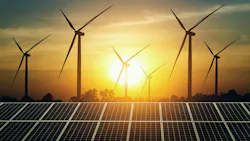
California’s continued investments in renewable energy and battery storage are paying off as the state has managed to meet 59% of its power needs in 2026 with wind, water, and solar (WWS). The state has spent 99 of the past 100 days running completely fossil-free for an average of 5.4 hours per day. Furthermore, the relatively recent addition of 17.023 GW of grid-scale battery storage now allows the system to continue to deliver significant amounts of photovoltaic-generated power for several hours after the sun has set.
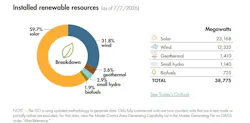
These surprising achievements are only some of the highlights of a recent post by Stanford Professor Mark Jacobson on LinkedIn, where he provides a regular analysis of the statistics collected by the California Independent System Operator ISO (CAISO). His analysis for July 9, 2026, shows that the grid’s relatively constant supplies of wind, geothermal, and hydro power provide roughly 35% of the state’s energy needs, with the remainder supplied by a mix of solar and fossil fuel (Fig. 1).
A Storage Revolution in Progress
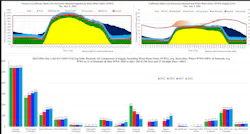
During peak hours, the state can now produce more than what it consumes and stores the remainder in 17.023 GW worth of batteries in grid-scale battery banks distributed throughout the region. Jacobson says that the current installed base of batteries is now large enough to meet 75% of the grid’s 22.6-GW average load or 44% of its 38.3-GW peak demand for up to four hours, with more installed capacity planned for the near future (Fig. 2).
Jacobson contends that with long-lived storage batteries now available at under $100/kWh, the cost of stored renewable power has dropped to <1% of grid electricity price. Thus, it’s far more cost-effective than the gas turbine that “peaking plants” traditionally used to supplement the grid’s baseline loads during high-demand periods.
In addition to achieving significant reductions in CO2 and other greenhouse-gas emissions, the state’s growing fleet of renewable-energy sources enabled power operators to reduce their use of increasingly expensive natural gas by 62% between 2023 and 2026. These, and other details about California’s June renewable-energy performance, historical statistics, and its economic and environmental savings can be found on CAISO’s website.
Next in This Edition of PowerBites


More PowerBites

 powerbites_promo
About the Author
 Lee Goldberg
Lee Goldberg
Contributing Editor
Lee is the author of the popular PowerBites series.
Lee Goldberg is a self-identified “Recovering Engineer,” Maker/Hacker, Green-Tech Maven, Aviator, Gadfly, and Geek Dad. He spent the first 18 years of his career helping design microprocessors, embedded systems, renewable energy applications, and the occasional interplanetary spacecraft. After trading his ‘scope and soldering iron for a keyboard and a second career as a tech journalist, he’s spent the next two decades at several print and online engineering publications.
Lee’s current focus is power electronics, especially the technologies involved with energy efficiency, energy management, and renewable energy. This dovetails with his coverage of sustainable technologies and various environmental and social issues within the engineering community that he began in 1996. Lee also covers 3D printers, open-source hardware, and other Maker/Hacker technologies.
Lee holds a BSEE in Electrical Engineering from Thomas Edison College, and participated in a colloquium on technology, society, and the environment at Goddard College’s Institute for Social Ecology. His book, “Green Electronics/Green Bottom Line - A Commonsense Guide To Environmentally Responsible Engineering and Management,” was published by Newnes Press.
Lee, his wife Catherine, and his daughter Anwyn currently reside in the outskirts of Princeton N.J., where they masquerade as a typical suburban family.
Comment About the Article
To join the conversation, and become an exclusive member of Electronic Design, create an account today!
 Leaders Logo
Leaders relevant to this article: