The Tapes That Bind Battery Energy Storage Systems

Avery Dennison has introduced a new portfolio of pressure-sensitive adhesive tapes (PSAs)for battery energy storage systems (BESS).
This broad family of adhesives, functional bonding, and protection tapes are designed to tackle the three core material challenges with these large-scale batteries: thermal-runaway protection, high-voltage insulation, and fast assembly. They are targeted at the large modules, battery packs, and containerized units of lithium-iron phosphate (LFP) cells commonly used in industrial- and grid-scale BESS applications (Fig. 1).
Thermal runaway remains one of the most significant hazards in big batteries. Triggered when one of the cells heats up uncontrollably, the event can spread throughout the pack, increasing the risk of fire and widespread failure. To help prevent propagation between cells, Avery Dennison has developed flame-retardant adhesives that allow designers to create rugged, multilayer thermal barrier solutions. The Flame Tough family can be easily assembled into packs along with the cells, the company said.
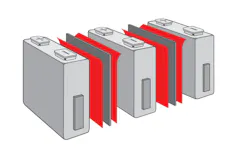
Dielectric tape solutions can help protect battery packs against one of the other safety risks with battery storage: arcing between cells, busbars, cooling plates, and module housings. Avery's Volt Tough family of materials and adhesives have been tested for breakdown voltage and dielectric strength requirements using GB/T 1408.1-2016 and ASTM D3755 test methods, and they offer high dielectric strength at very thin calipers.
To help BESS manufacturers meet aggressive timelines, automation requirements and cost pressures, the new PSA tapes deliver instant bonding for automated assembly lines. Die-cut precision eliminates waste and enables camera/vision system detection with colored variants. Other benefits include automated assembly compatibility, dimensional precision for tight tolerances, and no volatile emissions (VOCs) or mixing equipment.
About the Author
 Lee Goldberg
Lee Goldberg
Contributing Editor
Lee is the author of the popular PowerBites series.
Lee Goldberg is a self-identified “Recovering Engineer,” Maker/Hacker, Green-Tech Maven, Aviator, Gadfly, and Geek Dad. He spent the first 18 years of his career helping design microprocessors, embedded systems, renewable energy applications, and the occasional interplanetary spacecraft. After trading his ‘scope and soldering iron for a keyboard and a second career as a tech journalist, he’s spent the next two decades at several print and online engineering publications.
Lee’s current focus is power electronics, especially the technologies involved with energy efficiency, energy management, and renewable energy. This dovetails with his coverage of sustainable technologies and various environmental and social issues within the engineering community that he began in 1996. Lee also covers 3D printers, open-source hardware, and other Maker/Hacker technologies.
Lee holds a BSEE in Electrical Engineering from Thomas Edison College, and participated in a colloquium on technology, society, and the environment at Goddard College’s Institute for Social Ecology. His book, “Green Electronics/Green Bottom Line - A Commonsense Guide To Environmentally Responsible Engineering and Management,” was published by Newnes Press.
Lee, his wife Catherine, and his daughter Anwyn currently reside in the outskirts of Princeton N.J., where they masquerade as a typical suburban family.