Integrated 4-Stage Buck Converter Boosts Multi-Mode USB Charging
What you’ll learn:
- Inside what pSemi calls the world’s first single-chip, 4-stage buck converter for rapid USB battery charging.
- The main features of the 6-A buck converter, including its ability to support USB-PD, PPS, and other popular USB charging modes.
- The efficiency, area, and cost advantages of pSemi’s unique monolithic capacitor charge-pump architecture.
Silicon-carbide (SiC) and gallium-nitride (GaN) devices captured most of the attention at APEC 2026. However, a conversation with Ryan Roderick at pSemi about its PE26100 multi-level converter was a reminder of the many exciting developments in other corners of the power electronics industry.
The PE26100 is based on pSemi’s unique monolithic capacitor technology, which enables them to fabricate compact, efficient, single-chip, charge-pump-based devices (see figure). In this case, the technology been used to create a 4-stage, 6-A buck converter that can accept input voltages ranging from 4.5 to 18.5 V. It supports most popular USB charging modes, including USB-PD and PPS.
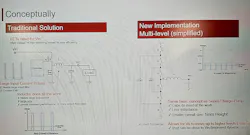
The high-efficiency multi-level buck converter is targeted at direct battery-charging applications in next‑generation smartphones, tablets, and compact mobile devices.
In the video, Roderick explained how, when paired with a simple microcontroller, the PE26100 can be configured to operate in a 4-level buck mode for higher USB PD voltage inputs or fall back to a 3-level buck mode for mid-to-low input voltages. In applications using USB PPS, the converter can also operate as a fixed-ratio, capacitor-divider charge pump, offering divider ratios of 2:1 and 3:1 depending on programmed input voltage.
Additional features include:
- Accurate input and output current and voltage, internal temperature monitoring, and telemetry using I2C.
- Full protection such as input and output undervoltage lockout (UVLO); input and output overvoltage protection (OVP); input and output overcurrent protection (OCP); IC overtemperature with fault and warning status.
- User-triggered thermal throttle.
- Dual external disconnect switch control.
Datasheets, application notes, and other information for the PE26100 multi-level converter can be found here.
>>Check out more of our APEC 2026 coverage
 dreamstime_dmytroskrypnykov_245154580_promo
About the Author
 Lee Goldberg
Lee Goldberg
Contributing Editor
Lee is the author of the popular PowerBites series.
Lee Goldberg is a self-identified “Recovering Engineer,” Maker/Hacker, Green-Tech Maven, Aviator, Gadfly, and Geek Dad. He spent the first 18 years of his career helping design microprocessors, embedded systems, renewable energy applications, and the occasional interplanetary spacecraft. After trading his ‘scope and soldering iron for a keyboard and a second career as a tech journalist, he’s spent the next two decades at several print and online engineering publications.
Lee’s current focus is power electronics, especially the technologies involved with energy efficiency, energy management, and renewable energy. This dovetails with his coverage of sustainable technologies and various environmental and social issues within the engineering community that he began in 1996. Lee also covers 3D printers, open-source hardware, and other Maker/Hacker technologies.
Lee holds a BSEE in Electrical Engineering from Thomas Edison College, and participated in a colloquium on technology, society, and the environment at Goddard College’s Institute for Social Ecology. His book, “Green Electronics/Green Bottom Line - A Commonsense Guide To Environmentally Responsible Engineering and Management,” was published by Newnes Press.
Lee, his wife Catherine, and his daughter Anwyn currently reside in the outskirts of Princeton N.J., where they masquerade as a typical suburban family.