Optocoupler Delivers High Isolation Voltage for 800-V Battery Packs

What you’ll learn:
- Why automotive and industrial battery-pack architectures are trending up to 800 V.
- How Vishay’s latest optocoupler delivers the robust isolation required by these systems.
- What grid-connected onboard chargers, DC-DC converters, and battery-management systems get out of the new optocoupler.
Vishay Intertechnology introduced a new automotive-grade optocoupler designed to deliver signal transmission with high galvanic isolation for emerging 800-V battery architectures in electric vehicles and industrial-automation systems.
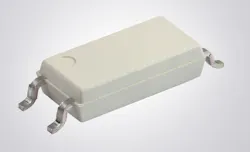
According to Vishay, the VOLA617A supports a high isolation voltage of 5,000 V RMS with a peak VIORM of 1,414 V and a maximum VIOTM of 8,000 V in a four-pin LSOP low-profile, compact package (see figure).
Most EVs on the road share the same power backbone: a densely packed battery operating at roughly 400 V. But companies are increasingly adopting 800-V battery packs in the drive for higher efficiency, faster charging, and other advantages — including cost, weight, and thermal — that come with doubling the voltage and halving the current racing through the bus. The challenge is preventing the controllers and other non-power electronics under the hood from being exposed to the 800-V bus.
The phototransistor-based device is geared for grid-connected on-board chargers, DC-DC converters, and battery-management systems (BMS), all of which require wake-up or other system control signals to be protected by galvanic and noise isolation. Most automotive optocouplers can be overwhelmed by battery voltages exceeding 500 V, limiting them to a traditional 400-V bus. But the new optocoupler isolates DC voltages of up to 1,000 V, opening the door for its use in 800-V and other emerging EV architectures.
Galvanic isolation separates the low- and high-voltage sides of the system to prevent the flow of DC and undesirable AC between them, while still allowing signal and power transfer across the optocoupler or other isolation barrier.
Robust isolation is a fundamental part of a BMS, for instance, because it divides high-voltage battery domains from low-voltage controllers. By eliminating direct electrical connections and shared grounds, it protects against hazardous voltages and prevents ground loops that cause noise and EMI.
High-voltage systems tend to need additional isolation because more signals, including high-speed gate-drive, current-sense, and digital communications signals, must traverse the isolation barrier. Many analog and digital circuits also require dedicated isolated bias voltages, where not only signals but also power crosses the isolation barrier. For instance, an isolated high-resolution analog-to-digital converter (ADC) may operate on a 3.3-V supply, while an isolated gate driver in the same system may require +15 V and −5 V.
Featuring a high 80-V collector-emitter voltage rating, Vishay’s optocoupler consists of an infrared emitting diode that’s optically coupled to a silicon planar phototransistor detector in a package with creepage and clearance distances of more than 8 mm.
The optocoupler operates over a wide −40 to +125°C operating temperature — with a junction temperature capability up to +145°C — while providing low coupling capacitance of 0.5 pF and high common-mode transient immunity. According to Vishay, the robust package provides an extra safety margin by meeting dual AEC-Q102 qualification standards, exceeding the rigorous requirements for automotive-grade reliability.
Pricing for the optocoupler starts at $0.90 per unit in 1,000-unit quantities.
About the Author
 James Morra
James Morra
Senior Editor
James Morra is the senior editor for Electronic Design, covering the semiconductor industry and new technology trends, with a focus on power electronics and power management. He also reports on the business behind electrical engineering, including the electronics supply chain. He joined Electronic Design in 2015 and is based in Chicago, Illinois.