Isolated Gate Driver Simplifies 800-V and Higher-Voltage EV Systems

A photovoltaic gate driver from Vishay Intertechnology aims to improve the safety and reliability of pre-charge circuits and battery-management systems (BMS) in electric vehicles running on 800-V or even higher-voltage battery packs.
Vishay said the VODA1275 features fast turn-on times, high open circuit voltage (OCV), and robust protection against short-circuit currents, enabling faster, safer, and more reliable driving of MOSFETs and IGBTs piling into EVs and hybrid EVs (HEVs). Built with reinforced isolation, the optically isolated MOSFET driver delivers a typical OCV of 20 V, short-circuit current of 20 μA, and turn-on time of 80 μs, which is around 3X faster than other devices in the same class, according to the company.
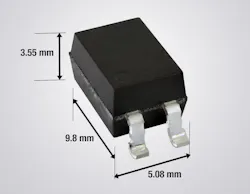
The driver features a working isolation voltage of 1,260 Vpeak and isolation test voltage of 5,300 V RMS, giving it more than enough headroom to handle higher-voltage EV battery architectures, such as Polestar’s 800-V platform and BYD’s 1,000-V fast-charging system. Vishay said it is also the first driver in the compact SMD-4 package to have a creepage distance of 8 mm. The device is intended for use in pre-charge circuits, which are used as safety mechanisms in EV to limit large inrush currents that occur when powering up, as well as BMS designs.
In most cases today, engineers connect a pair of MOSFET drivers in series to generate the higher voltages used in these architectures. However, Vishay said the high open circuit output voltage of the device allows designers to use a single driver instead, saving space and increasing power density. As a result, the VODA1275 also enables the development of solid-state relays to replace legacy electromechanical relays in EVs as well as in wall-mounted EV chargers.
The automotive-grade device draws all of the current required to drive its internal circuitry from an infrared emitter on the low-voltage side of the isolation barrier. This construction simplifies designs and lowers costs by eliminating the need for an external power supply.
About the Author
 James Morra
James Morra
Senior Editor
James Morra is the senior editor for Electronic Design, covering the semiconductor industry and new technology trends, with a focus on power electronics and power management. He also reports on the business behind electrical engineering, including the electronics supply chain. He joined Electronic Design in 2015 and is based in Chicago, Illinois.