TI “Transforms” Isolated Power Modules with Multichip Packaging Tech
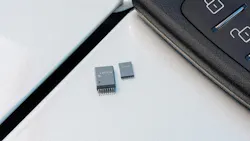
Texas Instruments revealed a family of isolated power modules based on its IsoShield multichip packaging technology, claiming 3X higher power density than discrete solutions in isolated power designs.
The UCC34141-Q1 and UCC33420 leverage IsoShield to integrate a high-performance planar transformer with an isolated power stage in a single package. Thus, their size shrinks as much as 70% while supplying up to 2 W of power. Besides boosting power density and efficiency, IsoShield delivers functional, basic, and reinforced isolation capabilities, enabling more robust and reliable power designs. TI introduced the new power modules at APEC 2026.
Kannan Soundarapandian, VP and GM of High-Voltage Products at TI, said these will primarily be used as almost-all-in-one isolated bias supplies in applications such as electric-vehicle (EV) traction inverters and grid-scale energy solutions.
They’re also targeted at power supplies in AI data centers. Such data centers are adopting many of the same power technologies and topologies as EVs — and requiring many of the same qualifications for safety, reliability, and ruggedness — with the rise of high-voltage DC power distribution (HVDC).
The main function of a bias supply is to power gate drivers. The UCC34141-Q1 gives them reinforced isolation of more than 5 kV RMS required to withstand the rigors of these high-voltage systems, which are increasingly equipped with fast-switching power devices such as silicon-carbide (SiC) MOSFETs. “These are for any application that needs a high-side switch turned on or off,” Soundarapandian said in a press conference ahead of APEC.
How Multichip Packaging Squeezes Together Passives and Power
Traditionally, power designers have turned to power modules to save valuable space by integrating a power converter with a transformer, capacitor, or inductor within a single package. TI has been trying to further close the distance between passives and power dies with new advanced packaging technologies such as MagPack, its proprietary 3D magnetic packaging technology that aims to effectively replace external inductors.
IsoShield technology co-packages a high-performance planar transformer and an isolated power stage, condensing the complexity of a DC-DC bias supply into a single module. Galvanic isolation prevents the flow of DC and undesirable AC high voltages while still enabling signal and power transfer.
By partitioning the system, it prevents high voltages from damaging the low-voltage side of the system. It also reduces EMI and other noise by eliminating ground loops and preventing transient high voltages.
>>Check out more of our APEC 2026 coverage
 dreamstime_dmytroskrypnykov_245154580_promo
A traditional isolated bias supply primarily consists of a dedicated DC-DC converter and a bulky transformer — usually placed in a flyback topology — that transfers power and signals through the magnetic isolation boundary. These parts can be surrounded by over 30 other discrete components, overcrowding the circuit board and undermining the goal of maximizing power density. In many designs, a separate isolated bias supply is typically required for each gate driver, further adding to complexity and cost.
In addition, the parasitic inductances (caused by the larger current loops on the circuit board) and parasitic capacitances (caused by the windings of the transformer) inherent in these complex designs are a primary source of EMI. As a result, engineers are forced to add filtering and implement shielding.
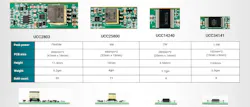
TI said IsoShield condenses everything from the power converter, transformer, and isolation into a chip-scale module, reducing the component count for the bias supply to less than 10. This drastically reduces the size, height, and weight of the power system. At the component level, the automotive-grade UCC34141-Q1 delivers 1.5 W of output power from inside a module measuring 5.85 × 7.5 × 2.6 mm.
By bringing the transformer and the isolation inside the module, TI said UCC34141-Q1 also mitigates noise by minimizing the size of the current loop in the circuit and reducing common-mode capacitance in the device. Thus, it can more tightly regulate its output voltage for the gate driver that’s in front. Fully integrating the primary- and secondary-side control with the isolation results in a ±1.5% regulated, isolated DC-DC bias supply all in one device.
TI introduced its first isolated power module with a fully integrated transformer, the UCC14240, in 2021. David Snook, product line manager at TI, noted that the technological improvements in IsoShield reduce the total solution size by another 40% on top of that.
Isolated Bias-Supply Modules Spanning from EVs to AI
Soundarapandian said IsoShield could make a difference in EVs, which are rapidly shifting from 400 V to 800 V — and even 1,000+ V — architectures to enable ultra-fast charging and longer range. By removing the need for a dedicated DC-DC converter and the components tied to it, IsoShield-based bias-supply modules can reduce the size, cost, and weight of traction inverters, onboard chargers, and the like.
At APEC, TI showed the modules in a SiC-based, automotive-grade, 300-kW traction inverter reference design.
The same pressures to maximize power density are emerging within data centers. At NVIDIA’s GTC this month, TI demoed a 30-kW power-supply unit for AI servers — a level that would have been associated with an entire rack a couple of years ago.
At the same time, server racks such as those based on NVIDIA’s Blackwell GPUs are already consuming at least 120 kW per rack. Meanwhile, power companies are preparing for NVIDIA’s Rubin Ultra superchip, which could potentially drive rack power up to 600 kW by the end of the year.
This escalation is forcing more power to be packed into tight, increasingly hot form factors spanning racks, servers, and circuit boards inside them. As traditional power-distribution approaches reach their limits with AI, NVIDIA and the likes of Google, Meta, and Microsoft are working to adopt 400-V, 800-V, and other high-voltage DC (HVDC) architectures to reduce distribution losses and bulky wiring. All of this high-voltage hardware, however, depends on robust galvanic isolation at the device level to maintain safety and reliability.
With rising power densities across the board, SiC and gallium nitride (GaN) are increasingly replacing silicon MOSFETs due to their faster switching speeds and higher efficiency. In AI server power supplies above 10 kW, the power-factor-correction (PFC) stages are moving to more advanced multilevel topologies, such as three-level flying-capacitor interleaved PFC. They frequently use fast-switching SiC to reach peak efficiencies above 99% while reducing passive component size and handling the heat in data centers.
TI said IsoShield is designed to address some of the issues encountered with these wide-bandgap semiconductors. The faster switching of SiC and GaN creates rapid voltage (dv/dt) transients. These transients can cause EMI, typically linked to ringing from parasitic inductances and capacitances within the power circuit, which may lead to unintended turn-on or damaging shoot-through currents. As a result, SiC and GaN tend to require tighter control of gate-drive voltages compared to silicon MOSFETs.
By integrating the transformer and isolation, IsoShield enables a common-mode transient immunity (CMTI) of 250 V/ns. This means the bias supply can withstand extreme voltage swings caused by the switch, even in the noisy insides of traction inverters and server power supplies. These bias supplies must deliver stable voltage rails with low noise and fast transient response to avoid overshoot and undershoot, which can reduce efficiency and reliability.
The UCC34141-Q1 is specifically designed to supply bias power to gate drivers in front of SiC or other high-voltage power-switching devices. In general, SiC requires positive gate-drive voltages (of around +15 V) to rapidly turn on, and negative voltage (of around -5 V) to rapidly turn off and make sure they stay off. The DC-DC power module is paired with external voltage dividers to set the positive and negative outputs to the gate drivers.
The UCC14240-Q1 features a wide input voltage range of 5.5 to 20 V that works with varying, unregulated outputs — as in the case of EV battery packs and energy storage systems (ESS) — or fixed, regulated outputs.
The power module can output 1.5 W at up to 85°C, giving it enough to power a gate driver in a distributed architecture. Such an architecture assigns a dedicated, local, and well-regulated bias supply to each gate driver, improving robustness and reliability by eliminating single points of failure.
For instance, in a traction inverter with six power switches, if one isolated bias supply fails, the remaining bias supplies can continue powering their paired gate drivers. As long as the other switches continue operating, the EV motor can decelerate and shut down safely.
The advanced control architecture in the UCC34141-Q1 also reduces output capacitance so that it can respond in time to fast-changing load currents, which are increasingly prevalent in electric motors as well as GPUs and other AI-class chips in data centers.
The industrial-grade UCC33420 is more compact and comes with more than 3 kV RMS. It’s designed to be used in isolated bias supplies based on GaN, among other applications.
>>Check out more of our APEC 2026 coverage
dreamstime_dmytroskrypnykov_245154580_promoAbout the Author
 James Morra
James Morra
Senior Editor
James Morra is the senior editor for Electronic Design, covering the semiconductor industry and new technology trends, with a focus on power electronics and power management. He also reports on the business behind electrical engineering, including the electronics supply chain. He joined Electronic Design in 2015 and is based in Chicago, Illinois.