eFuse Offers Resistor-Adjustable Current Limit, Multiple Protection Features

What you'll learn:
- Why eFuses have become widely used protection components, supplementing or replacing classical thermal fuses
- The functions and features of a new 75-V/6-A eFuse.
- The many details related to its setup and design-in covered by the comprehensive datasheet.
Electronic fuses (eFuses) have come a long way since they were first introduced over a decade ago. Initially, they were regarded by some (many?) with skepticism if not outright suspicion. After all, how could an active semiconductor device with all of its complexity provide the assuredness and confidence of the long-established, well-known, ultra-reliable thermal (or electromagnetic) fuse?
Skip forward to the present, and these eFuses are now a fully accepted component on the bill of materials (BOM) in many circuits and subsystems, and for good reasons. They’re fast-acting (milliseconds), many of them offer user-selectable thresholds, they offer remote reading and even reset, and they can be “sprinkled” around as needed for highly localized protection.
In fact, as proof of their performance and reliability, eFuses are now approved by many regulatory standards for overcurrent protection — and those standard-setting organizations don’t make such changes quickly or lightly. Further, using them doesn’t preclude also using the classic fuse as a higher-level backup.
A recent entry into the eFuse arena is the TCKE1401NM from Toshiba Electronic Devices & Storage Corp. This eFuse targets servers, network equipment, factory automation equipment, robots, and other industrial equipment, as its higher voltage rating is well-suited to the widespread adoption of 48-V power for increased efficiency in systems (Fig. 1).
It has a 75-V/6-A rating for power-line protection in systems operating up to 54 V, and it supports a wide operating-voltage range of 4.7 to 75 V. Its high voltage tolerance allows it to be used for power-line protection in 24-, 48-, and 54-V systems.
In addition, the low on-resistance (RDS(on)) of 44.5 mΩ (typical) helps improve equipment efficiency by reducing power loss during operation, while the 4.0- × 4.0- × 0.9-mm-high VQFN24D package contributes to reduced PCB real-estate requirements.
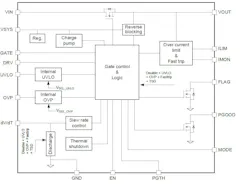
Additional protection features include adjustable overcurrent limit of 0.82 to 6.43 A, adjustable undervoltage lockout (UVLO), and adjustable overvoltage protection (OVP), all by user-selected external resistor; short-circuit protection; adjustable slew-rate control for inrush-current reduction by an external capacitor; and thermal shutdown.
It also offers reverse-current blocking by external MOSFET; input reverse -polarity protection, also by external MOSFET; two-mode selectable overcurrent fault response between auto-retry and latch-off; power-good output indication; and flag signal to indicate when it detects any of the cited faults (Fig. 2).
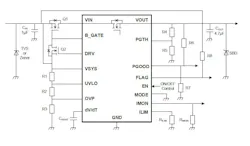
The comprehensive 24-page datasheet for the TCKE1401NM offers details on basic functionality, as well as detailed discussion of the various user-settable features along with explanation of the relevant equations needed to establish resist or capacitor values.
The datasheet also provides timing and threshold diagrams, in addition to insight and discussion of the various subtleties of a full-featured eFuse such as this one, for minimal set-p headaches. Furthermore, Toshiba offers two informative “user guides: “eFuse IC for robust power supply protection” and “Basic usage and functions of eFuse IC."
About the Author
 Bill Schweber
Bill Schweber
Contributing Editor
Bill Schweber is an electronics engineer who has written three textbooks on electronic communications systems, as well as hundreds of technical articles, opinion columns, and product features. In past roles, he worked as a technical website manager for multiple topic-specific sites for EE Times, as well as both the Executive Editor and Analog Editor at EDN.
At Analog Devices Inc., Bill was in marketing communications (public relations). As a result, he has been on both sides of the technical PR function, presenting company products, stories, and messages to the media and also as the recipient of these.
Prior to the MarCom role at Analog, Bill was associate editor of their respected technical journal and worked in their product marketing and applications engineering groups. Before those roles, he was at Instron Corp., doing hands-on analog- and power-circuit design and systems integration for materials-testing machine controls.
Bill has an MSEE (Univ. of Mass) and BSEE (Columbia Univ.), is a Registered Professional Engineer, and holds an Advanced Class amateur radio license. He has also planned, written, and presented online courses on a variety of engineering topics, including MOSFET basics, ADC selection, and driving LEDs.