Hall-Effect Current Sensor Delivers Multi-Axial Measurements to EVs
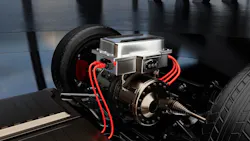
Traction inverters convert battery power to precisely control electric-motor torque. Minor measurement errors of the motor-phase current can adversely impact the torque control loop, creating torque ripple, vibrations, uneven acceleration, unwanted noise, and inefficient operation that reduce driving range.
As a result, automakers are continuously looking to make traction inverters lighter and more efficient to extend driving range and enhance vehicle performance.
Hall-effect current sensors detect the magnetic field emitted from electrical current through a busbar, which typically connects the traction inverter to the motor. Existing differential coreless sensors require busbar modifications such as notches, slices, or holes that can complicate thermal management and increase electrical resistance.
As AC or DC current flows through a busbar, generating a magnetic field, the integrated on-chip Hall-effect sensors measure the magnetic field. Typically, differential coreless current-sensing devices are highly susceptible to changes in magnetic-field strength due to system manufacturing tolerances, displacement, and vibration.
Traditional measurement approaches to overcome these shortcomings present designers with a fundamental tradeoff:
- Solutions with magnetic-core implementations deliver accuracy but add size and weight.
- Coreless alternatives are smaller but compromise precision due to displacement error and magnetic crosstalk.
Multi-Axial Coreless Hall-Effect Current Sensor
In response, Texas Instruments (TI) introduced what is said to be the industry’s first multi-axial coreless Hall-effect current sensor designed for all hybrid electric vehicle and electric vehicle (HEV/EV) traction-inverter applications. The TMCS2100-Q1 sensor offers a new approach to current sensing through the combination of multi-axial measurement and a proprietary algorithm, eliminating the tradeoff between precision and system size in traction-inverter designs.
The TMCS2100-Q1 also utilizes a TI proprietary algorithm to significantly reduce the effect of displacement. It’s an AEC-Q100 qualified ambient magnetic-field current sensor that’s designed to work in pairs with a secondary device feeding information to a primary device.
While existing coreless solutions are limited to single-axis measurements, the TMCS2100-Q1 sensor is the first to measure magnetic fields in both horizontal and vertical directions. By reducing error and maintaining accurate current measurement, the part minimizes magnetic crosstalk influence and torque ripple, a cause of jerky acceleration, motor noise, and inefficient operation that reduces range.
The TMCS2100-Q1 ATS certainly seems to have its spec sheet right. According to TI, this multiaxial measurement is 20X more accurate than single-axis alternatives, achieving displacement error of less than 1% at 0.4-mm movement and as low as 0.25% at 0.1 mm. This level of precision improves the EV powertrain torque control loop, maximizing efficiency and power delivery across varying load and thermal conditions.
“For the first time, engineers have a Hall-effect current sensor that breaks through the limitations of existing solutions, which is especially critical as 800-V architectures raise the bar for traction-inverter accuracy," said Jason Cole, vice president and general manager, Sensing Products at TI.
He added, ‘’The TMCS2100-Q1 was developed to give automakers a tool to build HEVs and EVs where tighter current measurement translates directly into longer range, smoother ride quality, and more efficient motor control.”
To assist engineers with getting started with this device TI offers the TMCS2100 evaluation module (EVM), a board used to facilitate the characterization process of the TMCS2100 devices in a system. It comes with a 3D-printed clip and a nickel-plated busbar. External headers allow easy access to all of the pins of the device. The TMCS2100EVM is used in conjunction with the TMCS2100CHAREVM, which performs the necessary characterization programming.
TMCS2100-Q1 Overview
The TMCS2100-Q1 Hall-effect magnetic current sensor is designed to minimize errors due to crosstalk and mechanical displacement of the sensors with respect to the busbars. The ambient magnetic-field current sensor is designed to work in pairs with a secondary device feeding information to a primary device.
Created specifically for the requirements of high-voltage, high-current, multi-phase systems, this design meets the performance requirements of significantly larger, heavier, and more expensive magnetic core-based products while achieving a space-saving footprint. And there’s no need to modify or notch the high-current-carrying busbars.
Production quantities of TMCS2100-Q1 are now available upon request.