20-Channel IC Delivers Data Center Thermal Measurement and Leak Sensing

What you'll learn:
- Insight into the application-specific thermal- and cooling-oversight needs of large data centers.
- How a single IC can simplify the associated challenges.
- How a multichannel IC can support traditional temperature sensors as well as sensors based on PCB copper traces.
Data centers have a long list of critical support requirements in addition to the ability to host a multitude of processors and link them together and to the outside world. Due to their apparently insatiable power needs and subsequent dissipation, it’s critical to monitor their temperature across numerous possible hotspots, as well as detect leaks in their liquid-cooling subsystem. Doing this can require a monitoring arrangement with numerous connection points for temperature sensors as well as the ability to manage and interpret them locally.
Addressing these requirements, Analog Devices developed the application-focused ADT7604, a data center thermal-measurement and leak-sensing system supporting 20 single-ended/10 differential channels incorporating numerous functions, features, and an internal EEPROM (Figs. 1 and 2). Connection to the system processor is via an SPI bus interface.
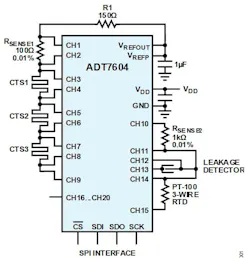
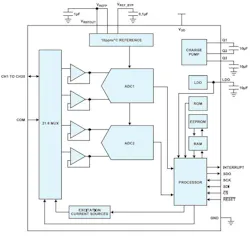
It includes all necessary active circuitry, switches, measurement algorithms, and mathematical conversions to determine the temperature for each sensor type. In addition to measuring RTDs and thermistors, the ADT7604 can directly measure copper-trace resistors and resistive-based leak sensors. It targets artificial-intelligence/high-performance-computing (AI/HPC) data center liquid-cooling systems, server-rack thermal management, and even industrial process control and monitoring.
The reconfigurable analog inputs enable many sensor connections and configuration options. The ADT7604 measures a wide variety of temperature sensors including standard 2-, 3-, or 4-wire RTDs and thermistors (including use of the Steinhart-Hart coefficients for the latter).
The system features accurate temperature measurement using copper-trace sensors, which are thin copper traces integrated into PCBs or laminate substrates, and it can be placed in mechanically hard-to-reach places to sense thermal hotspots. In addition, the ADT7604 accurately measures resistive leak detectors for safety monitoring in liquid-handling systems.
The device includes excitation current sources and fault-detection circuitry (open circuit, short circuit) as appropriate for each type of temperature sensor. There’s also an EEPROM for storing custom coefficients and channel configuration data, enabling zero-configuration startup.
It provides digital outputs of the temperature reading in Celsius, Fahrenheit, or Ω with 0.1°C accuracy and 0.001°C resolution. All signals are buffered and simultaneously digitized with two high-accuracy, 24-bit delta-signal ADCs.
The IC requires a single 2.85- to 5.25-V supply; no negative supply is needed. It’s housed in a 48-lead, 7- × 7-mm plastic LQFP package rated for maximum junction temperature (TJMAX) of +150°C and junction-to-ambient thermal resistance (θJA) of 57°C/W.
Copper Sense Resistors
This IC leverages a normally detrimental characteristic of copper — it has a relatively high temperature coefficient of resistance (TCR) of approximately 0.393% per °C. The ADT7604 can measure the resistance of copper traces with a precision of 1 mΩ, eliminating the need for discrete sensors and simplifying the bill of materials.
Copper-trace sensor measurements are performed ratiometrically relative to a known user-supplied sense resistor; for most applications, a single sense resistor can be shared with all copper-trace sensors. The ADT7604 reports the resistance value of the copper trace sensor in milliohms, and this value can be used to calculate the temperature.
For best accuracy, each copper trace sensor should have a resistance of at least 0.25 Ω at room temperature. A copper trace with resistance of 0.25 Ω increases its resistance by 1 mΩ/°C. Using the ADT7604 as a resistance measurement device allows for pinpoint temperature measurement on PCBs and laminates using tiny parasitic copper traces.
Setup and Evaluation
The IC’s comprehensive 78-page datasheet contains full functional and operational details and register information in addition to the usual specifications.
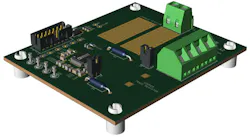
Analog Devices also offers the EVAL-ADT7604-AZ evaluation board with two copper trace sensors, two leak detectors, a 1-kΩ thermistor, and a PT-100 RTD (Fig. 3).
When connected to a DC2026C Linduino demo circuit and a host PC, the EVAL-ADT7604-AZ reports temperature, resistance, and fault status from multiple types of sensors through the graphical user interface (GUI) (Fig. 4). (Note: Linduino is an Arduino Uno-compatible microcontroller board and firmware development system created by Linear Technology, now part of Analog Devices.)
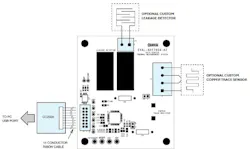
The GUI supports the evaluation of all onboard sensors as well as external custom sensors. In addition, a custom copper-trace sensor and a custom leak-detection sensor can be connected via their respective connectors.
About the Author
 Bill Schweber
Bill Schweber
Contributing Editor
Bill Schweber is an electronics engineer who has written three textbooks on electronic communications systems, as well as hundreds of technical articles, opinion columns, and product features. In past roles, he worked as a technical website manager for multiple topic-specific sites for EE Times, as well as both the Executive Editor and Analog Editor at EDN.
At Analog Devices Inc., Bill was in marketing communications (public relations). As a result, he has been on both sides of the technical PR function, presenting company products, stories, and messages to the media and also as the recipient of these.
Prior to the MarCom role at Analog, Bill was associate editor of their respected technical journal and worked in their product marketing and applications engineering groups. Before those roles, he was at Instron Corp., doing hands-on analog- and power-circuit design and systems integration for materials-testing machine controls.
Bill has an MSEE (Univ. of Mass) and BSEE (Columbia Univ.), is a Registered Professional Engineer, and holds an Advanced Class amateur radio license. He has also planned, written, and presented online courses on a variety of engineering topics, including MOSFET basics, ADC selection, and driving LEDs.