The Evolving State of Advanced 3D Printing
What you'll learn:
- Considerations on when to use additive manufacturing.
- The current state of the art in 3D printing.
- Thoughts on the marketplace and future development.
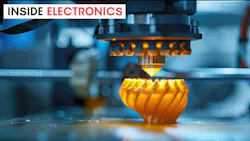




Additive manufacturing, also known as 3D printing, is growing in capability and utility in advanced systems. In the electronics industry, this is especially true with complex assemblies like connectors, which need to be made to high precision with many complex features. 3D printing also enables part consolidation by creating aspects via additive manufacturing that could not be done with traditional methods.
For instance, 3D printing can make things with lattice structures or with significant topology optimization, creating spindly components that still have the same strength as legacy solutions. Though 3D printing is encroaching on traditional manufacturing, it's also enabling new approaches and ways, especially in the connector space. Additive manufacturing eliminates the need for secondary components or assemblies, printing an entire device that combines three or four different components.
In this podcast, we talk to Benjamin Dopp, Senior Manufacturing & Process Developmental Engineer at TE Connectivity, about some of the challenges undertaken at TE, and the operations and production for 3D printing using the right tools on the printer side as well as the cleaning side.
SHOW NOTES
00:36 – 3D Printers in Engineering
02:25 – Complex Internal Geometries
04:35 – Scaled 3D Printing Challenges
07:40 – Achieving Micron-Level Accuracy with 3D Printers
10:02 – Future of Scaled 3D Printing
14:30 – 3D Printing’s Value
About the Author
 Alix Paultre
Alix Paultre
Editor-at-Large, Electronic Design
An Army veteran, Alix Paultre was a signals intelligence soldier on the East/West German border in the early ‘80s, and eventually wound up helping launch and run a publication on consumer electronics for the US military stationed in Europe. Alix first began in this industry in 1998 at Electronic Products magazine, and since then has worked for a variety of publications in the embedded electronic engineering space. Alix currently lives in Wiesbaden, Germany.
Also check out his YouTube watch-collecting channel, Talking Timepieces.
Benjamin Dopp
Manufacturing & Process Developmental Engineer, TE Connectivity
Benjamin Dopp, Senior Manufacturing & Process Developmental Engineer, has focused in optimizing and improving the manufacturing process at TE for nearly a decade. He has had his hand in the production of well over 1 million 3D-printed parts and is now using those skills to shorten the time to get parts into our external customers hands. Whether using additive or traditional manufacturing, he works tirelessly with his team to make the best connectors and from ideation to implementation in weeks not years.
Comment About the Article
To join the conversation, and become an exclusive member of Electronic Design, create an account today!
 Leaders Logo
Leaders relevant to this article: