SMRs Are Gaining Ground in On-Site Data Center Power
Key Highlights
- Data center power demand is expected to double within this decade, driven largely by AI workloads, creating urgent needs for alternative power solutions.
- SMRs provide high power output in a small footprint, making them ideal for space-constrained locations and regions with limited grid access or water scarcity.
- On-site power generation can be configured as grid-islanded or grid-connected, offering redundancy or independence based on operational priorities.
On May 22, 2026 in Computing, Energy Harvesting, Industrial, Power by Nicolette Emmino
(Source: Infinitylight/stock.adobe.com; generated with AI)
Power is emerging as the biggest constraint on data center expansion in some markets.[1] In major data center regions like Northern Virginia, Texas, and parts of the Western US, developers are finding it difficult to access enough electricity to run these behemoth facilities. Accessing it can take years, even after a site is ready for construction. The time required to connect large new loads to the grid often causes this delay.
While that constraint is real, data center demand doesn’t appear to be slowing anytime soon. Organizations like the International Energy Agency[2] and the US Department of Energy[3] suggest that data center electricity use could double within this decade, all driven by artificial intelligence (AI) workloads.
Instead of waiting for grid updates or navigating extended approval cycles, some hyperscale operators are opting to secure power generation directly or build it alongside their facilities. In this way, power is not an external dependency and becomes part of the system architecture.
The blog will explore how that change can impact power system design, where small modular reactors (SMRs) fit in, and what engineers should be thinking about in terms of power generation.
“Bring Your Own Power” Isn’t Always What It Sounds Like
On-site power generation is often referred to as “bringing your own power,” but there are many approaches to this task.
According to Brian M. Smith, Chief Technology Officer, Nuclear Science and Technology, Director, Nuclear Reactor Development, Idaho National Laboratory, “bringing your own power doesn’t always mean existing in a grid islanded environment.”
In a grid-islanded configuration, the data center operates independently of the utility and relies on its own generation and power management systems to keep operating. That type of control is appealing, especially in places where grid access is constrained.
Not every operator is willing to give up the benefits of staying connected, though. Grid access can add a layer of redundancy, even when on-site generation is available.
As Smith explains, “there are some data center developers who tell me, I never want to be grid islanded because I want redundancy from the grid.”
Some are moving in the opposite direction, making independence from a system that can introduce delays and uncertainty a top priority.
“Others say, get me out of this… I don’t want to deal with interconnection. Grid islanded is what I want to work on.”
Delivering large amounts of continuous power in a constrained footprint is not something every energy source can do, though. SMRs are one of the technologies under consideration in this space.
A Power Source That Matches the Constraints
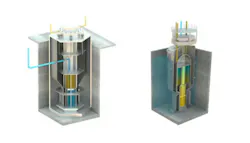
SMRs have characteristics that align well with the specific constraints that data centers face (Figure 1). Compared to traditional generation, they can deliver high power output from a small footprint, allowing power generation to be placed closer to the load without requiring large areas of land. This can be a valuable feature in places where space is limited, transmission capacity is scarce or permitting timelines limit expansion.
Figure 1: Cross-sectional views of SMR concepts, highlighting internal structure and configuration. (Image Credit: Illustration courtesy of Idaho National Laboratory)
Operators looking to colocate generation with their facilities are often limited by available land, making nuclear’s high energy density a practical advantage. As Smith explains, the energy density of nuclear allows developers to “get hundreds of megawatts… in tens of acres,” making it possible to deliver large-scale power without the spatial requirements associated with other generation options. For reference, 1 acre ≈ 0.405 hectares (ha).
How these systems are built and deployed will also directly impact cost, timelines, and feasibility. SMRs follow a more modular, factory-based design rather than traditional large-scale infrastructure approaches. This introduces complexity into an off-site, controlled manufacturing environment. Doing so improves cost and schedule predictability, which can be as important as total project cost for developers and financiers.
In addition, SMRs’ operational characteristics are appealing. Nuclear systems run constantly, often generating power more than 90 percent of the time.[4] This level of consistency allows a steady power source to meet most of a data center’s power demand and reduces the need for backup systems.
SMRs also enable data centers to be built in more locations. “There are reactors… that are fully air cooled. They use no water for cooling… that would seem to be an opportunity for places that are in a water scarce environment… parts of Texas… Arizona…,” says Smith. Cooling approaches vary by reactor and balance-of-plant (BoP) design; some emphasize dry (air) cooling to minimize water needs, while others may still require water for auxiliary systems. This opens up deployment options in regions where water availability could be limited.
But integrating nuclear generation into a data center is not just an extension of existing power architectures.
“It’s not as easy as just connecting a nuclear reactor to a data center,” Smith points out. “How the data centers leverage that and the power management architecture… that's an important component of the bring your own power framework.”
The Challenge Is Not the Reactor
The advantages SMRs bring do not automatically create a working system. Reactors run at a constant output, but data centers don’t behave that way. Reactors can adjust output, but they do it slowly. Changes are measured in minutes, not seconds. Data centers operate on a completely different timescale. As Smith explains, load changes can happen in milliseconds, and in some AI workloads, demand can swing from roughly 20 percent to 80 percent multiple times within a single minute.
Everything between the reactor and the load becomes very important. High-performance compute, especially those tied to AI workloads, can swing power demand up and down in ways a steady generation source can’t follow.
“There’s always something in between,” Smith says. “And those typically are batteries… and an uninterruptible power supply (UPS) system.”
These systems are responsible for more than just backup. They absorb rapid changes in demand, smooth out power delivery, and maintain stable power as it moves through the facility. Power from an SMR doesn’t go straight to a server rack. It passes through multiple stages—conversion, distribution, conditioning—and each must withstand constant change.
When the system is tied to the grid, some of that will happen outside the facility. In hybrid or grid-islanded setups, that responsibility can move inside. The data center will need to coordinate generation, storage, and load.
>>Click to read the entire article at Mouser
About the Author
Nicolette Emmino
Nicolette Emmino is a technology writer and editor with over 15 years of experience covering electronics, engineering, and emerging technologies. Her work focuses on translating complex topics into clear, accurate storytelling for engineering audiences. She collaborates closely with engineers and subject-matter experts on editorial development and also co-leads engineering-focused media companies.
Comment About the Article
To join the conversation, and become an exclusive member of Electronic Design, create an account today!
 Leaders Logo
Leaders relevant to this article: