A Look Back at Goodyear’s Illuminating Tires and the Space-Age Dream
What you'll learn:
- How Goodyear used translucent polyurethane and internal bulbs to create glowing prototype tires.
- Why the Golden Sahara II became the best-known showcase for the illuminated-tire concept.
- The traction, heat, wiring, and maintenance problems that prevented the tires from becoming a commercial product.

In the past, inventions were a bit shaky and not meant to last. Usually, these were purely experimental for the wow factor and designed in the moment. Although some didn’t go further, they were symbolic of how people imagined the future.
It all started in the late 1950s, when glowing tires were the next light bulb idea (Fig. 1). At this time, the post-war era had a big impact on the automotive and chemical sectors. Goodyear and other tire companies explored synthetic rubbers and polymers, including polyurethane. Invented in 1937, polyurethane could be formulated to become translucent. This allowed Goodyear to experiment with a tire material that let light pass through.
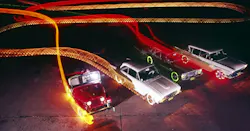
The company’s engineers saw potential in multiple uses for tires other than traction and driving support. Their idea revolved around making them glow to catch people’s attention on the road. One source of inspiration for this? The space age, futuristic car designs, and Jet Age technology culture.
Looking back, concept cars featured radar-inspired dashboards, bubble tops, fins, and lighting systems that reflected all sorts of futuristic designs. Goodyear also hoped that illuminating tires would help drivers see in foggy and poor weather.
Neothane Experiments Light the Way
William Larson and Anthony Finelli, Goodyear chemists, lit the way forward with their Neothane experiments. In the lab, they tested different mixtures to find one with the right balance of hardness and resilience for the illuminated tires. Larson blended diisocyanates and polyols, pouring the mixture into molds and baking at low temperatures (250°F) to produce tubeless tires.
They proved that polyurethane could be made translucent, hinting at internal illumination powered by integrated bulbs. Before baking, they added a certain dye color, including blue, white, yellow, green, orange, red, or amber, into the material (Fig. 2).
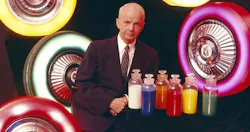
Tests were also performed for various hardness levels, tensile strengths, and surface textures to find a balance between flexibility, durability, and light transmission. Early experiments like these had one purpose: Demonstrating that tires could allow light to pass through as a functional object.
Larson and Finelli dove deeper, testing Neothane’s response to heat, load, and wear — essential for illuminating tires down the road. They discovered that polyurethane handled short bursts of testing, friction heat, and road conditions poorly over time, eventually clouding the material, which limited potential applications in the future. They also performed speed tests, noting that it ran well up to 65 mph. Beyond that, the tires started losing stability.
Prototype Tires Go on Display
When 1961 rolled around, Goodyear moved forward with full-size Neothane prototype tires for public demonstrations (Fig. 3). Each tire, weighing roughly 150 pounds, was fitted on cars like the Golden Sahara II and the Dodge Polara. The tire company showcased them in downtown Miami and Times Square. However, these public demonstrations left spectators, including other drivers, in awe, and some felt the concept tires could be distracting, which may make driving unsafe.
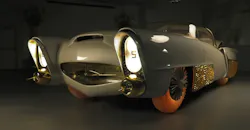
Designed by George Barris and Jim Street, the Golden Sahara II was a perfect match for Goodyear’s glowing tires as they featured advanced suspension, sleek aerodynamics, and a captivating design. This gave viewers the impression that the car came from a sci-fi novel.
So, what gave the tires that famous glow-up? For starters, the tires’ translucent material and interior lighting played a key role. Engineers integrated 18 small incandescent bulbs inside the wheel rim. As the bulbs lit up, light passed through the Neothane and spread across the tire’s circumference. This produced a vivid glow in a certain hue, depending on the dye color (Fig. 4).
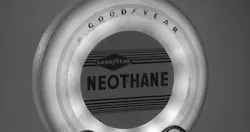
Each color served a unique purpose in the Space Age vision. Goodyear suggested the tires could be dyed in blue or white to match a car’s color scheme or driver’s outfit. The company also envisioned an added layer of safety — using the glow tires as an indicator for braking or turn signals.
However, the set of tires only had one fixed dye color before the baking process. This meant a car with blue-dyed tires glowed vividly, but it wouldn’t be able to switch to red, green, yellow, amber, or other colors.
Fully automatic color changes simply weren’t part of the concept. Back then, drivers controlled the lights manually from a switch on the control console near the steering wheel, connected to the vehicle’s electrical system. Some descriptions suggest the tires functioned as brake lights or turn signals.
Wires were routed from the console beneath the chassis and through the wheel arches to reach the hub. A slip ring mounted on the hubcap or rim maintained the connection between the car and the wheel. This setup distributed electricity to all 18 light bulbs, even as the tires spun.
In 1962 and 1963, Goodyear’s glowing tires were heavily showcased on the Golden Sahara II and other concept cars. Crowds gathered at auto shows and outdoor tracks during nighttime events to get a glimpse of the futuristic design. Although just a visual spectacle, these tires worked like interactive components that inspired future technology for signaling and communication. That includes motorcycle and bicycle LED wheel lights, tire-pressure monitoring systems, and concept smart tires featuring embedded sensors and lighting.
Technical Issues Derail the Tire’s Production
Goodyear couldn’t mass-produce the glowing tires as they became problematic. For starters, Neothane exhibited poor traction, especially on wet or snowy surfaces, and didn’t match the same quality of rubber types. That made them a significant safety concern on the road.
Friction from hard braking was a major drawback during road tests. Due to Neothane’s thermoplastic nature, the tires could soften under heat and potentially melt under severe stress. This deformed the tire, leading to dangerous handling that made the car difficult and unsafe to drive. In addition, the cars’ components, wiring, light bulbs, and slip rings were fragile, making them more likely to sustain damage from certain conditions and elements, like dirt and vibration.
If road grime and soot ended up on the tires, the glow would become cloudy and dull, making it harder to see the effect in real-world conditions. It would quickly need cleaning after every use just to maintain the glow. Moreover, the wiring system could wear out and spark, creating a fire hazard. Those problems, along with high production and maintenance costs, meant the tires were used as a showcase feature rather than a commercial product.
Now, I need your help. Despite all my digging on the subject, I couldn’t find a schematic for the tires. Have you seen it anywhere? If so, share in the comments below, or contact me directly. Whichever is easier. Thanks.
See more about this in the video below:
About the Author
 Cabe Atwell
Cabe Atwell
Technology Editor, Electronic Design
Cabe is a Technology Editor for Electronic Design.
Engineer, Machinist, Cartoonist, Maker, Writer. A graduate Electrical Engineer actively plying his expertise in the industry and at his company, Gunhead. When not designing/building, he creates a steady torrent of projects and content in the media world. Many of his projects and articles are online at element14 & SolidSmack, industry-focused work at EETimes & EDN, and offbeat articles at Make Magazine. Currently, you can find him hosting webinars and contributing to Electronic Design and Machine Design.
Cabe is an electrical engineer, design consultant and author with 25 years’ experience. His most recent book is “Essential 555 IC: Design, Configure, and Create Clever Circuits”
Cabe writes the Engineering Life & Engineering on Friday blog on Electronic Design.
See Cabe's cartoons & comic strips here.
Comment About the Article
To join the conversation, and become an exclusive member of Electronic Design, create an account today!
 Leaders Logo
Leaders relevant to this article: