The managed flash storage landscape is changing quickly. As flash memory demand continues to rise across consumer, industrial, automotive, and edge applications, product designers are reassessing which storage technologies best align with long-term performance, availability, and roadmap requirements. For many, that evaluation is increasingly pointing toward Universal Flash Storage, or UFS.

At the same time, end-user expectations are accelerating. AI-enabled experiences—from faster image recognition and voice interaction to local inference, predictive maintenance, and real-time analytics—are placing new pressures on device manufacturers. Storage is no longer just a capacity decision; it is now a meaningful contributor to overall system responsiveness, power efficiency, and user experience.
UFS has emerged as a modern managed flash technology designed to address these evolving needs. Compared with older managed flash approaches, UFS offers a more advanced interface architecture, higher performance potential, and features that better support multitasking, lower latency, and improved throughput. As more devices demand high-speed storage to keep pace with AI-driven workloads, UFS adoption is expanding well beyond flagship mobile devices.
KIOXIA is well-positioned to help customers navigate this transition. With a broad UFS portfolio that spans both legacy needs and the latest performance-oriented standards, KIOXIA supports customers at different points in their design cycles—from maintaining continuity in established platforms to enabling next-generation products with advanced storage capabilities.
Market Dynamics Driving Change
Several market forces are converging to make this an important moment for UFS:
- Flash memory demand remains strong across multiple sectors.
- Suppliers are focusing investment on technologies that best serve current and future application requirements.
- AI is reshaping storage expectations at the device level.
- Legacy managed flash technologies are seeing reduced industry support.
Heavy demand for flash memory is influencing how the industry allocates engineering and manufacturing resources. Storage suppliers are prioritizing technologies with the greatest long-term market relevance, especially those capable of supporting higher bandwidth, lower latency, and more sophisticated device architectures. UFS fits that profile well.

AI is a major catalyst behind this shift. Whether the application is a smartphone running on-device AI, an automotive platform processing sensor data, or an industrial edge device performing local analytics, storage performance matters. Faster read/write speeds, efficient command queuing, and support for full-duplex communication can all contribute to a more responsive system. These are areas where UFS provides meaningful advantages.
By contrast, legacy technologies such as embedded MultiMediaCard (e-MMC) have served the market reliably for years, particularly in low capacity and mainstream embedded applications. However, from both a supply availability and technology development standpoint, these legacy technologies face challenges. Industry support is gradually shifting toward newer standards that can meet future workload requirements more effectively.
For OEMs and system designers, this creates a strategic inflection point. Continuing with older storage standards may simplify short-term design decisions, but transitioning to UFS can offer stronger alignment with future performance expectations, broader ecosystem momentum, and a clearer technology roadmap.
Broad Spectrum of UFS Use Cases
UFS is already well established in applications where performance is critical and user expectations are high. It has become a proven choice in several categories that are actively incorporating new AI capabilities, such as smartphones, tablets and automotive infotainment and digital cockpit systems.
In these applications, UFS helps enable faster boot times, quicker app loading, smoother multitasking, and better support for high-resolution media capture and playback. As AI features become more deeply integrated into mobile and in-vehicle systems, the value of high-performance managed flash continues to grow.

At the same time, UFS is expanding into a broader set of emerging use cases. These include devices and systems that require stronger storage performance, increasing intelligence at the edge, and support for local data processing, such as:
- Robotics platforms
- Smart cameras and video systems
- Smart appliances
- Premium consumer electronics
- Intelligent edge devices
These applications often combine multiple demanding workloads—sensor input, video processing, AI inference, data logging, and real-time decision making. In such environments, storage must do more than simply hold data. It must move data efficiently and reliably, often under tight power and thermal constraints.
That is where UFS can offer clear value. Its modern serial interface and protocol stack are designed for performance-oriented embedded applications. Technical features such as command queuing and simultaneous read/write capability help improve system efficiency, particularly in multitasking environments where storage access patterns are increasingly complex.
KIOXIA Leadership in UFS Technology Development
KIOXIA has played an important role in the advancement of managed flash storage and continues to be a leader in UFS technology development. With deep expertise in flash memory innovation and a long history of supporting embedded storage applications, KIOXIA brings both technical credibility and practical market experience to customers evaluating UFS.
KIOXIA UFS technology milestones reflect ongoing investment in performance, capacity, and standards advancement. As the UFS ecosystem has evolved, KIOXIA has consistently introduced solutions designed to meet the changing needs of mobile, automotive, and embedded markets. This includes support for multiple generations of UFS, helping customers adopt the right level of performance for their application requirements and product timelines.
The KIOXIA UFS product portfolio is designed to serve a wide range of customer needs, including:
- Support for established platforms that require continuity and dependable sourcing.
- Solutions aligned with newer UFS standards for higher bandwidth and improved responsiveness.
- Options suitable for mobile, automotive, and embedded edge applications.
- Products backed by a company with broad flash storage expertise.
From its current lineup of UFS 3.1/4.1 products to its recent launch of cutting-edge UFS 5.0 technology, KIOXIA offers managed flash solutions for a wide range of applications.
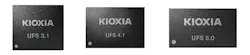
This breadth allows customers to make design decisions with greater confidence. Whether the goal is to extend an existing platform, upgrade from legacy managed flash, or launch a new AI-ready device, KIOXIA offers a portfolio that can support both current and future requirements.
For customers seeking additional information, KIOXIA encourages a visit to its UFS web page to access a wide selection of knowledge resources, some of which are noted below for easy access.
The case for UFS is becoming increasingly compelling. Market demand, AI-driven performance requirements, and changing supply dynamics are all pushing device makers toward newer managed flash technologies that can better support the next generation of intelligent systems. Whether you are new to UFS or an informed expert, the time is right to explore how it can serve your important business needs.
[1] Universal Flash Storage (UFS) is a product category for a class of embedded memory products built to the JEDEC® UFS standard specification.
[2] Embedded MultiMediaCard (e-MMC) is a specification developed by JEDEC for mobile applications. The current release is v5.1, published in February 2015.
Trademarks:
JEDEC is a registered trademark of the Joint Electron Device Engineering Council (JEDEC) Solid State Technology Association. All other company names, product names and service names may be trademarks of third-party companies.
Disclaimers:
The product images shown are representations of the design model and not accurate product depictions.
© 2026 KIOXIA America, Inc. All rights reserved. Information in this article, including product specifications, tested content, and assessments are current and believed to be accurate as of the publication date of the document, but is subject to change without prior notice. Technical and application information contained here is subject to the most recent applicable KIOXIA product specifications. This article is for informational purposes only and KIOXIA makes no representation or warranties of any kind, expressed or implied. Images within are for illustration purposes only.
Images used under license from Shutterstock.com