Bacteria-Based “Transistors” Implement, Connect Basic Logic Functions
What you'll learn:
- The basic concept of using bacteria to fabricate logic elements.
- Why this new approach differs from previous approaches in basic blocks and connectivity, and how it’s implemented.
- The results achieved with different configurations.
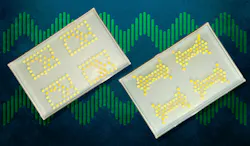
Perhaps it sounds like a premise from a futuristic science-fiction thriller: A team at MIT has engineered bacteria to behave like transistors, creating living circuit boards that can be printed onto agar plates. (The important word here is “like” — no one is claiming that they're electronic devices.)
Using two transistor types and three relay strains of Pantoea agglomerans for a total of five functions, the team built circuits capable of addition, multi-input logic gates, and demultiplexing by controlling flow of signaling molecules between colonies. As EEs know, you can build complicated digital systems using these building-block functions and combinatorial logic.
It’s a very slow-moving world that’s far away from our world of gigahertz clocks. The largest circuit they demonstrated used 24 bacterial colonies that were wired together and took about eight hours (yes, hours!) per calculation. The larger circuit boards were generally evaluated after about 72 hours. Researchers envision coating plant roots or leaves with such circuits to sense and respond to drought or pests, e.g., triggering fungicide production, rather than replacing digital computers.
That’s a Computer?
Under fluorescent light, the device looks less like a computer than a tiny constellation of dots. The specks are actually bacteria glowing red and green across a slab of agar that can perform mathematical computations (Fig. 1). One colony receives a chemical message, another decides whether to let it pass, while others relay it further along.
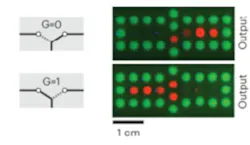
The bacterium they used is commonly found on plant surfaces. One engineered strain acts somewhat like an N-type transistor — it passes a chemical signal only when a second “switch” signal is present. The other behaves like its P-type counterpart, allowing the signal through unless that switch is activated (Fig. 2).
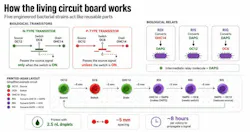
The interesting part is not that bacteria can “compute,” as synthetic biologists have already made cells perform logical functions for years. It’s that the researchers can change the computation without redesigning the bacteria themselves. By rearranging the five building blocks on the plate, the circuit can be set to do something different.
The transistor strains here don’t contain preset genetic instructions saying “be part of a half-adder” or “be part of a demultiplexer.” Instead, each performs only a simple reusable operation to allow or block the passage of another chemical signal depending on a switch signal. The researchers determine the larger computation by placing those same five cell types in different arrangements (Fig. 3).
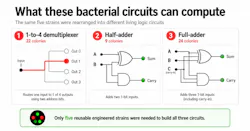
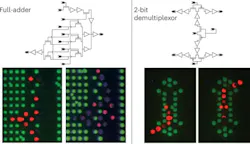
Using different arrangements of the same strains, they made a half-adder, which adds two one-bit numbers and reports both the sum and whether a carry is required. They also built a 24-colony full adder, which accepts three one-bit inputs (two numbers plus an incoming carry) and calculates a sum and outgoing carry, as well as a demultiplexer (Fig. 4). The latter takes one incoming signal and routes it toward one of four destinations, depending on two control inputs. That circuit required 22 colonies.
Lingering Questions About the Project
There are two obvious questions about this project. First, what does the “fab” process look like? The researchers printed the bacteria onto agar using an acoustic liquid-handling machine that deposited droplets as small as 2.5 nanoliters. Colonies that needed to communicate generally sat about five millimeters apart. A border of otherwise inactive green-fluorescent bacteria helped prevent colonies at the edges from growing differently simply because they had more available nutrients.
Their circuit also needs something analogous to a conductive wire to direct information toward the next component instead of indiscriminately bathing everything nearby. To do this, the researchers inserted an intermediate chemical signal and physically spaced the colonies so that a message would preferentially reach its intended neighbor.
Second, what possible use can this research serve, and where might it lead? Any answer is highly speculative, of course. Perhaps a plant could sense its own status and decide if it needed some specialized attention.
The researchers are particularly interested in agriculture. Since P. agglomerans naturally colonizes plant surfaces, future versions might live on roots or leaves, integrating several environmental signals before deciding whether a plant needs a response, perhaps producing a protective compound only when a particular combination of stresses is detected.
Another interesting aspect is that as a bacterial circuit operates, its colonies consume nutrients. Molecules carrying signals accumulate and diffuse into places where they’re not wanted. Eventually, colonies grow into one another.
Those effects currently put a hard ceiling on the usefulness and scaling of such technology. The authors write that signal buildup and crosstalk make it impossible, for now, to operate one of these living computers for much beyond about three days. They suggest that enzymes could eventually destroy old signaling molecules, effectively clearing a chemical signal after it has been used.
There is, interestingly, a coarse analogy to the situation of a conventional circuit powered from a non-rechargeable battery: This is a “computer” that eventually – and here, literally – consumes its own power supply!
The research was funded, in part, by the U.S. Defense Advanced Research Projects Agency (DARPA) and by the U.S. Intelligence Advanced Research Projects Activity. It’s detailed in their paper “Living circuit boards built by printing bacterial transistors” published in Nature Chemical Biology. Unfortunately, it’s behind a tight paywall, and the MIT team has not posted it at an internal open-access site. However, you can see the five images along with their very detailed captions here. There’s also a well-written summary at ZMET Science.
Should our conventional electronics be worried? Highly unlikely — but, again, “never say never.” Do you see any practical implications here? Even if you don’t come up with any, perhaps it will at least inspire a film script or short treatment. After all, it has all the needed elements!
About the Author
 Bill Schweber
Bill Schweber
Contributing Editor
Bill Schweber is an electronics engineer who has written three textbooks on electronic communications systems, as well as hundreds of technical articles, opinion columns, and product features. In past roles, he worked as a technical website manager for multiple topic-specific sites for EE Times, as well as both the Executive Editor and Analog Editor at EDN.
At Analog Devices Inc., Bill was in marketing communications (public relations). As a result, he has been on both sides of the technical PR function, presenting company products, stories, and messages to the media and also as the recipient of these.
Prior to the MarCom role at Analog, Bill was associate editor of their respected technical journal and worked in their product marketing and applications engineering groups. Before those roles, he was at Instron Corp., doing hands-on analog- and power-circuit design and systems integration for materials-testing machine controls.
Bill has an MSEE (Univ. of Mass) and BSEE (Columbia Univ.), is a Registered Professional Engineer, and holds an Advanced Class amateur radio license. He has also planned, written, and presented online courses on a variety of engineering topics, including MOSFET basics, ADC selection, and driving LEDs.
Comment About the Article
To join the conversation, and become an exclusive member of Electronic Design, create an account today!
 Leaders Logo
Leaders relevant to this article: