Linear Wi-Fi 7/8 Front-End Module Features Digital-Predistortion Efficiency

What you'll learn:
- The challenges posed by maintaining low error vector magnitude as frequencies and modulation increase in Wi-Fi designs.
- How a sophisticated device architecture minimizes the issues associated with digital predistortion.
- The RF and other performance of this new device, which is sampling now.
“Everything” may be going digital, if it’s not already there, but in the gigahertz-range world of RF (and wired) links, analog is still the only viable format. After all, “digital” remains a special subset of analog. Vendors are introducing RF-focused modules that enable RF applications as their frequencies and data rates extend to ranges.
Addressing this applications segment, the highly integrated QWX27104 from Swiss-based QuantalRF AG is a monolithic digital-predistortion (DPD)-efficient linear front-end module (FEM) designed for high-performance wireless local area networks (WLANs), supporting all standards including Wi-Fi 7 and Wi-Fi 8. It features a patent-pending power amplifier (PA) architecture that provides superior linearity across all power modes, a low-loss single-pole, triple-throw (SP3T) switch, and a low-noise amplifier (LNA) (Fig. 1).
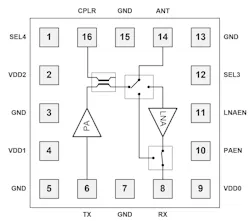
Typical applications include smartphones and other portable, rechargeable battery-operated devices, as well as AI wearables and AR/VR headsets.
Its linearity is optimized for DPD performance for further improved system error vector magnitude (EVM) performance across all modulation classes. Existing mobile systems built around available nonlinear gallium-arsenide (GaAs) FEMs lean heavily on DPD to correct amplifier distortion, as GaAs power amplifiers are fast, but they're not linear.
However, this approach consumes computational resources, increases power consumption, and erodes design margin. And it becomes progressively more difficult to sustain as channel bandwidths widen to 160 and 320 MHz.
The QWX27104 inverts that tradeoff. Because linearity is engineered into the FEM itself, the device achieves its target EVM with a lower-order, less complex DPD engine. That efficiency translates directly into system headroom: up to 3 dB more mask-compliant output power under the most demanding modulations at 160/320 MHz, greater tolerance to system, temperature and process variations, and a lighter, simpler DPD burden on the host SoC. The EVM holds within 0.5 dB across channels, compared to 4-dB+ swings for available competitive GaAs parts (Fig. 2).
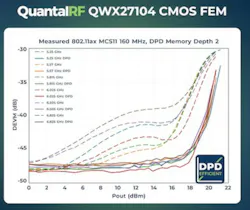
The QWX27104 has just started sampling with volume-production parts scheduled for Q1 2027. Built as a monolithic die on GlobalFoundries' 8SW RF-SOI process, engineers designed linearity into the device itself rather than correcting for it downstream. The PA architecture maintains EVM performance over varying VSWR conditions, and all RF ports are matched on-chip to 50 Ω to minimize external components and need for PCB layout area.
Other key RF specifications include:
- Transmit output power (DPD applied):
- 22 dBm, HE20, MCS0, 3 dB SEM margin
- 20 dBm, VHT80, −42 dB DEVM
- 18 dBm, HE160, −45 dB DEVM
- 16 dBm, EHT320, −43 dB DEVM
- Transmit gain: 28 dB (high gain mode)
- Current consumption: 252 mA at 21-dBm output power
- Noise figure: 2 dB
- Receive gain: 15 dB
The device operates from 5,150 to 7,125 MHz, and requires a 3.8-V supply for the PA and 1.8-V supply for the LNA. It comes in a 2- × 2-mm, 16-pin LGA package; it is also available as a flip-chip die that is smaller than 2 mm².
About the Author
 Bill Schweber
Bill Schweber
Contributing Editor
Bill Schweber is an electronics engineer who has written three textbooks on electronic communications systems, as well as hundreds of technical articles, opinion columns, and product features. In past roles, he worked as a technical website manager for multiple topic-specific sites for EE Times, as well as both the Executive Editor and Analog Editor at EDN.
At Analog Devices Inc., Bill was in marketing communications (public relations). As a result, he has been on both sides of the technical PR function, presenting company products, stories, and messages to the media and also as the recipient of these.
Prior to the MarCom role at Analog, Bill was associate editor of their respected technical journal and worked in their product marketing and applications engineering groups. Before those roles, he was at Instron Corp., doing hands-on analog- and power-circuit design and systems integration for materials-testing machine controls.
Bill has an MSEE (Univ. of Mass) and BSEE (Columbia Univ.), is a Registered Professional Engineer, and holds an Advanced Class amateur radio license. He has also planned, written, and presented online courses on a variety of engineering topics, including MOSFET basics, ADC selection, and driving LEDs.