Integrating Facial Recognition with a Smart Home
What you’ll learn:
- How to split the load for facial recognition.
- Some of Microchip’s processors that can handle smart-home chores.
In the video above, Microchip’s Brad Poole, Edge AI Business Development Manager, and Bill Li, Applications Manager for Microprocessors, highlight the SAM9x75 and SAMA7D65 application processors in a simulated smart-home environment. In this case, the SAM9x75 handles the image capture and optimization with its image sensor controller (ISC). The image is then passed via Ethernet to the SAMA7D65 that runs the facial recognition stack (Fig. 1).
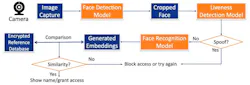
The SAM9x75 is based on an Arm ARM926 core. It incorporates 64K SRAM and a DDR2/3L interface. However, for this application, it’s the MIPI 4-lane CSI-2 camera interface and the built-in image sensor controller (ISC) that are important. The ISC supports ITU-R BT 601/656/1120 video interface up to 5 Mpixels as well as raw Bayer 12, YCbCr, monochrome and JPEG compressed sensors up to 12 bits. This provides a smart camera via Ethernet that improves the image quality before passing it on.
The SAMA7D65 is an Arm Cortex-A7 application processor running Linux. It gets the video stream via its 100/1000 Ethernet MAC with time-sensitive networking (TSN) support. The chip is supported by the Microchip Graphics Suite and MPLAB Machine Learning Development Suite. The chip is where the facial recognition software runs.
The application was running on the SAMA7D65 Curiosity Kit (Fig. 2). The board has a microSD slot plus 8 Gb of DDR3L, 64 Mb of QSPI NOR flash, 4 Gb of SLC NAND flash and a 2-kb serial EEPROM.
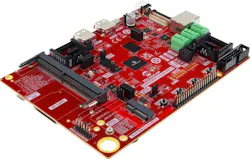
The SAMA7D65 Curiosity Kit provides two Ethernet ports (Fig. 3). One via a conventional RJ-45 jack and the other via the SODIMM socket. There are three on-board CAN-FD transceivers, too.
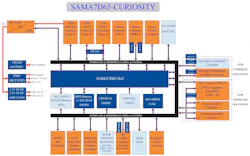
Also in the mix are a 40-pin Raspberry Pi expansion header, a pair of mikroBUS connectors, and a pair of PIOBU/system headers. The security support starts with a physically unclonable function (PUF) and includes secure boot, secure key storage, and high-performance crypto accelerators for AES, SHA, RSA, and ECC.
About the Author
 William G. Wong
William G. Wong
Senior Content Director - Electronic Design and Microwaves & RF
I am Editor of Electronic Design focusing on embedded, software, and systems. As Senior Content Director, I also manage Microwaves & RF and I work with a great team of editors to provide engineers, programmers, developers and technical managers with interesting and useful articles and videos on a regular basis. Check out our free newsletters to see the latest content.
You can send press releases for new products for possible coverage on the website. I am also interested in receiving contributed articles for publishing on our website. Use our template and send to me along with a signed release form.
Check out my blog, AltEmbedded on Electronic Design, as well as his latest articles on this site that are listed below.
You can visit my social media via these links:
- AltEmbedded on Electronic Design
- Bill Wong on Facebook
- @AltEmbedded on Twitter
- Bill Wong on LinkedIn
I earned a Bachelor of Electrical Engineering at the Georgia Institute of Technology and a Masters in Computer Science from Rutgers University. I still do a bit of programming using everything from C and C++ to Rust and Ada/SPARK. I do a bit of PHP programming for Drupal websites. I have posted a few Drupal modules.
I still get a hand on software and electronic hardware. Some of this can be found on our Kit Close-Up video series. You can also see me on many of our TechXchange Talk videos. I am interested in a range of projects from robotics to artificial intelligence.
 Brad Poole
Brad Poole
Edge AI Business Development Manager, Microchip Technology
Brad Poole is Edge AI Business Development Manager at Microchip Technology. He holds a Master's degree in international business from Saint Louis University.
 Bill Li
Bill Li
Applications Manager for Microprocessors, Microchip Technology
Bill Li is Applications Manager for Microprocessors at Microchip Technology. He holds a Bachelor of Applied Science from Queen's University and Master of Business Administration from The University of Arizona Global Campus.