What’s The Difference Between Simplex, Duplex, and Multi-Fiber Cables?
What you'll learn:
- How do fiber-optic cable assemblies work?
- Why choosing the right fiber-optic cable is important.
- Use cases for each type of fiber-optic cable.
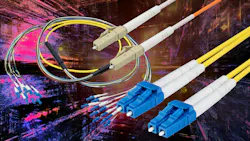
It’s no exaggeration to say that fiber-optic cables have transformed the modern world. With their ability to quickly move large amounts of data over long distances with minimal interference or signal loss, fiber optics have unlocked the potential for humans to communicate seamlessly on a global scale.
Whether serving as the backbone for military networks, providing the foundation for the internet as we know it, or enabling the growth of next-generation technologies like AI and edge computing, fiber optics continue to grow in importance as continuous connectivity becomes increasingly essential.
Before fiber optics went into wide usage in the 1970s, the primary options for long-distance signal transmission were copper wire, coaxial cable and, later, microwave radio towers and satellites. Each of these mediums had drawbacks, including limited bandwidth, susceptibility to interference, and security vulnerabilities.
With the breakthrough of transmitting data as pulses of light through hair-thin glass fibers, fiber optics eliminated many of the limitations that constrained earlier long-distance communication technologies. Their ability to send clean signals near the speed of light over hundreds of miles dramatically reduced the need for amplifiers or repeaters. And as the technology has advanced, cables can now accommodate massive bandwidths that would have been otherwise unattainable.
Today’s fiber optic cables can be divided into three broad categories — simplex, duplex and multi-fiber — which indicate how many fiber strands are in a cable and how data is transmitted.
Simplex Cables
Simplex cables were among the earliest fiber-optic designs to be deployed and as might be expected, are the least complex in terms of design.
Unlike duplex and multi-fiber configurations, simplex cables can only transmit data in one direction along a single fiber strand, with a transmitter at one end of each cable and a receiver at the other. This design has made simplex cables well-suited for applications such as broadcast video distribution, medical imaging devices, security cameras, and other monitoring systems (Fig. 1).
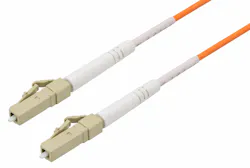
Because most modern fiber applications require data to flow in both directions, simplex cables are used less widely than they once were. However, there’s been an uptick in usage in recent years thanks to the development of single fiber BiDi (bidirectional) transceivers, which allow for transmitting and receiving on a single strand of fiber. This is achieved by using paired transceivers operating with different wavelengths over the same fiber.
Outside of two-way communication systems, these cables are still commonly used in sensor systems, alarms, and laboratory equipment.
Duplex Cables
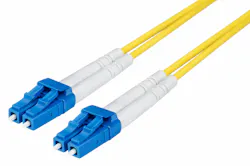
Duplex cables are the next step up in terms of functionality, providing simultaneous two-way communication using a transmitter and receiver at each end of the cable. A single cable contains two strands typically bonded together, with one sending data and the other receiving data.
Wide usage of duplex fiber cables began in the early 1990s as networking needs began to evolve. The expansion of Ethernet in enterprise and campus networks created a need for high-speed and longer-distance connections, making fiber a practical choice. Over the next few years, fiber’s versatility and immunity to electromagnetic interference (EMI) helped it become dominant as the backbone for data centers, campus networks, and other high-performance networks.
Even today, duplex remains the default for many applications (Fig. 2). Most networking and telecommunications hardware, including switches, routers, and transceivers, are designed around duplex connections. This compatibility with legacy systems helped establish duplex cables as an industry standard. Their simple two-way design also makes problems easier to troubleshoot, reducing the time and cost of maintenance.
Multi-Fiber Cables
As network speeds exceeded the capabilities of duplex connections, multi-fiber cables became a fixture in high-density environments like data centers (Fig. 3). Multi-fiber cables — a broader category of cables in which several independent fibers are bundled inside a single jacket — can carry many parallel data channels. These cables usually contain anywhere from eight and 72 fibers laid side-by-side in a ribbon-like design, with multiple connectors at each end of the cable.
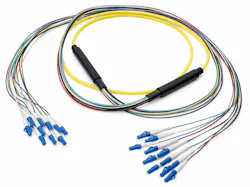
A major benefit of multi-fiber cables is their ability to simplify installation and management, eliminating the need for numerous individual cables.
Single vs. Multimode
While the design of multi-fiber cables suits them for high-density, high-speed network connections, the cables’ actual performance depends on the characteristics of each individual fiber inside. The diameter of each fiber’s core determines its bandwidth, speed, and distance.
Smaller cores, such as those in single-mode fiber, can carry a single light path over long distances at a very high speed, though they require more precise alignment during installation. The larger cores inside multimode fiber enable multiple light paths; therefore, more data can be transferred over shorter distances compared to single-mode fiber.
Multimode fibers are categorized based on the speeds and distances they’re able to support. The oldest category, OM1, has been around since the late 1980s and is still used today in legacy networks, supporting speeds from 1 to 10 Gb/s. Each successive OM (optical magnitude) generation has increased bandwidth and distance capabilities. OM3 and OM4 are common in modern data centers, supporting speeds from 10 Gb/s to as high as 100 Gb/s.
The newest generation of multimode fiber, OM5, is designed to support shortwave wavelength-division multiplexing (SWDM), in which multiple independent high-speed data streams are sent over the same fiber using different wavelengths. This method effectively increases the bandwidth of a single fiber and allows an enormous amount of data to be sent using fewer total fibers.
Choosing the Right Cable
When selecting the right type of fiber for a given application, several key questions should be considered:
- How will the fiber be used? If the data only flows in one direction, simplex fibers might be an appropriate choice. In many standard networking situations where data is being sent and received at the same time, duplex fiber is sufficient.
- What distance does the data need to travel? Single-mode fiber is best suited for long distances, while multimode fiber is generally more practical for shorter runs, such as within data centers, on campuses, or inside office buildings.
- What are the required bandwidth and speed? Higher-speed, higher-density network environments might require newer generations of multimode fiber, such as OM4 or OM5, to support modern Ethernet standards.
- How important is future scalability? If a network is being designed with growth in mind, it’s important to consider fibers and cable configurations that accommodate high speeds and increased capacity over time.
By clearly understanding the variables, network engineers can make a knowledgeable decision that balances performance, cost and long-term flexibility, selecting a fiber solution that delivers reliable performance while supporting future growth.
>>Download the PDF of this article, and check out the TechXchange for similarly themed articles and videos

About the Author
 Paul Hospodar
Paul Hospodar
Fiber Optic Product Line Manager, Infinite Electronics
Paul Hospodar is a fiber-optic product line manager at Infinite Electronics, where he oversees the development and management of advanced fiber-optic connectivity solutions. His focus is on supporting the expanding requirements of telecom, data center, and enterprise networking with cutting-edge fiber-optic products.
Comment About the Article
To join the conversation, and become an exclusive member of Electronic Design, create an account today!
 Leaders Logo
Leaders relevant to this article: