What EN 1175 Means for Connector Design in Electrified Material-Handling Equipment
What you’ll learn:
- What is EN 1175 and why has it become more important as fleets shift to lithium-ion power?
- EN 1175 testing requirements for connectors.
- Mistakes engineers and OEMs make when applying EN 1175.
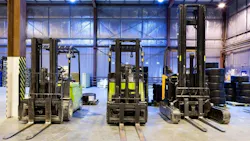
As material-handling fleets rapidly electrify, equipment designers are being asked to support higher power demands, new battery chemistries, and more frequent charging while maintaining operator safety, equipment reliability, and uptime.
With that shift comes a new design standard that many equipment designers still don't fully understand: EN 1175, a European safety framework for the electrical and electronic systems used in industrial trucks, including forklifts. The standard touches everything from battery-management systems and charging to control system safety functions.
I spoke with Josh Haney, Engineering Manager at Anderson Power, about what the latest edition of EN 1175 means for OEMs and designers, how it changes the way engineers should evaluate connectors, and why compliance should be treated as a starting point rather than the end goal for next-generation designs.
What is EN 1175 and why has it become increasingly important as fleets electrify?
At the highest level, EN 1175 is a safety standard for electrically powered industrial trucks that establishes performance and safety requirements for equipment electrical systems and subsystems.
Within the European Union, EN 1175 is particularly significant because it’s a harmonized standard that supports conformity with the region’s machinery safety requirements. Meeting the standard is not necessarily the only possible route to conformity, but it’s one of the most established and practical ways for a manufacturer to demonstrate that its equipment has been designed and tested against recognized safety expectations.
Because OEMs typically aren’t designing equipment for only one isolated market, manufacturers globally are also paying attention to this standard. Designing around EN 1175 can put them in a stronger position to sell in Europe while also creating a rigorous safety and performance foundation for products sold elsewhere.
The shift from lead-acid batteries toward lithium-ion technology is also contributing to its relevance. Lithium-ion systems generally incorporate a battery-management system (BMS) and introduce different considerations around charging, controls, and system integration. As manufacturers adopt those technologies, they’re looking for a clear framework to help them determine what safe performance should look like across the complete truck.
While compliance isn’t mandatory, the demanding testing requirements of EN 1175 give engineers greater confidence that a component has been evaluated against a substantial set of safety and performance requirements and therefore is an indicator of a well-tested design.
Where do connectors fit within the EN 1175 safety framework?
EN 1175 applies to the complete electrical system, but it also includes requirements for specific subsystems. Connectors are addressed in Annex A, which covers connections for energy sources.
That annex includes performance requirements as well as a rigorous test plan intended to represent the wear, damage, and environmental exposure a connector may experience in the field. Where a datasheet rating shows how a connector performs when it’s new and in a controlled lab environment, EN 1175 testing requires that a connector continues to perform safely after being exposed to mechanical stress, chemical conditioning, and other forms of foreseeable use and abuse.
Testing may involve chemical exposure, mechanical damage, and drop testing, followed by additional safety checks to verify that the connector still protects operators and technicians from electrical hazards.
How does EN 1175 change the way engineers evaluate connectors?
Historically, engineers may have started primarily with voltage, current rating, and physical fit. Those are still necessary considerations, but they’re not sufficient on their own.
Engineers need to understand the conditions behind a published rating. EN 1175 establishes specific performance thresholds, including the allowable temperature rise associated with a current rating. Keep in mind that a rating only applies within the conditions under which it was established. If an application pushes beyond those boundaries, the engineer cannot assume the same performance or safety conclusions still apply.
Material selection is another major consideration. Connector insulation has always needed to protect against electrical shock and mechanical damage. But EN 1175 raises the bar by exposing the product to substances such as acids and oils before requiring it to complete additional performance and safety testing. A conventional engineering plastic that has worked in an existing product for years may be unsuitable for an EN 1175 design if it cannot withstand that conditioning.
Engineers should therefore ask suppliers for compliance documentation, test information, and an explanation of the conditions under which the product’s ratings apply. They should also discuss the actual operating environment, mating frequency, charging strategy, maintenance procedures, and potential misuse.
At the same time, compliance should not be the only selection criterion. EN 1175 establishes an important baseline, but it doesn’t prescribe every feature that could improve the end user’s experience or the equipment’s reliability.
- A latching system, for example, can help ensure that the connection remains secure and may reduce certain forms of misuse.
- Temperature-sensing capability can provide information that supports monitoring and preventive action.
- Auxiliary contacts or signals can also be implemented in different ways depending on the needs of the equipment.
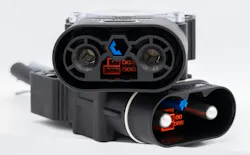
Two products may both meet EN 1175 and still offer meaningfully different functionality, so engineers should ask manufacturers what else the design can do to support their specific application. That approach has guided recent work at Anderson Power, including development of the Industrial Battery Connector (Fig. 1).
How can connector selection help reduce risk and affect uptime and long-term fleet performance?
Connectors take a disproportionate amount of abuse as a component that's often treated as an afterthought next to the battery.
Industrial battery connectors experience significant physical wear. They’re mated and unmated repeatedly, dropped, pulled, contaminated, and handled improperly. With lithium-ion batteries, some operators also use opportunity charging during breaks, which can increase the number of mating cycles a connector experiences compared to a more traditional once-per-shift charging routine.
Batteries, by comparison, tend to last a long time, which means that a connector design should account for potential degrading behavior.
While there may be a modest cost difference between an EN 1175-compliant connector and a more conventional design because of the materials, testing, and construction involved, engineers should evaluate that difference against the potential cost of unplanned downtime, field failures, maintenance, and redesign. The lowest-cost component at the time of purchase may not be the lowest-cost option over the life of the fleet.
What mistakes do OEMs make when applying EN 1175?
The most consequential mistake is timing. EN 1175 should influence architecture and component decisions early in the design process, rather than being used as a checklist when the equipment is already entering validation.
A compliant component doesn’t automatically work in every application. The engineer must understand the connector’s rating conditions and confirm that the intended voltage, current, temperature, duty cycle, and environment remain within those boundaries.
Another mistake is treating the standard as though every design detail is prescribed. Some requirements are fixed, while others leave room for different implementations. For example, the standard may require auxiliary signaling with a certain level of performance without specifying one universal configuration for every product. That gives engineers room to ask for features that better serve the equipment, but they need to understand which changes can be made without affecting compliance.
This is where early collaboration with component suppliers becomes valuable. A knowledgeable supplier can help distinguish between mandatory requirements, flexible design areas, and optional features. That conversation allows the OEM to prioritize what the equipment must have, what would be useful to have, and where tradeoffs may be necessary.
Before electrifying or continuing to electrify their fleets, what else should OEMs know about EN 1175?
Start by defining the complete set of requirements: Determine where the equipment will be sold, which standards and regulatory frameworks apply in those markets, and which product features are mandatory versus preferred. Different standards don’t automatically coordinate with one another, so engineers need to understand the combination their equipment may be expected to satisfy.
Then, treat EN 1175 compliance as a strong starting point rather than a finish line. Once it’s identified that a component satisfies EN 1175, the next question should be: What else can this design do?
Some manufacturers are already building past the compliance ceiling. For example, Anderson Power's Industrial Battery Connector is built to meet EN 1175:2025 alongside DIN VDE 0623-589, UL 1977, CSA 22.2, and related standards, while adding a modular cartridge design for tool-less servicing, an integrated temperature-sensing accessory, and an IP68 sealing kit and latching handle option (Fig. 2).
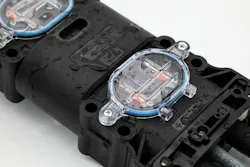
The most effective designs will combine recognized compliance with application-specific features that improve safety, usability, and reliability. EN 1175 should not be viewed as a restriction. Used early and thoughtfully, it’s a benchmark that can help OEMs build a stronger product and create a competitive advantage in fleet performance and uptime.
About the Author
 William G. Wong
William G. Wong
Senior Content Director - Electronic Design and Microwaves & RF
I am Editor of Electronic Design focusing on embedded, software, and systems. As Senior Content Director, I also manage Microwaves & RF and I work with a great team of editors to provide engineers, programmers, developers and technical managers with interesting and useful articles and videos on a regular basis. Check out our free newsletters to see the latest content.
You can send press releases for new products for possible coverage on the website. I am also interested in receiving contributed articles for publishing on our website. Use our template and send to me along with a signed release form.
Check out my blog, AltEmbedded on Electronic Design, as well as his latest articles on this site that are listed below.
You can visit my social media via these links:
- AltEmbedded on Electronic Design
- Bill Wong on Facebook
- @AltEmbedded on Twitter
- Bill Wong on LinkedIn
I earned a Bachelor of Electrical Engineering at the Georgia Institute of Technology and a Masters in Computer Science from Rutgers University. I still do a bit of programming using everything from C and C++ to Rust and Ada/SPARK. I do a bit of PHP programming for Drupal websites. I have posted a few Drupal modules.
I still get a hand on software and electronic hardware. Some of this can be found on our Kit Close-Up video series. You can also see me on many of our TechXchange Talk videos. I am interested in a range of projects from robotics to artificial intelligence.
 Josh Haney
Josh Haney
Engineering Manager, Anderson Power
Josh Haney is the Engineering Manager at Anderson Power. He holds a Bachelor of Science in Mechanical Engineering from the University of Massachusetts Amherst and has worked in the connector industry for 10 years. He has experience in connector design for many different markets and has worked with certifying bodies such as UL, CSA, and TUV.
Related

Comment About the Article
To join the conversation, and become an exclusive member of Electronic Design, create an account today!
 Leaders Logo
Leaders relevant to this article: