Making Variable Refresh Rate Performance Comparable
What you’ll learn:
- How to verify variable refresh rate performance claims by display manufacturers.
- The pitfalls of cherry-picking performance.
- How testing conditions can further distort results, while aggressive overdrive could reduce response times at the cost of visible artifacts.
- Find out about VESA’s Adaptive-Sync Display standard.

Variable refresh rate (VRR) technology is now a baseline feature across modern displays. From gaming monitors to laptops, support for Adaptive-Sync protocols is now effectively ubiquitous, with broad enablement across GPUs and display interfaces.
At the same time, as adoption of VRR has scaled across the industry, the challenge has been to ensure that performance claims by display manufacturers are consistent, comparable, and reflective of real-world behavior. Displays may advertise similar specifications, such as refresh rates of 144 Hz, 240 Hz, or higher, yet deliver meaningfully different user experiences depending on factors such as gray-to-gray (G2G) transition behavior, overdrive-induced artifacts, flicker, jitter, and frame handling characteristics. This makes it difficult to establish true apples-to-apples comparisons based on spec sheet values alone.
The Pitfalls of Cherry-Picking Performance
Part of the challenge lies in how display performance has traditionally been measured and marketed.
As an example, G2G response time, which measures the time it takes for a pixel to transition from one shade of gray to another, is frequently reported as a single “best case” value. However, G2G performance can vary significantly depending on the transition being measured. Reporting only the fastest transition doesn’t represent the overall behavior of the display in the real world.
Testing conditions can further distort results. Increasing panel temperature may significantly improve measured response times — in some cases by as much as 2X with modest increases in ambient temperature. Meanwhile, aggressive overdrive settings can reduce response times at the cost of visible artifacts such as ghosting (Fig. 1).

These practices highlight a broader issue: Without standardized, real-world test methodologies, performance claims aren’t always directly comparable.
A More Rigorous Approach to VRR Measurement
While Adaptive-Sync protocols define how a GPU and display coordinate refresh timing, they don’t define how well a display performs when doing so. To address this gap, VESA introduced the Adaptive-Sync Display Compliance Test Specification (CTS), along with the AdaptiveSync and MediaSync logo programs (Fig. 2).

The Adaptive-Sync Display CTS evaluates displays under conditions intended to reflect actual usage:
- Testing is performed in factory-default configurations, rather than tuned modes.
- Measurements are GPU-agnostic, ensuring consistent baseline performance.
- Multiple aspects of visual performance are evaluated, including response time behavior, flicker, jitter, and dropped frames.
Rather than relying on isolated metrics, the result is a multi-dimensional assessment of display behavior.
The Adaptive-Sync Display CTS defines more than 50 test criteria, supported by automated and repeatable methodologies. Several elements distinguish this approach from conventional practices. G2G response time is averaged across multiple transitions, thereby avoiding best-case bias.
Overshoot and undershoot are restricted, balancing speed with visual quality. Ambient conditions such as temperature are tightly controlled (to 72.5-76°F / 22.5-24.5°C) to ensure consistency. Flicker and jitter are explicitly defined and measured, including across all of the main international video frame rate standards for media playback (EDID Minimum, 23.976, 24, 25, 29.97, 30, 47.952, 48, 50, 59.94 and 60Hz).
This emphasis on measurement rigor is intended to ensure that certified performance aligns with what users actually see on their screens. The table summarizes the high-level Adaptive-Sync Display specifications that vary across the logo performance tiers.
Evolving with New Display Capabilities
As display technologies continue to evolve, so too does the Adaptive-Sync Display specification.
Test spec version 1.1 updated both the scope and precision of testing. For example, the transition from a 5x5 G2G test matrix to a larger 9x9 G2G test matrix significantly increased coverage of response behavior. Meanwhile, the replacement of fixed percentage overshoot and undershoot limits when overdrive is enabled with perceptual quantization (PQ)-based limits aligned measurement thresholds more closely with human visual sensitivity. These changes deliver a far better representation of the display’s variable refresh rate performance, including significantly reduced undershoot allowances.
Figure 3 illustrates the maximum 10-bit Delta-PQ overshoot and undershoot values permitted by the VESA Certified Adaptive-Sync Display CTS. The axes identify the starting and ending 8-bit SDR gray-level transitions being tested. And the values within the tables represent the maximum allowable overshoot and undershoot tolerances expressed in 10-bit Delta-PQ using the SMPTE ST 2084 transfer function, which provides a measurement that more closely reflects human visual perception.
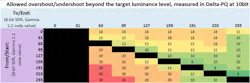
Delta-PQ tolerance values aren’t provided for tests that start and end with the same code value, and for tests that finish in either code value 0 or 31. Overshoot or undershoot that occurs on these 56 gray-to-gray transitions is measured. If overdrive is being applied, up to 35 of the transitions may overshoot, and up to 21 of the transitions may undershoot.
In each of the 56 transitions, the overshoot and undershoot limits are compared to a mandate defined in 10-bit PQ values, in which the change of the measured overdrive compared to the target level is called the Delta-PQ.
Additional updates to the Adaptive-Sync Display standard supported emerging display capabilities, such as overclocking or faster mode operation, as well as operation across multiple resolution and refresh rate combinations (known as “dual mode”), while maintaining consistent certification requirements. These changes reflect an ongoing effort to ensure that the standard remains relevant as display performance continues to advance.
Display OEMs wishing to certify products that support an overclocked mode option at a higher AdaptiveSync Display refresh rate certification than the factory default configuration must have the displays tested at both their out-of-the-box factory default settings and in their overclocked mode while still at maximum resolution. Moreover, all VESA Adaptive-Sync Display CTS requirements must be met in both modes.
For Adaptive-Sync Display dual-mode certification, all requirements of the Adaptive-Sync Display CTS must be met at both tested resolutions. This includes a minimum of 144 Hz at maximum resolution, and a minimum of 1080p vertical resolution when tested in the reduced resolution/maximum refresh rate mode.
Building on the DisplayHDR Model
The Adaptive-Sync Display program builds on the model established by VESA’s DisplayHDR specification, which introduced a standardized approach to evaluating high-dynamic-range (HDR) performance. DisplayHDR demonstrated that open, industry-wide, front-of-screen performance standards can drive both transparency and adoption. Adaptive-Sync Display extends this concept to VRR, addressing a different but equally important dimension of display quality.
The development of the Adaptive-Sync Display standard reflects broad collaboration across the display ecosystem, including panel manufacturers, GPU vendors, OEMs, and component suppliers. Adoption of the standard has grown rapidly, with more than 300 display models certified under the Adaptive-Sync Display program to date.
This level of participation underscores the industry’s recognition of a shared need: a consistent and credible way to characterize display performance. For OEMs, certification also provides a consistent and trusted way to communicate display quality to the market, enabling clearer differentiation based on measurable, real-world performance rather than isolated spec sheet metrics.
Establishing Clear Benchmarks for VRR Comparison
As VRR has become ubiquitous, the focus has shifted to how well it’s implemented. To support that effort, standardized, transparent, and reproducible testing become essential. By defining how VRR performance is measured — and ensuring that those measurements reflect real-world conditions — the Adaptive-Sync Display CTS provides a foundation for more meaningful comparisons across displays.
For engineers and OEMs, that clarity enables more consistent product design and a more credible way to communicate performance characteristics. For the broader market, it provides a clear and consistent set of metrics to easily compare variable refresh rate performance of displays. As a result, consumers not only know that a display supports VRR, but they can better understand how well it performs.
>>Download the PDF of this article, and check out the TechXchange for similarly themed content
 dreamstime_jjfarq_127267342

About the Author
 Roland Wooster
Chairman, VESA Display Performance Metrics Task Group
Roland Wooster is chairman of the Video Electronics Standards Association (VESA) task group responsible for VESA’s Adaptive-Sync Display, DisplayHDR, and ClearMR specifications and logo programs, as well as the association’s representative from Intel Corp., where he is the principal engineer responsible for client platforms display architecture.
Roland holds bachelor’s and master’s degrees in computer science from Lancaster University (England), and Virginia Polytechnic Institute and State University, respectively, as well as an MBA from the University of Phoenix (Sacramento, Calif.).
Comment About the Article
To join the conversation, and become an exclusive member of Electronic Design, create an account today!
 Leaders Logo
Leaders relevant to this article: