5 More Popular Single-Board Computers for July 2026
What you'll learn:
- Insight into five of the latest single-board computers designed for AI, robotics, industrial automation, and Linux projects.
- How today’s SBCs are incorporating faster processors, AI accelerators, high-speed networking, and expanded storage.
- Comparisons of their hardware specifications and capabilities.
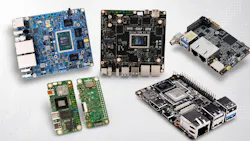
Single-board computers (SBCs) continue to evolve beyond the simple maker platforms that debuted years ago, as manufacturers outfit them with desktop and RISC-V processors, dedicated AI accelerators, faster networking, and high-speed expansion. Whether they're designed for edge AI, robotics, industrial automation, or general-purpose computing, today's SBCs pack more processing power in incredibly small footprints.
In this roundup, we look at five more popular single-board computers for July 2026.
Orange Pi 6 Plus
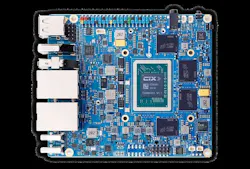
The Orange Pi 6 Plus is a tiny board that packs a ton of features. The board integrates a CIX P1 SoC with a DynamIQ processor that has 4x Cortex‑A720 big cores, 4x Cortex‑A720 medium cores, and 4x Cortex‑A520 LITTLE cores. In addition, it includes an Arm Immortalis G720 MC10 GPU, up to 64 GB of LPDDR5 RAM, and a neural processing unit (NPU) that drives up to 30 TOPS. Also in the mix are a pair of M.2 Key-M sockets for storage; one M.2 Key-E socket for Wi-Fi and Bluetooth; dual 5-GbE networking; five display interfaces via HDMI, DP, USB-C, and eDP; two 4-lane camera interfaces; and more.
Product: Orange Pi 6 Plus
Company: Orange Pi
Form Factor: Single-board computer
SoC: CIX Pi SoC
CPU: DynamIQ processor with 4x Cortex‑A720 big cores, 4x Cortex‑A720 medium cores, and 4x Cortex‑A520 LITTLE cores.
GPU: Immortalis G720 MC10
VPU: NPU with up to 30 TOPS.
Memory: Up to 64 GB of LPDDR5 RAM.
Storage: 64-Mbit SPI NAND flash, 2x M.2 M‑Key (PCIe Gen4 x4) 2,280 sockets for NVMe SSD, microSD card slot.
Communication: 2x 5Gb/s Ethernet RJ45 ports supporting 10/100/1,000/2,500/5,000-Mb/s speeds, optional Wi-Fi and Bluetooth module via M.2 E‑Key socket.
Connections: 2x M.2 Key-M (PCIe Gen4 x4) sockets for NVMe SSD or AI accelerators, M.2 Key-E (PCIe Gen4 x2+ USB) socket for wireless module, 40-pin color-coded GPIO header with UART, I2C, SPI, PWM. 1x UART via 10-pin wafer, 2x RS-232/422/485 10-pin header.
USB: 2x USB 3.2 Gen 2, 1x Type-C port with DP Alt Mode and Power Delivery, 2x USB 3.2 Gen 2 Type-A ports, 2x USB 2.0 Type-A ports, 9-pin socket with USB 2.0 header.
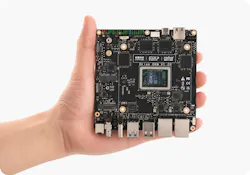
The Radxa Orion O6N, a Nano-ITX SBC, is a less expensive version of the Orion O6 mini-ITX motherboard launched late in 2024. The board is driven by a CIX P1 CD8160 SoC equipped with a 12-core DynamIQ processor that includes 4x Cortex‑A720 big cores, 4x Cortex‑A720 medium cores, and 4x Cortex‑A520 LITTLE cores. The board also packs an Arm Immortalis G720 MC10 GPU, up to 64 GB of LPDDR5 RAM, and an NPU capable of delivering up to 30 TOPS.
Product: Radxa Orion O6N
Company: Radxa
Form Factor: Single-board computer
SoC: CIX P1 CD8160
CPU: DynamIQ processor with 4x Cortex‑A720 big cores, 4x Cortex‑A720 medium cores, and 4x Cortex‑A520 LITTLE cores.
GPU: Immortalis G720 MC10 Memory: Up to 64 GB of LPDDR5 RAM. Storage: 2x M.2 M‑Key (PCIe Gen4 x4) sockets for NVMe SSD, UFS connector for Radxa module.
Communication: 2.5-Gb/s Ethernet RJ45 ports supporting 10/100/1000/2500-Mb/s speeds. Optional Wi-Fi 7/6E and Bluetooth module via M.2 E‑Key socket, optional 4G LTE/5G cellular via M.2 B-Key socket.
Connections: 2x M.2 Key-M (PCIe Gen4 x4) socket for NVMe SSD, M.2 Key-E (PCIe Gen4 x2+ USB) socket for wireless module, M.2 Key-B key socket, 6x UART via headers, 40-pin color-coded GPIO header with 3x UART, 2x I2C, 2x I2S, 2x PWM, 1x SPI, 10x GPIO.
USB: USB 3.2 Gen 2 Type-C port with DP Alt Mode, 2x USB 3.2 Gen 2 Type-A ports, 3x USB 2.0 Type-A ports.
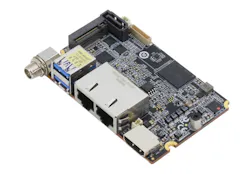
AAEON’s de next-RAP8 is touted as “the world’s most powerful credit card-sized SBC,” as it comes equipped with Intel’s Core i7-1365UE CPU, depending on the model. Users can have their choice of processor, including Intel’s Core i3-1315UE, Core i5-1335UE, or Core i7-1365UE CPU, along with the Intel Iris Xe GPU and up to 16 GB of LPDDR5x RAM. The board also supports SATA and M.2 NVMe SSDs, features GbE and 2.5-GbE networking ports, a pair of USB Type-A ports, HDMI and eDP display interfaces, and more.
Product: AAEON de next-RAP8
Company: AAEON
Form Factor: Single-board computer
SoC: DENEXT-RAP8-A10-0001, DENEXT-RAP8-A10-0002, DENEXT-RAP8-A10-0003
CPU: Core i3-1315UE, Core i5-1335UE, Core i7-1365UE CPU
GPU: Intel Iris Xe
Memory: Up to 16 GB of LPDDR5x RAM.
Storage: SATA III 6-Gb/s port and SATA power connector, NVMe SSD via M.2 2280 M-Key socket.
Communication: Gigabit Ethernet RJ45 jack via Intel I219-LM controller, 2.5-GbE RJ45 jack via Intel I226-LM controller, 2x RS-232/422/485 via pin header.
Connections: M.2 2280 M-Key socket (PCIe x2), PCIe Gen3 x4 via FPC connector, 8-bit GPIO header, Optional SMBus/I2C.
USB: 2x USB 3.2 Gen2 Type-A ports, 4x USB 2.0 via pin header.
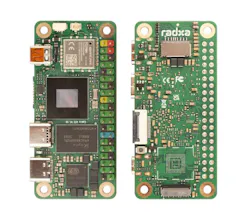
Radxa’s Cubie A7Z is similar in size to the Raspberry Pi Pico, but it packs a powerful Allwinner A733 SoC. The board packs a dual-core Arm Cortex-A76, hexa-core Arm Cortex-A55, and a single-core RISC-V E902 real-time core, along with Imagination Technologies’ BXM-4-64 MC1 GPU and up to 16 GB of LPDDR4/4x RAM. Additional features include a microSD card slot, optional UFS flash, micro HDMI and USB-C DisplayPort video output, a Wi-Fi 6 and Bluetooth 5.x wireless module, and more.
Product: Cubie A7Z
Company: Radxa
SoC: Allwinner A733
CPU: Dual-core Arm Cortex-A76, hexa-core Arm Cortex-A55, single-core RISC-V E902 real-time core.
GPU: Imagination Technologies BXM-4-64 MC1
Memory: Up to 16 GB of LPDDR4/4x RAM.
Storage: MicroSD card slot, connections for optional 64-, 128-, 256-, or 512-GB 2-lane UFS 3.0 module.
Communication: Dual-band Wi-Fi 6 and Bluetooth 5.4 module (Quectel FCU760K), IPEX antenna connector.
Connections: 40-pin color-coded GPIO header, PCIe Gen3 x1 FPC connector.
USB: USB 2.0 OTG Type-C port, USB 3.1 OTG Type-C port with DisplayPort Alt. mode.
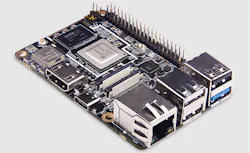
Geniatech’s XPI-7110 is another RISC-V-based SBC designed around the powerful StarFive JH7110 SoC. It contains an RV64GC quad-core RISC-V processor, an Imagination BXE-4-32 GPU, and up to 8 GB of RAM. The board also features multiple USB ports, HDMI 2.0, Gigabit Ethernet, Wi-Fi/BT, GPIO, camera and display ports, and more.
Product: XPI-7110
Company: Geniatech
SoC: StarFive JH7110
CPU: RV64GC RISC-V processor
GPU: Imagination BXE-4-32
Memory: Up to 8 GB of RAM.
Storage: Up to 256 GB of eMMC flash, microSD card slot.
Communication: Gigabit Ethernet RJ45 port, onboard 2.4/5-GHz dual-band Wi-Fi with U.Fl connector for external antenna, Bluetooth 5.0.
Connections: 40-pin Raspberry Pi-compatible GPIO header.
USB: 3x USB 2.0 ports, 1x USB 3.0 port.
Final Thought
Single-board computers continue to push into new territory, offering everything from powerful AI accelerators and multi-core processors to faster networking and expanded storage options. Whether they're destined for robotics, industrial control, edge computing, or everyday Linux projects, these latest platforms show there's no shortage of capable hardware for just about any project.
About the Author
 Cabe Atwell
Cabe Atwell
Technology Editor, Electronic Design
Cabe is a Technology Editor for Electronic Design.
Engineer, Machinist, Cartoonist, Maker, Writer. A graduate Electrical Engineer actively plying his expertise in the industry and at his company, Gunhead. When not designing/building, he creates a steady torrent of projects and content in the media world. Many of his projects and articles are online at element14 & SolidSmack, industry-focused work at EETimes & EDN, and offbeat articles at Make Magazine. Currently, you can find him hosting webinars and contributing to Electronic Design and Machine Design.
Cabe is an electrical engineer, design consultant and author with 25 years’ experience. His most recent book is “Essential 555 IC: Design, Configure, and Create Clever Circuits”
Cabe writes the Engineering Life & Engineering on Friday blog on Electronic Design.
See Cabe's cartoons & comic strips here.