Motor-Driven Reflexes Will Define the Future of Robotics
What you'll learn:
- Why robotics require better motor-driven reflexes, not only more advanced AI.
- How deterministic motion control keeps robotic movements stable, precise, and safe.
- Why motion control, high-performance compute, and functional safety are converging into all-in-one robotics controllers.
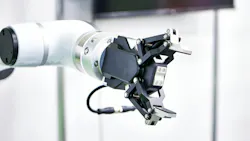
Today's robotics conversations are centered around AI, especially as new foundation models promise more capable humanoids, vision systems can identify objects with remarkable accuracy, and large language models (LLMs) start to enable more intuitive human-robot interaction.
However, intelligence alone doesn't make a robot useful or safe for real-world settings. Every AI-generated decision ultimately becomes a physical action. Whether a robot safely picks up an object, repeats a function, or adjusts its path around an unexpected obstacle depends on one thing: its motion-control architecture. Equally important as AI is the ability to translate perception into smooth, deterministic, real-time motion.
In many ways, the robotics industry's attention has been focused on building smarter robot "brains" when the next phase of robotics requires better “reflexes.”
AI is Changing the Requirements for Motion Control
In robots, these reflexes are powered by multiple servo motors — in many cases, brushless DC (BLDC) motors — each powered by a motor driver that regulates current, torque, velocity, and/or position. For instance, a robotic arm can be equipped with 6 to 12 servo-motor joints, while a humanoid robot could contain as many as 40 to 70 motor joints distributed throughout the body, including in the neck, torso, arms, legs, and hands.
The motor drive inside each one acts as the muscles. It interprets the low-voltage command signals from the MCU or other motor-control SoC and supplies high-power current/voltage to the motor or actuator. Encoders that measure the position of the motor’s rotors and/or force sensors that measure torque provide the feedback required to close the motor-control loop.
A robot contains several layers of real-time processing: the decentralized motor drives at the joint level and a centralized motion controller a level above them that runs motion algorithms, delivers command signals to them, and synchronizes the movement of the joints to guide the robot’s velocity and trajectory. At the system level, a robotics controller makes sense of its surroundings and then runs AI to decide how everything at the extremities should react.
Traditional industrial robots followed predefined motion paths inside carefully controlled spaces such as robotic arms enclosed within a safety cage on a factory floor. The motion controllers inside are designed to execute the same trajectories over and over with little variation. For engineers, the challenge is largely one of optimization: how to perform a repeated motion as accurately, efficiently, and quickly as possible.
Today's robots operate very differently. Rather than executing fixed programs, they continuously interpret data from cameras, LiDAR, force sensors, tactile sensing, and environmental inputs before dynamically adjusting their movements. AI allows robots to perceive changing conditions, collaborate with people, and make context-aware decisions in real-time, which fundamentally changes what engineers expect from motion-control systems.
Control-loop response times in humanoid robots, for instance, need to be in the sub-millisecond range at the joint level to maintain dynamic stability when walking or manipulating objects, with motor-position updates occurring at 1 to 4 kHz and current regulation exceeding 10 kHz. In turn, today’s controllers must support real-time changes to trajectories, synchronized multi-axis coordination, and deterministic response times while maintaining safe operation under constantly changing conditions.
Given these new demands on robotics systems, the new industry challenge is less about generating intelligent decisions and more about executing them with predictable, reliable physical movement.
The Criticality of Deterministic Control for Robotics
Real-world environments leave little to no margin for uncertainty. If a collaborative robot detects a person stepping into its workspace, every component, from perception software to motion planning to servo control, must respond within deterministic timing constraints.
In a humanoid robot, for instance, taking even a single step involves coordinated control of dozens of motor joints to enable precise motion and good balance. If the movement of even one joint is delayed, it can lose its balance when encountering obstacles, recovering from a collision, or traversing uneven terrain.
Maintaining stability requires tight synchronization across the entire body. Motor controllers at each joint must react with high accuracy and low latency to local conditions, rapidly report conditions up the line, and enable the central motion controller to coordinate everything in real-time. Even short delays between motor controllers or synchronization errors between motor drives can affect positioning accuracy, reduce efficiency, or compromise safety.
That makes closed-loop motor control increasingly important. High-resolution feedback from encoders and other sensors enable controllers to continuously compare commanded motion with actual system behavior and make corrections in real-time. Due to the location of motor drives in the robot, enabling deterministic communication between them all is also important. They’re typically daisy-chained with a motion controller or connected to one via linear bus topology.
Achieving fast, deterministic response times for the motor drive requires engineers to consider timing, latency, jitter, and bandwidth. These factors dictate which real-time communication protocol is needed. They also influence how to split motor-control algorithms between the inner motor drives deployed in the robot, the centralized motor controller, and the outer robotics controller. The right architecture can minimize the communication data frame size needed between these nodes.
Likewise, real-time industrial networks such as EtherCAT allow multiple motion axes to remain tightly synchronized while coordinating with vision systems, AI inference engines, and safety controllers.
Motion Control and Functional Safety Can No Longer Be Separate
In many of today’s industrial robots, real-time motion control, functional safety, and AI acceleration run on independent processors. While this approach simplifies system partitioning, it also requires complex integration, introducing latency due to delays between all of the hardware and software interfaces. These delays can lead to, for instance, imprecise, unnatural movement in humanoid robots, particularly when fast responses are required.
In safety-critical situations, these delays can force the robot to shut down when unforeseen dangers are detected or when operating in close proximity to humans. Instead of triggering an emergency stop every time that occurs, the robot should dynamically reduce its speed, adjust its trajectory, limit applied force, or reroute its movement while maintaining productivity and protecting nearby workers. As a result, functional safety can no longer be treated as a standalone subsystem.
Instead, engineers are increasingly adopting architectures that tightly integrate motion control, safety processing, sensing technologies, and real-time software to enable faster, more context-aware motion (see figure).
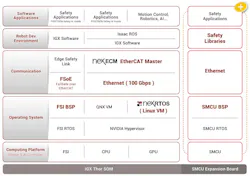
All-in-one robotics controllers are emerging as a key building block in these systems, bringing together AI acceleration, motion control, and functional safety a single unit. They fuse data from cameras and other sensors to identify humans and dynamic obstacles in real-time and communicate with the system using the multi-master EtherCAT protocol. As a result, these units can coordinate safety-certified motor joints and other actuators and execute controlled motion responses in real-time.
These all-in-one controllers tend to be based on processors such as Qualcomm's Dragonwing IQ10 or NVIDIA's IGX Thor, and they can be complemented by safety MCU expansion boards that can be used to trigger the main controller's native functional-safety features. The enhanced safety helps enable reliable detection and preventive multi-axis safe motion to avoid human injury.
Ultimately, safety in these scenarios is becoming less about reacting to failures and more about shaping how robots move in the first place to avoid catastrophe.
Modular Architectures for More Intelligent, Scalable Robotics
Robotics technology is evolving far faster than traditional hardware development cycles. New AI models, sensors, end effectors, and applications are constantly emerging. Designing entirely new control systems for every advancement simply isn't sustainable.
Instead, modular and software-defined architectures allow engineers to upgrade individual system components without redesigning entire robotic platforms. Separating AI computing, motion control, safety functions, and application software into modular building blocks creates greater flexibility while improving long-term maintainability and scalability.
Open ecosystems built around standards such as EtherCAT further simplify the process of integrating these modules, enabling developers to combine specialized components while avoiding proprietary lock-in. This modular approach also strengthens system resilience by allowing individual components to evolve independently as robotic capabilities continue expanding.
Next-Generation Robots to Be Defined by Their Reflexes
The robotics industry must quickly realize that progress can no longer be measured by the sophistication of AI models. As robots become more mainstream in real-world deployments, intelligence alone won’t determine success.
Future robotic systems must combine perception, decision-making, motion control, and functional safety into unified architectures capable of responding predictably under constantly changing conditions.
As robots become increasingly autonomous, engineers will need to focus just as much on deterministic motion, real-time control, and system integration as they do on actual AI capabilities. After all, every intelligent decision eventually becomes physical movement. The next generation of successful and safely deployable robots will possess the smartest brains and most reliable reflexes.
About the Author
 Jenny Shern
General Manager of NexCOBOT, a NEXCOM Company
Jenny Shern is General Manager of NexCOBOT, a NEXCOM Company, bringing extensive expertise in intelligent machinery and industrial automation. Prior to assuming her role as General Manager, Jenny held senior positions at NEXCOM from 2005 to 2018. She graduated from Université Paul Valéry in France with a master's degree specializing in Education.
Related
 Circuit Diagram51965608 © Irina Toloknovskaia Dreamstime
 dreamstime_doberman84_323880771

Comment About the Article
To join the conversation, and become an exclusive member of Electronic Design, create an account today!
 Leaders Logo
Leaders relevant to this article: