11 Myths About Energy Harvesting: Updated
What you’ll learn:
- How advances in energy-harvesting PMICs, photovoltaics, and energy storage have made reliable, battery-free IoT systems practical across a wider range of applications.
- How modern power-management techniques, including dual-source PMICs, integrated MPPT, and ultra-low-quiescent current, maximize energy capture and enable continuous operation from ambient energy sources.
- Why improvements in harvesting efficiency, system integration, and component performance are enabling wireless, edge AI, and industrial IoT devices while reducing maintenance and total cost of ownership.
- Discover why many of the biggest misconceptions about energy harvesting no longer apply to modern IoT designs.

Seven years ago, I wrote an 11 Myths article on energy harvesting for Electronic Design. The article was written to dispel some of the more egregious misconceptions we were seeing at the time.
Back in 2019, energy harvesting could hardly be said to be in its infancy. Jimmy Carter had solar panels installed on the White House back in 1979, and huge advances had been happening in photovoltaics (PV), piezo, RF, and thermal generation in terms of extraction efficiency. While it was clear that energy harvesting was a no-brainer for powering the IoT revolution, I must admit it wasn’t so clear which applications would be first adopted, nor was the pace of improvement that now makes the technology pervasive.
A good example of these changes includes PV cells that can supply meaningful levels of power when in both direct sunlight and under indoor low-level ambient lights. And the improvements in efficiency on energy generation (across all classes of ambient energy sources), management via the power-management IC (PMIC), and storage have been huge.
Similarly, the introduction of dual-source PMICs, which allow (for example) PV and thermal energy generation to be used simultaneously, opens up significant flexibility in system design. Another big leap forward is the very recent introduction of PMICs capable of withstanding 3 W from the energy harvester, which further pushes the boundaries of edge IoT applications.
For this article, we've gone back to the original myths to look at how things have changed. In some cases, I think evolutions have been so significant we'd struggle to call them myths anymore.
1. Energy harvesting is expensive.
The idea that energy harvesting is expensive remains, sadly, a pervasive myth. Back in 2019, we countered this by highlighting the total cost of ownership of an energy-harvesting system versus disposable batteries, which is still absolutely true nowadays.
For consumer systems, replacing disposable batteries can be highly expensive for the end-user, and this results in slowing down their adoption or simply leads to failure of commercialization. And while it’s true that the cost of the batteries themselves plummets for B2B operators (they buy them in large volumes), the man-hours (and therefore cost) needed to employ people to routinely check batteries and replace them when required is considerable and accounted for in deployment balance sheets.
This is especially true for large facilities, such as a hospital trust or supermarket chain, where the number of devices can stretch into the tens of thousands. It’s a similar case when devices are used for logistic tracking, where devices will be placed on vehicles and individual items of equipment move across multiple sites.
As said, these factors are still very true. But from a purely baseline economic view (which matters most to an OEM), we need to look at the cost of producing such devices — it’s in this space where big advances have come in the last six years. Today, the cost of implementation for an energy-harvesting-powered system is reaching parity with battery-powered systems. But beyond this, there’s also a significant (9.7%) price premium that OEMs can charge for more sustainable and low-maintenance systems.
2. Energy harvesting is hard to implement.
I almost find it hard to believe I had to even state this back in 2019. Not only was it a myth at that time, but since then huge amounts of work have been undertaken by an exceptionally wide array of companies to create ecosystems, and to create evaluation kits that vastly simplify the development of energy-harvesting-based products versus 2019.
Replacing disposable batteries with an energy-harvesting system requires three components:
- The energy harvester (e.g., a PV cell).
- A small energy storage element to allow for the harvested energy to flow in and out of the devices when the Harvester source isn’t producing.
- A PMIC to manage them while maximizing the efficiency, protecting the storage, and ensuring the flow is managed to the application independently of the state of the other two.
The evolution of PMICs for energy harvesting has happened at such a rate that not only are PMICs now tailored for specific harvesters and storage combinations, but these also automatically undertake all types of MPPT tracking to ensure the harvest is always delivering as much power as possible.
Some people may still think this today, but I’m not even sure it’s still at a level where it could be considered a myth. Certainly the dozens of evaluation kits, product samples, and commercial implementations using off-the-shelf products are evidence it’s not a myth anymore.
3. Design and aesthetics.
Back in 2019, there was a belief that aesthetics could suffer when using energy harvesting. Batteries could be concealed; the harvester could not (or at least not easily).
I would still argue that aesthetics are impacted by the battery, with the need to incorporate an AA or similar cell adding to size and weight, and dictating elements of the overall design, just like an energy harvester. This isn’t just the battery compartment, or a 5-V USB port, but it also involves features to ensure IP6X protection can be implemented given you can’t easily seal a device if the battery is to be replaced.
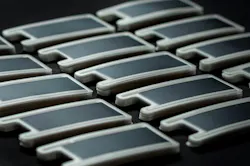
More importantly, however, the harvester — especially PV cells — are now being made into design features that accentuate (rather than detract from) the looks of the system. The evolution of flexible PV cells (and their reduced price) means energy-harvesting components can now be employed to enhance the aesthetics (Fig. 1).
That this has happened is no surprise. Consumers are willing to pay a price premium for energy-harvesting-powered systems, so why wouldn’t you make the PV cell visible?
And even if you don’t want to have it as a major part of the design, the efficiency gains now mean these elements can be much smaller and (in some cases) hidden. For example, Cartier’s 2022 Tank watch hid a small cell behind the watch face and was still able to deliver enough power to run continuously.
4. Reliability.
Back in 2019, there was anxiety about deploying energy-harvesting systems, I guess this is a modification on the range anxiety that comes with an EV — until you use one.
Back then, “battery life extension” was a common discussion topic. Today, we’re speaking of “full autonomy” every day and confidence levels in continuous performance has risen considerably. Many PV suppliers have also now passed ISO9001 certifications, as have most of the storage element makers, which reinforces that high-quality, high-reliability systems are in place.
In ambient energy devices, the harvester, storage element, and PMIC (type and size) are all selected based on the type and amount of energy available in the specific situation a device is going to be used, and the known fluctuations. For instance, with PV-based systems, both nights and winters are factored into the calculation.
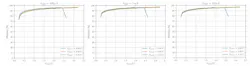
As I highlighted six years ago, we can “rest assured the sun will always come out.” And even when operating for sustained periods in low energy sources — e.g., under low-level ambient light — modern PMICs for energy harvesting enable ultra-low-quiescent currents, draining less than 6 nA from storage elements (Fig. 2).
So, while this myth is arguably still present, I think energy-harvesting-based systems are undergoing the same process as EVs, and the more people use them, the more they’re trusted. Six years later, it’s natural that this anxiety has therefore decreased.
5. You can't generate enough energy for wireless applications.
Back in 2019, I conceded that “until recently, that may have been true, but technology marches on.” Back then, I highlighted advances in transmission technologies and mentioned Bluetooth Low Energy (BLE). Today, not only have further improvements been made in wireless transmission standards, but also across the complete value chain: in the SoCs, the PMICs, the sensors, and, of course, the harvesters themselves.
Today, I don't even think I'd include this myth on my list at all. Indeed, this myth is truly busted. Expanding on this, the last four years alone have seen improvements in PV harvester performance that are in the region of 30% to 40%.
And looking specifically at wireless applications, it’s now the standard (and rightly held) belief that BLE applications can easily be implemented via energy harvesting. For example, BLE5.4 is the default communication standard in many applications (such as electronic shelf labels and PC accessories like keyboards), but cellular and GPS can all be powered by energy harvesting.
6. Energy harvesting takes up more space.
Up until now, we’ve tended to concentrate on the advances made by PMIC developers and in the energy harvesters themselves.
Here I think it’s important to also highlight the leaps forward made in energy storage technologies. Today, supercapacitors can be implemented in a range of form factors, including flat (thin film/flexible) as well as miniature and ultra-miniature SMD types.
In short, we’re now at the point where not only are the harvesters are more efficient (and therefore smaller), but ambient-energy components can now be integrated into ever smaller spaces to the point where they’re almost unnoticeable.
So, while I don’t think we have fully displaced this myth, I do think it’s not long for this world.
7. Implementing energy harvesting is hard to do.
Would I include this myth if I was writing from scratch? No, I don’t think so.
We’ve touched on it already, but today the energy-harvesting ecosystem is vast. As we’ve highlighted, many functions, such as MPPT, are now built straight into the PMICs. And the support from across the ecosystem is typically exceptional.
Not only do we have the component manufacturers, be it a PMIC, piezo harvester, or supercapacitor, but the tools and design services side of the sector has also extended significantly in just six years. This means custom implementations are far easier to source now than they were in 2019.
That it’s happened is hardly surprising. Environmentally, the use of batteries from IoT devices and similar systems is far from sustainable. Millions of batteries are discarded daily and recycling rates are far from ideal. And while legislation forcing energy harvesting over batteries isn’t yet on the books anywhere, momentum is growing. For example, the EU’s EnABLES positioning paper is already making the case for such legislation.
8. It affects end-user experience.
This myth is arguably the biggest change on my list. Back in 2019, we needed to get across the message that replacing batteries didn’t affect end-user experience.
Today, I’m stating the opposite. Energy harvesting absolutely affects end-user experience. But it does so positively.
Energy harvesting removes the need to buy batteries as a consumer. For B2B organizations, it reduces the maintenance time and costs and prevents failure on systems where checks would be difficult. This means a higher quality of service with energy harvesting, and it means a lower total cost of ownership.
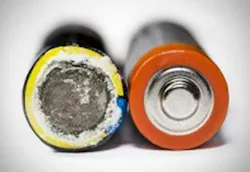
It also means there will never be damage from leaking batteries (Fig. 3).
As we highlighted above, people and organizations are willing to pay a large premium for this and the environmental benefits.
9. It puts the burden of energy elsewhere.
Previously, I argued that energy harvesting removed the many stages of power generation, distribution, and storage, and with it, losses. I highlighted that energy harvesting “generates power at the point of use, with fewer [intermediate] steps between generation and consumption.”
This is as true as it was then. But, crucially, the efficiency gains enabled by modern harvesting systems simply make it possible for more systems to benefit.
Indeed, the idea of collecting local energy for its local use now has a name: the Ambient IoT.
10. It's not required by law.
This point has probably the slowest change. Legislation moves at a glacial pace, and six years later, the fact that there’s still no legislation enforcing energy harvesting over battery usage remains true. However, despite its slow pace, change here is happening.
We’ve already highlighted the EnABLES European infrastructure project, which seeks to reduce battery waste from IoT devices and highlights energy harvesting as the key way to achieve that goal.
This project is arguably the most prominent initiative, but it’s far from the only one. For example, in the U.S., ARPA-E and DOE are actively awarding grants to develop advanced RF, thermal, and kinetic energy scavengers specifically to eliminate the installation and disposal costs of industrial batteries. And in Asia, projects such as Japan’s METI and South Korea’s KAIST also seek to reduce battery usage in consumer and medical IoT systems.
Indeed, extended manufacturers’ responsibility and concepts like SSbD (safe and sustainable by design) are moving the needle in the right direction. In addition, regulating the management of disposable batteries already exists in many territories. It looks at the number and mass being discarded as well as the collection rate, and digital battery passports will be mandated from February 2027.
11. It's not 24/7.
As I highlighted in 2019, energy harvesting is about so much more than PV. And even where it’s based purely on solar charging, system design allows you to ensure the harvester, energy storage, and PMIC are all tailored to ensure that even in the depths of winter, the system will be able to function across all 24 hours.
So, energy harvesting puts the source of energy right at the point of use, making it an important part of sustaining IoT devices. Moreover, we can extract energy from a wide range of sources far more efficiently than we could do in 2019, meaning it’s applicable to a far greater number of applications today.
12. It’s limited to usage in only low-power devices (to replace the one I would remove).
One myth that I didn’t include in my original 11 related to the idea that energy harvesting for IoT was limited to only very low power devices.
Back in 2019, this was arguably true — at least within the confines (cost, size, etc.) placed on most IoT equipment. Today, the idea persists, but there have been huge leaps in the efficiency of solar cells, energy storage, and extraction via the PMIC. And it’s not firmly in myth territory.
Indeed, the AEM15820 PMIC can support a source range from a few microwatts to 3 W without compromising efficiency. Harvesters for such power levels include not only off-the-shelf PV cells, but also thermoelectric generators that are both powerful and compact in size.
The gains listed above, of course, also have been coupled with ever-improving efficiency improvements from IoT system and component developers. And when combining all of these factors, we’re at the point where a vastly increased number of devices can run using ambient IoT than was the case in 2019.
For example, today, even an IoT security camera, one with Wi-Fi or cellular connectivity and capable of running edge-AI image analysis software, is able to run continuously from a 3-W PV – when paired with an advanced high-power energy-harvesting PMIC and fresh release sodium-ion high-capacity battery sticks. It’s all due to the convergence of advances being made across the industry.
>>Download the PDF of this article, and check out the TechXchange for similarly related content


About the Author
 Bruno Damien
Bruno Damien
Marketing Director of Ecosystem and Partners, e-peas
Bruno Damien is Marketing Director of Ecosystem and Partners at e-peas, leading the relationship with key partners involved in the implementation of energy harvesting solutions based upon e-peas Power Management products.
After graduating in 1988 as Electronics Engineers and Quality reliability engineer, he has been taking leading roles as Semiconductor Technology expert, Technical Support, Sales Director and Marketing Director at major WW semiconductor vendors.
Comment About the Article
To join the conversation, and become an exclusive member of Electronic Design, create an account today!
 Leaders Logo
Leaders relevant to this article: